










Why Ancient Mystical Archetypes Are Finding New Meaning Among Younger Generations
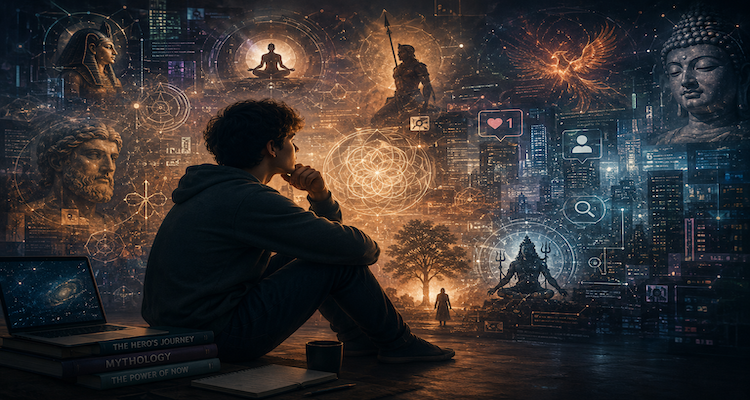
A surprising shift is unfolding across digital culture. Symbols, stories, and archetypes that once belonged primarily to religious traditions, esoteric communities, or ancient philosophical texts are now appearing in podcasts, social media discussions, creative projects, and personal development conversations. Younger generations are not necessarily embracing these traditions in their original forms. Instead, they are reinterpreting them through the lens of identity, psychology, creativity, and self-discovery.
From the seeker, the warrior, and the sage to figures associated with transformation, destruction, rebirth, and transcendence, ancient mystical archetypes are experiencing an unexpected revival. Yet this resurgence is not simply about spirituality. It reflects a broader cultural shift in how people understand meaning, purpose, and personal growth in an increasingly complex world.
What makes this trend especially noteworthy is that many younger individuals are engaging with these archetypes outside formal religious structures. Rather than accepting inherited interpretations, they are adapting ancient symbols to address modern questions about authenticity, mental well-being, relationships, career choices, and identity.
The Search for Meaning in an Age of Information
Access to information has never been easier. Answers to practical questions can be found instantly, and digital platforms provide constant streams of content, opinions, and perspectives.
Yet abundance does not always produce clarity.
Many younger people are growing up in environments where traditional institutions hold less influence than they once did. Religious affiliation, community structures, and cultural norms have become more diverse and individualized in many parts of the world. As a result, people often find themselves navigating life without a single shared framework for understanding purpose or belonging.
Ancient mystical archetypes offer something that algorithms and information feeds often cannot: symbolic meaning. They provide narrative structures that help people make sense of internal experiences such as uncertainty, transformation, loss, ambition, and personal growth.
The enduring appeal of these archetypes lies in their ability to translate complex emotional experiences into stories and symbols that feel universally recognizable.
From Religious Figures to Psychological Maps
One of the most significant changes in recent years is how mystical archetypes are being interpreted.
Historically, many archetypal figures were understood primarily within spiritual or religious contexts. Today, younger generations often approach them as psychological frameworks rather than literal religious truths.
The archetype of the warrior, for example, may be viewed as a symbol of resilience rather than a historical or mythological figure. The seeker may represent curiosity and lifelong learning. Archetypes associated with destruction and rebirth can become metaphors for personal reinvention after major life transitions.
This shift reflects the growing influence of psychology, self-development culture, and therapeutic language in mainstream society. Rather than asking whether a symbol is objectively true, many people are asking whether it helps them better understand themselves.
The result is a more personal and flexible relationship with ancient wisdom traditions.
Social Media Has Become an Unexpected Gateway
Digital platforms have played an important role in the revival of mystical archetypes.
Short-form videos, visual storytelling, podcasts, and online communities have made complex philosophical and spiritual ideas more accessible to broader audiences. Concepts that were once confined to specialized books or academic discussions can now reach millions of people through creative interpretations and relatable explanations.
This accessibility has encouraged experimentation. A young person may encounter archetypal ideas through literature, mythology, meditation content, wellness communities, gaming culture, or even entertainment franchises that borrow heavily from ancient symbolic structures.
The appeal often lies in the ability to explore these ideas without committing to a specific belief system. People can engage with symbolism, mythology, and spiritual concepts in ways that feel exploratory rather than prescriptive.
However, this democratization also creates challenges. Complex traditions can sometimes be simplified or detached from their original contexts. As interest grows, the balance between accessibility and depth becomes increasingly important.
The Rise of Identity as a Personal Journey
Previous generations often inherited clearer social identities based on family, profession, religion, or community expectations.
Today, identity is frequently viewed as an ongoing process rather than a fixed destination.
This cultural shift helps explain why archetypes resonate so strongly with younger audiences. Archetypal narratives mirror the idea that individuals evolve through stages, challenges, and transformations throughout life.
The hero’s journey, the quest for wisdom, the confrontation with inner fears, and the search for authenticity all reflect experiences that many people recognize in their own lives.
Rather than serving as distant myths, these stories become tools for understanding personal development.
In this context, mystical archetypes function less like doctrines and more like mirrors. They offer symbolic language for experiences that can otherwise feel difficult to describe.
A Cultural Response to Uncertainty
Another factor driving interest is the growing sense of uncertainty that characterizes modern life.
Economic instability, rapid technological change, shifting career paths, and global social transformations have made long-term planning more challenging. Traditional expectations about success, relationships, and personal fulfillment are evolving.
When certainty becomes scarce, people often seek frameworks that provide coherence.
Ancient archetypes endure because they address timeless human experiences rather than specific historical circumstances. They speak to fear, hope, ambition, sacrifice, transformation, and meaning, questions that remain relevant regardless of technological advancement.
This may explain why interest in mythology, spirituality, symbolic thinking, and contemplative practices often grows during periods of cultural transition.
The attraction is not necessarily nostalgia for the past. Instead, it reflects a desire to find enduring insights that can help navigate an unpredictable future.
The Hidden Insight Behind the Trend
The resurgence of mystical archetypes reveals something larger than a renewed interest in ancient traditions.
It suggests that younger generations are searching for symbolic literacy, the ability to understand life not only through facts and data but also through stories, metaphors, and deeper patterns of meaning.
Modern society excels at delivering information. What many people increasingly seek, however, is interpretation.
Archetypes help bridge that gap. They transform isolated experiences into larger narratives that provide context and significance.
This may be why discussions about mythology, spirituality, personal growth, and psychological transformation often attract audiences far beyond traditionally religious communities. People are not merely looking for answers. They are looking for frameworks that help them ask better questions.
What This Means for the Future
The reinterpretation of mystical archetypes is unlikely to disappear anytime soon.
As artificial intelligence, automation, and digital technologies continue reshaping daily life, questions about identity, consciousness, creativity, and human purpose may become even more prominent. Ancient symbolic systems could remain relevant precisely because they address dimensions of experience that technology cannot fully explain.
Future engagement with archetypes will likely become increasingly interdisciplinary. Psychology, philosophy, spirituality, literature, education, and even workplace development may continue drawing upon archetypal concepts to explore human potential and personal transformation.
The most significant development may not be a return to ancient beliefs themselves, but a growing recognition that old symbols can still illuminate modern challenges.
In a culture overflowing with information, younger generations are rediscovering the value of wisdom traditions not as rigid doctrines, but as living frameworks that help make sense of an ever-changing world.
This content is published for informational or entertainment purposes. Facts, opinions, or references may evolve over time, and readers are encouraged to verify details from reliable sources.
Related News
- Why Shiva Remains Relevant Even Outside Traditional Religious Practice
- Shiva’s Cosmic Dance: Why Nataraja Represents Creation, Destruction and the Rhythm of Time
- What Shiva’s Meditation Reveals About the Hindu Idea of Inner Stillness
- The Meaning of Ardhanarishvara: When Shiva and Shakti Become One Form