










The Past Behind the Present: How Old Ideas Built Today’s Technology
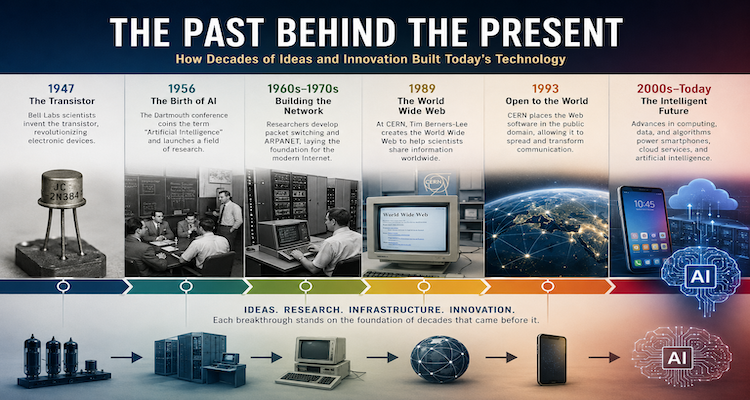
The technologies people use every day can feel almost entirely new: artificial intelligence writes and analyzes text, smartphones put powerful computers in our pockets, cloud services move information across continents, and the internet connects billions of people. Yet much of the present is built from ideas that are decades old.
The transistor emerged from research at Bell Labs in 1947. The concept of artificial intelligence was formally established as a field at the Dartmouth summer workshop of 1956. The foundations of the modern internet grew from networking research in the 1960s and 1970s, while the World Wide Web was created at CERN in 1989.
The important lesson is not simply that technology has a history. It is that technological change is often cumulative. Today’s breakthroughs frequently become possible because earlier researchers solved problems that initially appeared unrelated to the products and services eventually built on top of them.
Key Takeaways
- Modern technology is often the result of decades of accumulated research rather than a single breakthrough.
- The transistor provided a crucial foundation for the miniaturization of electronic computing.
- The internet evolved from research into networking systems designed to connect computers and share resources.
- The World Wide Web became easier to spread after CERN released its software into the public domain in 1993.
- Artificial intelligence has roots reaching back to the 1950s, long before today’s generative AI systems.
- Understanding technological history helps explain why some innovations scale while others remain experiments.
The Technology We See Is Usually the Last Layer
A smartphone is a useful example.
What appears to be one product is actually an accumulation of technologies developed at different times: semiconductor electronics, digital computing, wireless communications, batteries, operating systems, software engineering, data networks, satellite positioning, cameras and touch interfaces.
None of these developments appeared simultaneously.
The transistor was demonstrated at Bell Labs in December 1947, when John Bardeen and Walter Brattain successfully created a semiconductor amplifier using germanium. Bell Labs publicly announced the device in 1948.
That invention mattered because electronic systems could increasingly move away from bulky vacuum-tube technology toward smaller solid-state components. The modern computing industry would eventually depend on the ability to make electronic components dramatically smaller and more numerous.
This is one of the recurring patterns in technological history: a breakthrough may initially solve a narrow engineering problem, but later generations discover entirely different uses for it.
The Internet Was Not Designed as Today’s Internet
Today’s internet is associated with social media, streaming, online shopping, cloud computing and artificial intelligence. Its early history looked very different.
Research into packet switching and computer networking during the 1960s helped establish the technical ideas behind ARPANET. By the end of 1969, four host computers were connected to the early ARPANET.
The objective was not to create today’s consumer internet. Early networking research focused heavily on connecting computers, sharing expensive computing resources and allowing different networks to communicate.
That distinction is important. The internet became powerful partly because it was developed as a general-purpose infrastructure rather than as a platform for one predetermined application.
The development of TCP/IP was particularly significant. Research led by Robert Kahn and Vint Cerf produced protocols designed to allow different networks to communicate with one another. The Internet Society’s historical account describes this as an important step toward an architecture capable of connecting independently operated networks.
In other words, the people building the underlying infrastructure could not fully predict what later generations would do with it.
That is a recurring feature of important technologies: infrastructure often becomes more consequential than the original application imagined by its creators.
The Web Added a Human-Friendly Layer
The internet and the World Wide Web are often treated as interchangeable, but they are not the same thing.
The internet provides the underlying network infrastructure. The Web is one system built on that infrastructure for accessing and linking information.
Tim Berners-Lee invented the World Wide Web at CERN in 1989. His original goal was practical: make it easier for researchers at universities and institutes around the world to share information.
The Web’s subsequent growth illustrates another important principle.
CERN placed the World Wide Web software in the public domain on April 30, 1993, later making it available under an open licence. That decision helped remove barriers to adoption and allowed the technology to spread far beyond its original scientific environment.
The lesson extends well beyond the Web. Technical capability alone does not guarantee widespread adoption. Standards, openness, interoperability, affordability and accessibility can be just as important.
AI’s Present Has a Much Older Beginning
Artificial intelligence provides perhaps the clearest example of the distance between technological history and public perception.
Today’s AI conversation is dominated by large language models, generative systems, image generation, coding assistants and increasingly sophisticated automated tools. But the idea of creating machines capable of performing tasks associated with human intelligence is much older.
In 1956, researchers gathered at Dartmouth for the Summer Research Project on Artificial Intelligence. John McCarthy organized the project, and the term “artificial intelligence” became associated with the emerging field.
The early researchers were dealing with questions that remain surprisingly recognizable today: how machines might represent knowledge, solve problems, learn and reproduce aspects of human reasoning.
But the technology available to them was vastly different.
That gap matters because it changes how today’s AI should be understood. Generative AI did not emerge from nowhere. It represents a new stage in a much longer sequence of research into computation, algorithms, machine learning and artificial intelligence.
Dartmouth itself is marking the 70th anniversary of the 1956 workshop in 2026, highlighting how the field’s original question—whether machines could perform tasks associated with human intelligence has evolved into broader questions about how humans should work and make decisions alongside AI.
Why Old Ideas Keep Returning
Technology rarely develops as a straight line.
Some ideas arrive too early. Others require hardware that does not yet exist. Some remain confined to laboratories until costs fall. Still others become important only after a different technology creates a practical market for them.
The history of the internet demonstrates this clearly. Early networking connected relatively small numbers of computers, while later growth in personal computers, local networks and commercial infrastructure dramatically expanded its usefulness.
The same principle can be applied to AI.
The question is not simply whether an idea works in a laboratory. A technology becomes transformative when enough surrounding conditions exist to make it useful at scale: computing power, data, networks, software, investment, standards, skilled people and customers.
This helps explain why technological progress can appear sudden even when its foundations are decades old.
The visible breakthrough may be new. The conditions that made it possible often are not.
The Present Is Still Building the Next Past
There is a practical reason to understand this history.
When a technology becomes popular, attention naturally focuses on the product people can see. But the more important developments may be occurring underneath it in semiconductor manufacturing, networking standards, computing architectures, research institutions, energy systems, software infrastructure and fundamental science.
Those developments can remain relatively invisible until another layer of technology makes them commercially or socially useful.
The technologies being developed today may therefore have consequences that are difficult to recognize now. A research project that appears specialized could eventually become infrastructure for an entirely different industry.
That does not mean every laboratory experiment will become a breakthrough. Technological history contains plenty of abandoned ideas, failed products and dead ends. But it does show why judging an emerging technology only by its immediate application can be misleading.
The most important question is often not, “What can this technology do today?”
It is, “What does this technology make possible later?”
Conclusion
The present is rarely as new as it appears.
The smartphone carries decades of semiconductor and computing progress. The modern internet rests on networking research that began long before social media existed. The Web grew from a scientific information-sharing project, and today’s AI has intellectual roots reaching back to the 1950s.
Seeing that history changes the way technological progress looks. Breakthroughs are often less like isolated explosions and more like layers accumulating over time.
The past does not merely explain the technology people use today. It also provides clues about where today’s seemingly ordinary research could lead next.
This content is published for informational or entertainment purposes. Facts, opinions, or references may evolve over time, and readers are encouraged to verify details from reliable sources.