








The Village That Was Buried Under Sand While Its Residents Were Still Living There
In the deserts of the United Arab Emirates, an abandoned settlement is slowly disappearing beneath drifting sand. But the story of Al Ghuraifa is not simply about nature reclaiming empty buildings. It is about families who once struggled to live where the desert refused to stay outside.
Imagine opening your front door and finding that the desert has moved closer overnight. Sand has gathered against the walls, blown through gaps, and settled in corners that were cleared only recently.
For the former residents of Al Ghuraifa, near Al Madam in the emirate of Sharjah, encroaching sand was more than an inconvenience. It was part of a difficult environment in which families attempted to build permanent lives.
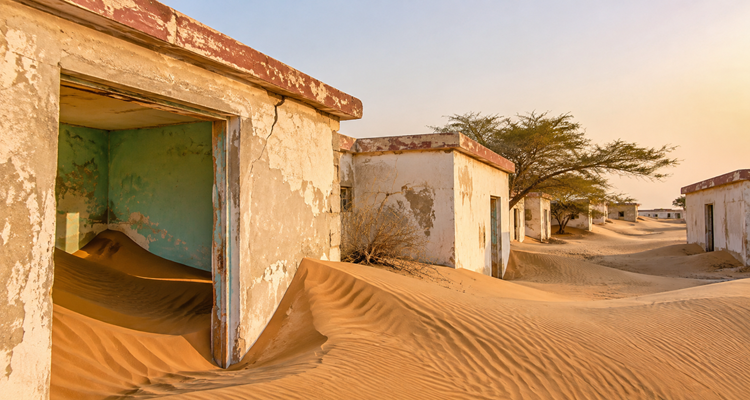
Today, the village is famous for its abandoned houses, where dunes spill through doorways and accumulate inside once-colorful rooms. Yet the most remarkable part of its history happened before the village became a ghost town.
People really lived here while the desert was advancing around their homes.
The village was built during the United Arab Emirates’ early decades as a modern nation, primarily to accommodate members of a formerly semi-nomadic Bedouin community. Within roughly two decades, its residents had moved elsewhere. Sandstorms, difficult living conditions, limited infrastructure, and opportunities in better-connected communities all help explain why.
Its story reveals something more interesting than a supposedly haunted settlement: what happens when permanent buildings meet a landscape that never stops moving.
A Village Built to Create a Permanent Home
Al Ghuraifa emerged during a period of extraordinary change in the United Arab Emirates.
Following the country’s formation in 1971, oil revenues supported major investments in housing, infrastructure, transportation, and public services. Communities that had traditionally moved seasonally across the desert increasingly gained access to permanent settlements.
Al Ghuraifa was part of this transformation.
Constructed in the 1970s, the village was designed to house members of the Al Ketbi tribe. According to reporting by the Associated Press, drawing on research by University of Sharjah scholar Ahmad Sukkar, approximately 100 people lived in the settlement.
Its layout was modest but deliberate. Two rows of cement houses faced a central street, with a mosque at one end.
Inside the houses were details that reflected both changing lifestyles and established community traditions. Some rooms featured brightly colored walls, decorative tiles, and patterned surfaces. Spaces for a majlis, a traditional gathering where guests and community members could meet, were incorporated into the homes.
These were not makeshift shelters awaiting inevitable destruction. They were intended to provide security, stability, and a new kind of domestic life.
But building permanent homes in the desert did not mean the desert would become stationary.
When the Sand Began Moving Into the Houses
The most distinctive feature of Al Ghuraifa today is the extraordinary amount of sand inside its buildings.
Some rooms contain deposits that climb high against the walls. Doorways have become passages between dunes. Empty windows frame stretches of sand rather than the streets and courtyards they once overlooked.
These scenes are the result of a gradual natural process.
Desert sand is transported by wind. When moving air encounters an obstacle such as a wall, building, or fence, its flow changes. In some places, wind slows sufficiently for sand grains to settle. In others, turbulence redistributes material around the obstacle.
Over time, repeated episodes of deposition can create substantial accumulations.
A house may initially offer protection from the wind. But once sand begins collecting against its exterior, the building itself can become part of the process that encourages further accumulation.
Open doorways, damaged windows, and unmaintained interiors create additional opportunities for windblown sand to enter.
For an occupied house, regular cleaning and maintenance can limit the problem. Once a building is abandoned, that human resistance disappears.
This distinction matters at Al Ghuraifa. The sand was already a problem during the village’s inhabited years, but much of the dramatic burial visible today occurred after residents had left.
What Former Residents Remember
One of the most valuable accounts of Al Ghuraifa comes from people who actually lived there.
In a March 2020 report by Khaleej Times, former resident Abu Khalfan Al Kutbi recalled growing up in the village during the 1980s.
He described the surrounding dunes as a familiar part of childhood and explained that the quantity of sand increased over the years. He also said that the houses were not completely buried during the period when families occupied them.
His account challenges the idea that a single catastrophic sandstorm suddenly swallowed the settlement.
Another former resident, Fatima Al Ketbi, remembered the village as a peaceful place, far from the noise of expanding cities.
These recollections reveal two sides of the same experience.
For outsiders, Al Ghuraifa may look like a failed attempt to settle an unforgiving landscape. For the people who lived there, it was also a neighborhood filled with family relationships, childhood memories, and ordinary routines.
The desert was a challenge, but it was also home.
Why Did Everyone Eventually Leave?
The village’s abandonment is often presented as a mystery, although the available evidence points toward several practical explanations.
Sandstorms made daily life difficult. Access to water and electricity was limited, and residents faced long journeys to schools, employment, and other services.
At the same time, the UAE was rapidly developing. Newer residential areas offered improved infrastructure and greater convenience.
Former residents interviewed by Khaleej Times said they moved into government-provided housing elsewhere, with compensation connected to their relocation. The publication reported that residents left in 1999, although other accounts place departures earlier.
The precise timeline is therefore not entirely settled.
What is clear is that the abandonment should not be reduced to one dramatic event.
The sand was a genuine environmental pressure. But the decision to leave also occurred within a wider transformation of housing, public services, and economic opportunities.
Al Ghuraifa did not simply lose a battle against the dunes. Its residents were also moving toward places where permanent settlement had become more practical.
The Science Behind a Village Disappearing Into Sand
In 2022, researchers Mohammed Fareed Sherzad and Dirk Goossens published a peer-reviewed study in the journal Buildings examining how windblown sand accumulates around structures in desert settlements.
Their research combined field observations with wind-tunnel experiments to investigate how building dimensions, spacing, and arrangement affect sand deposition.
Al Madam was among the locations discussed.
The researchers found that buildings can generate distinctive patterns of sand accumulation, including crescent-shaped deposits and piles that develop between neighboring structures.
Their findings also suggested that the arrangement of buildings could help reduce some of these effects. Building height, the distance between neighboring structures, and their orientation relative to prevailing winds all influenced where sand collected.
The study did not establish that one architectural change would have saved Al Ghuraifa. Its experiments covered selected building shapes and configurations rather than every possible settlement layout.
Nevertheless, the research offers an important insight: the design of a desert village can influence how quickly sand becomes a threat to its buildings.
This makes Al Ghuraifa more than an unusual tourist destination. It provides a real-world example of the challenges facing architects and planners who construct permanent settlements in active sandy environments.
The Legend of the Haunted Village
As the buildings emptied and the desert advanced, another story began to spread.
According to local folklore, supernatural beings known as jinn were responsible for driving the inhabitants away.
In Islamic and regional traditions, jinn are beings distinct from humans. Stories about their presence have long formed part of the cultural imagination in parts of the Middle East.
At Al Ghuraifa, the combination of abandoned houses, silent streets, and sand-filled interiors helped such legends flourish.
Some accounts even connected the settlement with Umm Duwais, a frightening female figure in regional folklore.
But these are cultural stories, not verified explanations of the village’s abandonment.
CNN’s reporting on the settlement documented both the supernatural legends and the more practical accounts of sandstorms and difficult living conditions. Former residents interviewed by Khaleej Times also rejected the suggestion that jinn had forced families to leave.
The difference is important.
The village may look mysterious, but its physical transformation does not require a supernatural explanation.
The combination of wind, sand, abandonment, and time is extraordinary enough.
What the Buried Village Looks Like Today
Al Ghuraifa has become one of Sharjah’s most recognizable abandoned sites.
Visitors encounter the remains of a small residential community surrounded by desert dunes. Houses still retain traces of their original decoration, even as sand occupies much of their interior space.
The mosque remains a prominent feature of the settlement. According to Associated Press reporting in 2023, maintenance workers from nearby Al Madam continued clearing sand from it.
The village has attracted photographers, researchers, and travelers interested in seeing a side of the UAE that contrasts sharply with the skyscrapers and modern infrastructure of Dubai and Abu Dhabi.
Sharjah’s official tourism website identifies the site as the Al Madam Buried Village and describes its gradual transformation into a desert landmark.
Yet its popularity creates a responsibility.
These buildings are not merely dramatic backgrounds for photographs. They are the remains of homes where real families once lived.
Damaging walls, removing objects, or disturbing fragile structures would erase pieces of that history.
For anyone exploring the site, the experience is more meaningful when the village is understood as a former community rather than simply a collection of ruins.
What Al Ghuraifa Teaches Us About Living With the Desert
The history of Al Ghuraifa raises a question that extends far beyond one abandoned village: how should people design settlements in landscapes that are constantly changing?
Desert environments are not necessarily unsuitable for permanent habitation. Communities have lived successfully in arid regions for centuries, developing architectural and settlement practices adapted to local conditions.
The challenge is understanding those conditions before imposing new building designs.
Traditional desert architecture can offer useful lessons in orientation, ventilation, construction materials, and protection from windblown sand.
The 2022 research by Sherzad and Goossens examined traditional settlements in Algeria alongside modern buildings affected by sand accumulation. Their findings highlighted how established local building practices can inform more resilient design.
Al Ghuraifa also demonstrates that successful settlement planning involves more than buildings.
Reliable water, electricity, transportation, schools, employment, and connections to surrounding communities all influence whether a place remains practical to inhabit.
A house may withstand the desert physically while becoming increasingly difficult to live in.
That is one of the central lessons of this abandoned village.
A Village That Was Not Forgotten by Its People
From a distance, Al Ghuraifa looks like a place that simply vanished.
Its streets are quiet. Its rooms are filled with sand. Its buildings stand as reminders of an earlier chapter in the UAE’s development.
But the village did not disappear from the memories of the people who once called it home.
Former residents have spoken about childhood experiences, family life, and the peaceful surroundings they remember. Their stories give the ruins a meaning that photographs alone cannot capture.
The sand began encroaching while families were still living there. Over time, residents relocated, and the desert continued its work without them.
Today, the buildings offer a striking visual record of that process.
Al Ghuraifa’s real story is not that a village was suddenly swallowed by sand. It is that people tried to establish lasting homes in a moving landscape, built lives there, and eventually moved on while the desert continued to reshape what they left behind.
That history is more human, and ultimately more revealing, than any ghost story.
This content is published for informational or entertainment purposes. Facts, opinions, or references may evolve over time, and readers are encouraged to verify details from reliable sources.
Related News
- The Town That Went to Sleep and Woke Up to Find Its Lake Had Vanished Overnight
- The Day an Entire Town Started Dancing and Nobody Could Explain Why They Couldn’t Stop
- The Town Where a Deadly Fog Arrived Without a Storm and Changed History
- The Village Where the Ground Has Been Burning for More Than a Century