








Why Empty Places Feel Creepy: The Psychology Behind Abandoned Spaces
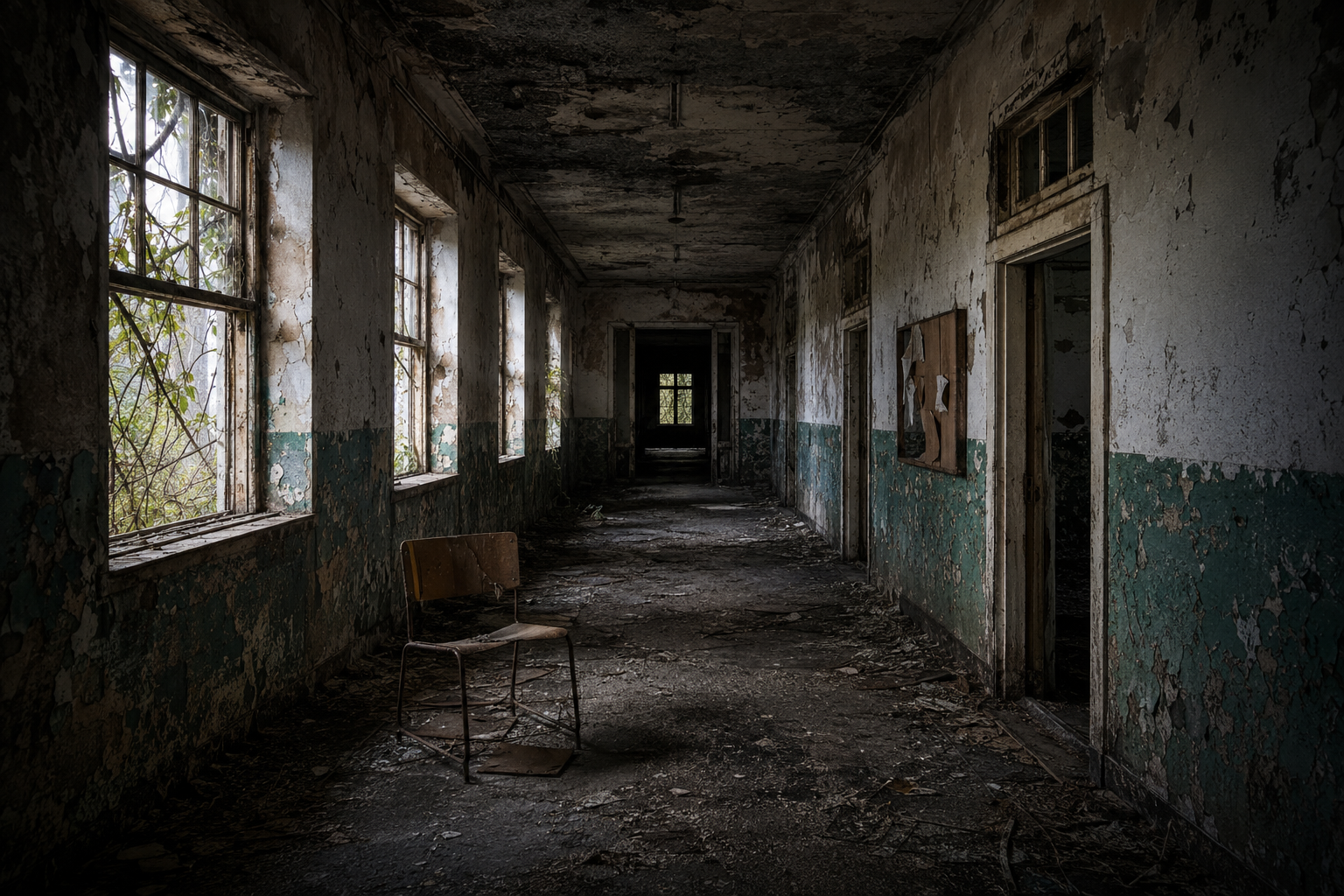
An abandoned house can be completely silent, structurally intact and free of any visible danger and still make people want to leave.
A deserted hospital corridor, an empty school after dark or a neglected railway station can produce a similar reaction. The discomfort is often described as creepy, but that word hides several different psychological processes. Research on uncertainty, environmental perception and ambiguous threat suggests that empty places can become unsettling when they combine missing information with cues that imply possible danger.
The important point is that the brain does not need proof that something dangerous is present before becoming alert. In some situations, uncertainty itself can be enough to heighten vigilance. A space with poor visibility, hidden corners, signs of neglect and no other people to help interpret what is happening can leave the mind trying to answer a question it cannot easily resolve: Is this place safe?
That may help explain why abandoned spaces are so effective in horror films and video games and why the same environments can affect how people experience real neighborhoods.
Key Takeaways
- Empty places can feel threatening when they make potential danger difficult to identify or predict.
- Darkness, visual obstacles and hiding places can increase vigilance by reducing what people can see and interpret.
- Signs of abandonment may communicate neglect and a lack of social control, affecting perceptions of safety.
- “Creepy” environments often work through ambiguity rather than evidence that an actual threat is present.
- The same psychological mechanisms help explain why abandoned settings are powerful in horror, games and real-world urban environments.
When the Absence of Information Becomes the Problem
Psychologists commonly distinguish fear from anxiety by the nature of the threat. Fear is generally associated with an identifiable and immediate danger, while anxiety is more future-oriented and linked to uncertain or diffuse threats.
An abandoned building can sit somewhere between those two experiences.
There may be no visible person, animal or immediate hazard. Yet the environment can contain unanswered questions. What is behind the closed door? Is someone around the corner? Is the floor stable? Why does this place appear neglected?
Research into ambiguous threat shows that uncertainty about whether, when or where something threatening might occur can produce an anxious response even when a specific threat is not visible. In a research project using a virtual environment designed around ambiguous danger, participants described the setting as creepy and unpredictable, despite the absence of a concrete threat.
This provides a useful way to understand abandoned spaces: their unsettling quality may come less from what is visible than from what cannot be confidently ruled out.
Why Darkness and Hidden Corners Change a Place
An ordinary location can feel very different after dark.
Research on environmental perception has found that darkness can increase fear because it conceals possible dangers and reduces a person’s ability to inspect the surroundings. Visual obstacles and hidden areas can have a similar effect because they create uncertainty about what may be present beyond immediate view.
This does not mean that darkness automatically makes a place dangerous. The psychological response concerns perceived risk as well as actual risk.
A well-lit, populated street provides information. People can see where they are going, observe other activity and interpret what is happening around them. An abandoned corridor provides much less social and visual information.
That difference matters. When the environment becomes harder to read, attention may shift toward scanning for possible threats.
In other words, emptiness can remove reassurance as effectively as it removes people.
Abandonment Sends Social Signals
A crumbling building is not simply an architectural object. People also interpret it as evidence about the social environment around it.
Broken windows, vandalism, overgrown vegetation, trash and boarded entrances can suggest that a place is not being actively maintained or monitored. Research examining perceptions of transit and urban environments has identified factors such as darkness, desolation, poor maintenance and nearby abandoned buildings as influences on how safe people feel.
That distinction is important because perceived danger and actual danger are not identical.
An abandoned house may trigger anxiety even when nobody inside poses a threat. At the same time, some neglected properties can create genuine hazards, including unsafe structures or unauthorized access. A randomized study involving abandoned housing in Philadelphia explicitly examined how remediation affected perceptions of safety and other neighborhood outcomes, reflecting the fact that abandoned properties can have consequences beyond appearance alone.
The broader lesson is that the built environment communicates. A maintained place can signal that someone is responsible for it. A neglected one may suggest the opposite.
Our emotional response is partly shaped by that interpretation.
The Strange Power of a Place That Looks Familiar but Feels Wrong
Abandoned spaces often contain another unsettling ingredient: familiarity disrupted.
A school is supposed to contain students. A hospital is expected to have staff and patients. A house is designed for domestic life. When those expected human patterns disappear, the building remains recognizable but its normal purpose is no longer being fulfilled.
This creates a subtle mismatch between what the place is and what the mind expects it to contain.
Psychological research on eeriness and the “uncanny valley” is not a direct explanation for abandoned buildings, but it offers a related insight: unfamiliarity, categorization difficulty and perceptual mismatch can contribute to feelings of eeriness and avoidance.
An empty classroom filled with desks is therefore different from an empty field. The classroom carries evidence of human activity while simultaneously displaying its absence.
That contrast can make a place feel suspended in time.
The result is not necessarily fear. It may be melancholy, curiosity or nostalgia. But when darkness, decay and uncertainty are added, the emotional interpretation can shift toward unease.
Why Horror Creators Understand This So Well
Horror films and video games frequently rely on empty environments because emptiness is an efficient way to create uncertainty.
A filmmaker does not always need to show a monster. A long hallway, a flickering light or an open door can work because the audience begins anticipating information that has not yet arrived.
Research on ambiguous threat helps explain why this technique is effective. Spatial uncertainty, temporal unpredictability and cues suggesting hidden danger can generate psychological tension without revealing a specific source of harm.
The empty setting becomes a kind of psychological invitation to imagine possibilities.
That also explains why sound matters so much. In a crowded place, footsteps may be meaningless. In an empty building, the same sound demands interpretation.
The environment changes the meaning of the stimulus.
Not Everyone Finds Empty Places Creepy
The reaction is not universal.
Personal experience, familiarity, cultural associations and individual differences can all influence how a person interprets an environment. A photographer may see an abandoned factory as visually interesting. An urban explorer may experience curiosity. A nearby resident may associate the same building with neglect or insecurity.
Research on perception emphasizes that people do not respond only to the physical world in front of them; interpretation is also shaped by individual expectations, goals, fears and prior knowledge.
This is why “creepy” should not be treated as a property that exists objectively inside a building.
A more accurate description is that certain environmental features are especially capable of producing unease under particular conditions. Darkness, uncertainty, isolation and visible disorder can combine to make a place difficult to interpret and potentially threatening.
Context determines much of the response.
The Real-World Consequence of Feeling Unsafe
The psychology of abandoned spaces matters beyond horror entertainment.
When vacant or deteriorating properties are concentrated in residential areas, they can influence how residents perceive safety, stress and neighborhood conditions. Research has linked environmental disorder and abandoned properties with fear and psychological stress, while studies of property remediation have investigated whether improving neglected spaces can change residents’ perceptions and social outcomes.
That means an abandoned place is not merely an aesthetic problem.
How a neighborhood looks can influence how people move through it, whether they use outdoor spaces and how secure they feel. The psychological experience of a place can therefore become part of its social reality even though perception alone should never be mistaken for proof that a specific location is objectively dangerous.
This distinction is crucial. Good urban policy should address real hazards and conditions rather than simply trying to make places look safer. But the evidence also suggests that visible care, maintenance and environmental improvements can matter to the people who live nearby.
Conclusion
Empty places feel creepy because the human mind is highly sensitive to environments that are difficult to interpret. Abandoned spaces often combine several of the most potent ingredients for unease: uncertainty, poor visibility, hidden areas, isolation, disrupted expectations and visible signs of neglect.
The deeper insight is that creepiness does not always require a monster, a crime or even an immediate danger. Sometimes the feeling emerges because the environment leaves too many important questions unanswered.
That is why an empty hallway can be more unsettling than a crowded one. A crowd gives the brain information. An abandoned space can take it away and what fills the gap is often anticipation.
This content is published for informational or entertainment purposes. Facts, opinions, or references may evolve over time, and readers are encouraged to verify details from reliable sources.