









The Town That Went to Sleep—and Woke Up to Find Its Lake Had Vanished Overnight
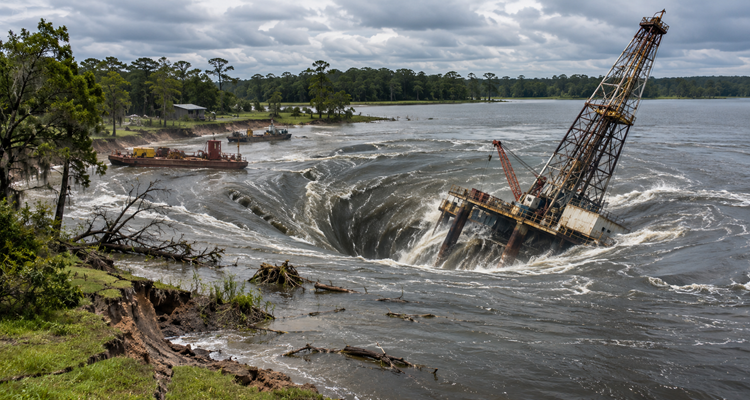
In November 1980, a peaceful Louisiana lake disappeared into the earth, swallowing an oil rig, boats, trees, and sections of shoreline. What looked like an impossible natural disaster was actually a terrifying collision between human engineering and the hidden geology beneath the water.
On the morning of November 20, 1980, something extraordinary happened at Lake Peigneur, near New Iberia, Louisiana.
A lake that had existed for generations began draining into the ground. An enormous whirlpool formed, dragging heavy industrial equipment and surrounding land toward a widening opening. Within hours, the shallow lake had effectively vanished into an underground salt mine.
It sounds like the beginning of a supernatural mystery. But the disaster was real, and its explanation was even more unsettling: people had been drilling for oil above a vast network of underground mining tunnels.
Remarkably, everyone escaped alive.
The story is often told as though an entire town went to bed beside a lake and woke to find it missing. The historical record reveals something different and more dramatic. Lake Peigneur disappeared during daylight hours, in a catastrophe that unfolded on the morning of November 20. Its disappearance was witnessed by workers and residents as it happened.
A Peaceful Lake With a Hidden World Beneath It
Before the disaster, Lake Peigneur was a broad, shallow body of freshwater in southern Louisiana.
According to the University of Louisiana at Lafayette, the lake covered approximately 1,300 acres but was only about 11 feet deep. It was associated with fishing, recreation, and the surrounding landscape of Jefferson Island.
Few people looking across its surface would have imagined how dramatically the land below had been altered.
Beneath the lake lay a massive geological formation known as a salt dome. Such formations develop when deeply buried salt moves upward through surrounding rock over geological time.
Salt domes can contain valuable natural resources, making them attractive locations for mining and petroleum exploration.
At Jefferson Island, two industrial activities were taking place in close proximity.
Aboveground, Texaco was conducting oil exploration. Deep underground, Diamond Crystal Salt Company operated a mine containing excavated tunnels and chambers.
The mine was not simply a narrow shaft extending into the earth. It was a substantial underground industrial complex, with spaces supported by pillars of salt.
For years, the lake and the mine had coexisted.
Then, on one November morning, that separation catastrophically failed.
The Morning Everything Went Wrong
The first indication of trouble came from an oil-drilling operation on the lake.
Workers aboard the drilling platform encountered an unexpected problem: the drill became stuck, and drilling fluid circulation was lost.
These were serious warning signs. Something beneath the drill was not behaving as expected.
The situation rapidly deteriorated.
The platform began tilting, prompting its crew to evacuate. Soon afterward, the structure was drawn into the water as the lakebed collapsed.
What initially appeared to be an equipment emergency had become a geological catastrophe.
Water began rushing downward through the developing opening. As material collapsed around it, the opening grew larger, allowing even more water to escape.
The lake was effectively draining through its own bottom.
A geological account published by the University of Texas Bureau of Economic Geology describes how the drilling rig, its support barge, and the lake disappeared into the expanding collapse feature within approximately three hours.
Meanwhile, underground miners faced an entirely different emergency.
Water was entering the salt mine. The tunnels that had provided access to valuable mineral deposits were becoming conduits for a powerful flood.
The workers had to escape before those underground passages became impassable.
The Whirlpool That Swallowed an Oil Rig
As the lake drained, an enormous whirlpool developed.
This was not an ordinary whirlpool created by wind or a river current. It formed because a huge volume of water was being pulled into an opening beneath the lakebed.
The flow was powerful enough to carry large objects toward the collapse.
The oil rig disappeared. Barges and other vessels were pulled into the expanding crater. Trees, shoreline structures, and portions of the surrounding land were also lost.
Contemporary reporting described a chaotic scene in which the ground continued to give way while the water rushed downward.
The disaster was not limited to the surface.
The mine below was rapidly flooding, while the collapse altered the stability of the land above it.
In an extraordinary reversal of expectations, a lake only a few feet deep in many places had become the entrance to a much deeper underground disaster.
The size of the collapse was remarkable. A geological assessment published by the Texas Water Development Board reported a maximum sinkhole width of approximately 1,300 feet, or 400 metres.
The Escape That Prevented a Human Tragedy
Perhaps the most remarkable part of the Lake Peigneur disaster was not what disappeared, but who survived.
Workers on the drilling platform managed to abandon it before it was swallowed.
Underground, the miners recognized the danger and evacuated as water entered the workings.
Contemporary news reports described seven workers escaping the oil rig and approximately 50 miners escaping from belowground.
Despite the scale of the collapse, no deaths or injuries were reported in those accounts.
The outcome could easily have been different.
Flooding inside an underground mine is especially dangerous because workers depend on limited access routes to reach the surface. A sudden inflow can overwhelm tunnels, disrupt equipment, and cut off escape paths.
At Lake Peigneur, the miners’ evacuation and the drilling crew’s decision to abandon the platform prevented an industrial catastrophe from becoming a mass-casualty event.
How Could an Entire Lake Disappear?
The answer lies in the unusual combination of geology, underground excavation, and drilling.
A lake does not ordinarily disappear simply because a small hole forms in its bottom. Most natural lakebeds contain sediment and rock that restrict how quickly water can escape.
Lake Peigneur was different.
Beneath it was an extensive network of human-made cavities excavated from a salt dome.
Investigations connected the disaster to an apparent breach between the drilling operation and the underground mine. The breach allowed lake water to enter the mine, initiating a chain of flooding, erosion, and collapse.
The process can be understood in four stages:
-
A connection opened underground. Drilling activity apparently penetrated or destabilized part of the mine system, allowing water to enter.
-
Water rushed into the mine. The underground cavities provided space for enormous quantities of lake water.
-
The collapse expanded. As water entered and surrounding material failed, the opening grew, accelerating the flow.
-
The lake drained. Water, sediment, and debris moved into the mine and the developing sinkhole until the original lake was largely emptied.
Salt added another complication.
Unlike many other rocks, salt dissolves readily in freshwater. Water entering a salt mine can weaken exposed surfaces and contribute to the instability of underground structures.
The exact sequence of failures was complex. Although the drilling operation is widely identified as the initiating event, contemporary investigations also examined the mine’s geometry, drilling information, and responsibilities of the companies involved.
The disaster should therefore not be reduced to the simplistic claim that someone merely drilled in the wrong place. The deeper lesson concerns the dangers of poorly understood interactions between neighboring industrial operations.
Then Something Even Stranger Happened: The Water Came Back
The lake’s disappearance was not the end of the story.
Lake Peigneur was connected through waterways to coastal Louisiana and, ultimately, the Gulf of Mexico.
Before the disaster, water generally moved outward through this drainage system.
But after the lake emptied into the mine, the water-level difference reversed the flow.
Water from connected waterways began moving toward the emptied lake basin.
Instead of flowing toward the Gulf, water was now being drawn inland.
This created a remarkable temporary reversal of the drainage system, with water flowing toward the enormous opening left by the collapse.
As the underground cavities filled and the system stabilized, the lake began filling again.
However, the returning water was not simply restoring the old freshwater lake.
The connection with coastal waterways introduced saltier water, transforming the lake’s character.
The lake that eventually emerged was substantially different from the one that had existed before November 20, 1980.
Its depth, shape, and water chemistry had changed.
Lake Peigneur had disappeared and then returned as a different lake.
What Happened to Jefferson Island?
The disaster affected more than the lake itself.
Jefferson Island, a raised area of land beside the lake, experienced serious damage as the ground collapsed and the shoreline changed.
Buildings, trees, equipment, and portions of the surrounding landscape were lost.
The event also created uncertainty about whether additional underground collapses might occur.
Residents were evacuated while officials monitored ground stability and assessed the risk of further subsidence.
Contemporary reporting shows that the danger did not end when the dramatic whirlpool subsided. Authorities remained concerned about cracks in the ground and the stability of the flooded mine.
By Thanksgiving, November 27, 1980, evacuated residents had been permitted to return after officials reported improving conditions.
For the community, the disaster was not merely an extraordinary spectacle. It disrupted homes, employment, industrial operations, and confidence in the ground beneath their feet.
The Mine That Never Reopened
The Diamond Crystal salt mine was permanently lost as a working mine.
Floodwater had entered the underground system, and the collapse fundamentally altered the site.
The economic consequences extended beyond the equipment swallowed by the lake.
The loss of the mine affected workers and businesses connected to salt production. Contemporary reports described efforts to find employment for people whose jobs had been disrupted.
Diamond Crystal accused Texaco of responsibility for the collapse. Texaco disputed that responsibility and raised questions about information concerning the underground mine and drilling permissions.
These disagreements highlight an important aspect of the disaster: the physical mechanism was easier to describe than the complete allocation of responsibility.
The accident involved overlapping industrial operations, underground infrastructure, geological uncertainty, and decisions made by multiple organizations.
It became a cautionary example of what can happen when the consequences of one operation extend into another operation’s underground environment.
Does Lake Peigneur Still Exist Today?
Yes. Lake Peigneur did not disappear permanently.
It refilled after the catastrophe, although the lake that exists today is markedly different from its pre-1980 form.
Before the accident, the lake was broad and shallow, with freshwater conditions.
After the collapse and refilling, it became deeper and more saline.
The original mine remains flooded and closed.
A 2025 Iberia Parish emergency operations document confirms that the November 1980 accident flooded the Jefferson Island salt mine and that the main mine shaft has been sealed.
The lake therefore survives as both a natural feature and a reminder of the disaster that reshaped it.
Could Another Lake Disappear the Same Way?
Lake Peigneur was an exceptional event, but the underlying geological hazards are not unique.
Sinkholes can form when underground material dissolves or when the roofs of natural or human-made cavities collapse.
These processes occur in regions containing soluble rock, including limestone, gypsum, and salt.
Human activity can increase the danger when excavation, drilling, groundwater extraction, or other operations disturb underground structures.
However, it would be misleading to suggest that ordinary lakes are generally at risk of suddenly disappearing.
Lake Peigneur involved an unusual combination of circumstances:
-
A lake positioned above an extensively excavated salt formation.
-
Active oil exploration near underground mining operations.
-
A breach that allowed large volumes of water to enter the mine.
-
Progressive collapse that dramatically enlarged the opening.
The disaster illustrates why geological mapping, accurate underground records, coordination between operators, and careful risk assessment matter.
It is not evidence that lakes can routinely vanish without warning. Rather, it demonstrates how a specific combination of industrial and geological conditions can produce an extraordinary result.
The Most Important Lesson Beneath the Mystery
The story of Lake Peigneur is memorable because it appears to violate something we take for granted.
We expect lakes to occupy stable places in the landscape.
We expect the ground beneath us to remain solid.
And we tend to think of underground industrial operations as separate from the ordinary world above them.
On November 20, 1980, those assumptions failed simultaneously.
The surface of a quiet Louisiana lake became the entrance to a collapsing underground mine. Industrial equipment vanished, the shoreline gave way, and water began moving in directions it had not previously followed.
Yet the most important part of the story is not the whirlpool or the disappearing lake.
It is the fact that an underground hazard, largely invisible to people at the surface, transformed an entire landscape in a matter of hours.
Lake Peigneur eventually returned.
The mine did not.
And the lake that exists today carries a permanent reminder of what happened when human engineering collided with the hidden structure of the earth.
The mystery was never where the water went. It was how an ordinary-looking lake could conceal the conditions for such an extraordinary disaster.
This content is published for informational or entertainment purposes. Facts, opinions, or references may evolve over time, and readers are encouraged to verify details from reliable sources.
Related News
- The Day an Entire Town Started Dancing and Nobody Could Explain Why They Couldn’t Stop
- The Town Where a Deadly Fog Arrived Without a Storm and Changed History
- The Village Where the Ground Has Been Burning for More Than a Century
- Jiang Xiaorou: The Chinese Influencer Who Challenged a Curse and Died a Year Later