









The Websites That Look Completely Different Depending on Which Country You Visit Them From
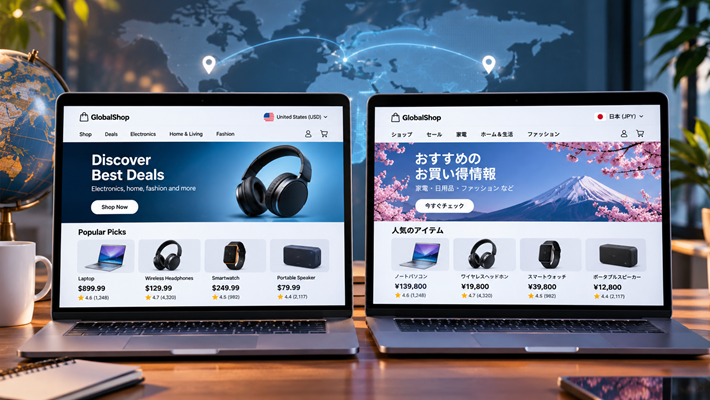
The internet may be global, but the websites we see are often surprisingly local. From streaming libraries and shopping platforms to search results and online encyclopedias, your country can change what appears on your screen and sometimes what you are allowed to access.
Imagine two people opening the same website at the same moment. One is sitting in London, the other in Mumbai. They enter the same address, use similar devices, and expect to see the same thing.
Instead, they encounter different homepages, products, recommendations, languages, or entire collections of content.
Neither person necessarily has a technical problem. They may simply be seeing two versions of the same digital service, each designed for a different market.
This is one of the less obvious realities of the modern internet: the web is connected globally, but the experience of using it is increasingly shaped by geography.
Some differences are practical, such as showing prices in local currencies. Others are more consequential, determining which films people can watch, which information appears prominently in search results, and whether a service is available at all.
Here are some familiar websites that demonstrate just how different the internet can look across national borders.
1. Netflix: One Streaming Service, Different Entertainment Worlds
A film available to someone in Japan might be absent from the catalog in the United States. A series accessible in India might have different subtitle or audio options elsewhere.
Netflix confirms that its selection of movies and television programs varies by country. Even maturity classifications and the availability of downloaded titles can change when subscribers travel.
The explanation is largely about distribution rights.
A production company might license a film to Netflix in one territory while granting another streaming platform exclusive rights elsewhere. Regional audience preferences can also influence what Netflix chooses to offer.
Netflix says these factors help explain why its libraries differ internationally.
The result is that Netflix is not quite one universal digital library. It is a collection of country-specific viewing experiences operating under a shared brand.
And the difference goes beyond whether a particular title exists. The recommendations displayed to an individual can also depend on viewing history, language preferences, and other personalization signals.
What changes: Available titles, audio and subtitles, content ratings, and personalized recommendations.
2. Amazon: A Familiar Brand That Becomes a Different Marketplace
Amazon offers one of the clearest examples of how a global website can operate as a collection of local marketplaces.
Compare Amazon.com in the United States, Amazon.in in India, and Amazon.co.jp in Japan.
The familiar shopping structure remains, but the experience can change considerably.
Products available in one country might not be sold in another. Prices appear in different currencies, delivery options depend on local logistics, and promotional campaigns reflect regional shopping habits.
The language, product categories, and featured merchandise can also vary.
Amazon officially allows users to select different shopping countries, languages, and currencies within its app. It distinguishes browsing another country’s marketplace from transferring an account’s country of residence.
This distinction matters because selecting a different marketplace does not automatically make every product available for delivery to your address.
What changes: Product selection, currencies, languages, delivery eligibility, promotions, and shopping recommendations.
3. Google: The Same Question Can Produce Different Answers
Google’s differences are less immediately obvious because the basic search interface remains recognizable across much of the world.
The results, however, can be substantially different.
Consider someone searching for football scores.
In the United States, the query may be interpreted in the context of American football. In many other countries, it is more likely to relate to association football, commonly called soccer in the US.
Or consider a search for best restaurants. The answer depends heavily on where the searcher is located.
Google explains that its search systems use context such as location, language, device type, and recent activity to help determine relevant results. Personalization may introduce further differences.
That means two people can enter identical words and encounter different sources, rankings, maps, and suggestions.
Even language settings do not tell the entire story. Google says its systems consider multiple signals to decide which languages are most useful for a particular search.
This creates an important distinction: Google does not simply translate the same universal list of answers. It can select different information based on the circumstances of the person searching.
What changes: Search rankings, local results, languages, maps, news relevance, and some interface features.
4. BBC: A Website Where Location Can Determine Access
The BBC illustrates a different kind of geographical variation: a service that may be accessible in one country but restricted in another.
The BBC’s international digital offerings and its UK-focused streaming service are not interchangeable.
BBC iPlayer is intended for viewers in the United Kingdom, subject to the applicable television licensing requirements. The BBC confirms that iPlayer is available only in the UK.
Meanwhile, BBC.com offers international audiences other digital services and subscription arrangements, which can themselves vary by market.
Someone accessing the BBC’s online services from Britain may therefore have entertainment options unavailable to a visitor elsewhere.
This is not necessarily a matter of website design. It reflects broadcasting rights, distribution agreements, and the conditions under which different services operate.
What changes: Streaming availability, subscription offerings, and access to certain video content.
5. Wikipedia: Different Languages Can Mean Different Knowledge
Instead, they are shaped by language editions.
Visit English Wikipedia and Japanese Wikipedia, and you are accessing separate editorial communities.
These are not simply identical encyclopedias translated into different languages.
According to Wikimedia, Wikipedia’s language editions operate as distinct projects. Articles are created and maintained by their respective volunteer communities, and the content is not automatically synchronized between languages.
An article about the same historical event may contain different levels of detail, different references, or different editorial emphasis depending on the language edition.
This does not automatically mean one version is more accurate than another. It means that language communities can develop different bodies of coverage.
Wikipedia also highlights an important qualification to the geographical-web phenomenon: not every international difference is caused by location detection. Sometimes the user chooses a different language edition, and that choice changes the information available.
What changes: Article coverage, detail, references, editorial emphasis, and language.
6. YouTube: One Video Platform, Different Viewing Experiences
YouTube might seem like a single global collection of videos, but its recommendations and available content can vary significantly between countries.
The platform allows users to change their preferred location, which can influence recommendations, charts, and news content. Language preferences can also affect displayed video information.
There is another difference that viewers sometimes encounter: videos that cannot be played in their country.
YouTube explains that content owners may restrict videos to particular territories because of licensing agreements. The platform may also restrict content to comply with local laws.
Consequently, a video link shared by a friend abroad might lead to an unavailable-content message rather than the expected video.
These restrictions illustrate how geography can influence not just what a platform recommends, but which parts of its catalog viewers can actually access.
What changes: Recommendations, news, charts, language settings, and video availability.
7. Spotify: The Music Library That Changes Across Borders
Music is often described as a universal language, but the digital rights governing its distribution are anything but universal.
Spotify provides access to music and podcasts across numerous markets, yet its available catalog can differ by country.
Spotify confirms that content availability changes across territories and over time, depending on permissions granted by rights holders.
This means that a song appearing in one listener’s playlist may be unavailable to another listener whose account is associated with a different country.
Spotify also explains that moving to another country may require updating an account’s country or region, potentially affecting pricing and catalog availability.
Unlike a simple language change, these differences can affect what people are actually able to hear.
What changes: Music and podcast availability, regional pricing, and account-related service options.
8. IKEA: The Same Furniture Brand, Different Local Stores
The company maintains country-specific shopping websites that customers can select through IKEA’s global website.
These sites can differ in language, product selection, prices, delivery arrangements, and local store information.
IKEA confirms that its product availability varies by market. Some items sold internationally are not offered in India, for example.
And browsing another country’s website does not necessarily mean a customer can order its products internationally.
IKEA’s Indian customer support explains that products offered by overseas IKEA stores cannot generally be purchased online for direct shipment to India through its local operation.
The difference reflects a practical reality: a global furniture company still depends on local inventory, supply chains, and retail operations.
What changes: Product catalogs, currencies, local stock, delivery arrangements, and language.
Why Do Websites Change Depending on Your Country?
The differences are not accidental. They result from several overlapping technical, commercial, and legal decisions.
Five forces behind the localized internet
Geolocation
Estimating a visitor’s country or region
Language
Showing content suited to local audiences
Legal rules
Applying territorial restrictions and requirements
Licensing
Controlling where media can be distributed
Local commerce
Adapting prices, products, and delivery
Location detection
Websites can estimate a visitor’s location using their internet connection, including their IP address. Some services also use location permissions, account settings, or delivery addresses.
An IP address does not provide a perfectly reliable indication of physical location. Virtual private networks, mobile networks, and routing arrangements can complicate the estimate.
Language and cultural relevance
Companies often adapt content to local languages, cultural expectations, and consumer habits.
This can involve more than translating text. A company may select different homepage imagery, navigation categories, promotional campaigns, or featured products for different markets.
Licensing and distribution rights
Streaming platforms cannot always distribute every film, television series, or song worldwide.
Rights may be licensed separately for different territories, leaving a service with different catalogs across countries.
Laws and regulations
Online services must consider the laws that apply to their operations and audiences.
Depending on the jurisdiction and service, those requirements can affect privacy notices, content availability, age restrictions, payment options, and other features.
Commercial strategy
Companies may deliberately tailor their websites to different markets.
A shopping platform might highlight products that are popular locally. A retailer may prioritize seasonal promotions appropriate to the region.
The result is a website designed to feel relevant to its audience, rather than identical everywhere.
Does Changing Your Country Setting Show You the Other Version?
Sometimes but not always.
There is an important difference between changing a website’s displayed region and changing the country from which the service determines you are accessing it.
For example, changing Amazon’s shopping country can let you browse another marketplace. It does not automatically grant access to every product or international delivery option.
Changing YouTube’s location preference can influence recommendations, but it does not necessarily remove territorial video restrictions.
Similarly, a streaming service may rely on account information and other location signals when deciding which catalog is available.
A VPN may change the apparent location of an internet connection, but it does not guarantee access to another country’s services. Platforms can detect or restrict VPN connections, and account eligibility or licensing conditions may still apply.
Try It Yourself: Compare Websites Across Countries
You do not need to travel internationally to explore many of these differences.
Here are some simple comparisons that can be made using official regional websites or built-in settings.
| Website | What to compare |
|---|---|
| Amazon | US, Indian, and Japanese storefronts |
| IKEA | Swedish and Indian product catalogs |
| Wikipedia | English and Japanese articles about the same topic |
| Search results with different region settings | |
| YouTube | Recommendations and charts after changing location preferences |
When comparing them, look beyond the language. Examine featured content, prices, product categories, available features, and whether certain material disappears entirely.
For a more controlled comparison, use the same device and browser, remain signed out where practical, and change one setting at a time. Remember that cookies, browsing history, account preferences, and ongoing website experiments may also affect the results.
This is especially important when interpreting screenshots: two different-looking pages do not automatically prove that geography alone caused the difference.
The Bigger Question: Is There Really One Internet?
Technically, people around the world access interconnected networks using many of the same underlying internet technologies.
But that does not mean everyone experiences the same digital environment.
A person searching for information in one country may encounter different results from someone elsewhere. A streaming subscriber may have access to a different collection of entertainment. A shopper may see different prices, products, or delivery options.
Some differences make the internet more useful. Local languages, currencies, and services help websites serve audiences more effectively.
Others raise questions about equal access to information and digital culture.
When a service limits content by territory, people may encounter different boundaries despite using the same platform. When search systems prioritize locally relevant results, users can encounter different perspectives without necessarily realizing it.
Neither outcome is automatically good or bad. Much depends on why the difference exists and whether users understand it.
What matters is recognizing that the internet is not always the same shared experience it appears to be.
Conclusion: The Internet Has More Than One Face
The next time you visit a familiar website, remember that someone thousands of miles away might be seeing something quite different.
Their shopping options may be broader or narrower. Their entertainment catalog may contain different titles. Their search results may emphasize different information.
Sometimes those variations are as simple as a translated button or a local currency symbol. Other times, they determine what people can watch, buy, discover, or access.
The internet connects the world, but it does not always show the world the same thing.
And perhaps that is the most interesting part: behind every familiar website may be dozens of different experiences, each shaped by the place from which someone connects.
The information presented in this article is based on publicly available sources, reports, and factual material available at the time of publication. While efforts are made to ensure accuracy, details may change as new information emerges. The content is provided for general informational purposes only, and readers are advised to verify facts independently where necessary.