







The Little Cloud Who Was Afraid to Rain Because Nobody Had Ever Thanked a Storm
An original, heartwarming story about a little cloud who discovers that doing something good does not always mean being thanked for it.
The Cloud That Collected Thank-Yous
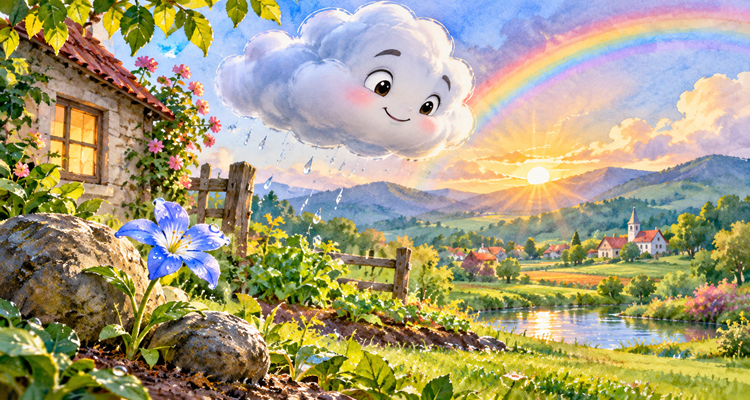
High above a valley of crooked rooftops, sunflower fields, and sleepy blue mountains lived a little cloud named Nimbus.
Nimbus was smaller than the other clouds. He was round at the edges, soft as a pillow, and so white that the morning sun sometimes mistook him for a piece of itself.
But Nimbus had a peculiar habit.
He collected thank-yous.
Whenever the sun warmed a cold hillside, Nimbus listened to the flowers whisper, “Thank you, sunshine.”
Whenever the wind carried a dandelion seed across the meadow, he heard the grasses rustle, “Thank you, wind.”
And whenever the moon appeared above the mountains, the owls greeted her with grateful songs.
Nimbus kept these little moments in his memory like treasures.
He hoped that one day someone would thank him, too.
There was only one problem.
Nimbus was a rain cloud.
And nobody, as far as he could tell, had ever thanked a storm.
The Day Nimbus Learned to Be Afraid
One afternoon, Nimbus drifted beside a large gray cloud named Thunderbelly.
Thunderbelly was old and enormous. He had traveled over oceans, forests, deserts, and cities. His thunder could shake windows, although he rarely meant to frighten anyone.
“Thunderbelly,” Nimbus asked, “do people like the rain?”
Thunderbelly considered this.
“Sometimes,” he said.
“Do they thank you when you make it rain?”
Thunderbelly gave a low rumble.
“Not very often.”
Nimbus looked down at the village below.
A woman hurried indoors as dark clouds gathered. A boy pulled his bicycle beneath a porch. A shopkeeper frowned at the sky and began closing his windows.
“Oh, not again!” someone shouted.
Nimbus shrank a little.
“Are they angry with you?” he whispered.
“Perhaps they’re disappointed,” Thunderbelly replied. “Rain changes people’s plans.”
“But rain helps things grow, doesn’t it?”
“Of course.”
“Then why doesn’t anyone say thank you?”
Thunderbelly looked toward the distant hills.
“That,” he said gently, “is something you may have to discover for yourself.”
Nimbus did not like the sound of that.
He made a quiet decision.
He would never rain.
If he never rained, nobody would ever complain about him.
And perhaps, if he stayed white and fluffy enough, people would love him just as he was.
A Valley Without Rain
For several days, Nimbus floated happily above the valley.
He made himself into wonderful shapes.
One morning, he became a rabbit.
The next, a sailing ship.
On Thursday, he stretched himself into a magnificent dragon with a tail that curled around the sun.
Children pointed upward and laughed.
“Look at that cloud!”
Nimbus glowed with pride.
At last, he thought, people liked him.
But as the days passed, something began to change.
The grass beneath the apple trees turned brittle.
The pond grew smaller.
The sunflowers lowered their heavy heads.
Even the wind seemed tired.
One evening, Nimbus passed over a small garden behind a yellow cottage.
There, an elderly woman named Mara knelt beside a row of drooping vegetables.
She pressed her fingers into the dry earth.
“Just a little rain,” she murmured. “That’s all we need.”
Nimbus heard her.
His heart gave a hopeful flutter.
Perhaps she wanted him to rain.
But then he remembered the shouting villagers, the closed windows, and the disappointed faces.
What if Mara complained afterward?
What if she wished he had gone away?
Nimbus squeezed himself tightly together.
Not a single drop escaped.
And the garden remained dry.
The Smallest Flower in the Valley
The next morning, Nimbus noticed something he had never seen before.
At the edge of Mara’s garden, between two stones, grew a tiny blue flower.
It was no taller than a spoon.
Its petals were curled inward, and its stem leaned against a pebble for support.
Nimbus floated lower.
“Hello,” he said.
The flower lifted its head as much as it could.
“Hello, cloud.”
“You look very tired.”
“I am,” the flower admitted.
“Why?”
“The earth is thirsty. My roots cannot find enough water.”
Nimbus felt a strange heaviness inside him.
He was full of water.
So full, in fact, that his edges had begun to darken.
“Would rain help?” he asked.
“Oh, yes,” said the flower. “Very much.”
Nimbus hesitated.
“But rain makes people unhappy.”
The flower was quiet for a moment.
“Some people don’t like getting wet,” it said. “But the earth still needs water.”
Nimbus looked toward the village.
“What if nobody thanks me?”
The flower blinked.
“Thanks you?”
“For raining.”
“Oh,” said the flower.
It considered this carefully.
Then it asked, “Does the sun stop shining when nobody says thank you?”
“No.”
“Does the wind stop blowing?”
“No.”
“Does the river stop flowing?”
Nimbus looked down.
“No.”
“Then perhaps,” the flower whispered, “some gifts are important even when nobody notices who gives them.”
Nimbus had never thought about that before.
But he was still afraid.
So he floated away.
The Night the Cloud Became Too Heavy
That evening, the sky turned violet.
The other clouds traveled toward the mountains, leaving Nimbus alone above the valley.
He tried to make himself into a rabbit again.
But he was too heavy.
He tried to stretch into a dragon.
But his edges sagged.
He was holding so much rain that he could barely move.
Below him, the village settled into darkness.
Mara placed an empty watering can beside her garden.
The pond reflected only a thin sliver of moonlight.
And the little blue flower had bent so low that its petals touched the ground.
Nimbus felt something inside him ache.
He had spent so long worrying about whether anyone would appreciate his rain that he had forgotten why rain mattered.
He looked at the flower.
Then at the garden.
Then at the fields beyond the village.
“What if I rain,” he whispered, “and nobody thanks me?”
The stars offered no answer.
Nimbus waited.
At last, he asked a different question.
“What if I don’t rain, and the flower never stands up again?”
That question frightened him even more.
For the first time, Nimbus understood that his fear was not the only thing that mattered.
Something below him needed what he had to give.
The First Drop
Nimbus took a deep breath.
He loosened the tight little knot he had made of himself.
A single raindrop slipped from his belly.
It fell through the cool evening air and landed on the dry earth beside the blue flower.
Plip.
Nimbus waited.
Nobody cheered.
Nobody clapped.
Nobody shouted thank you.
He almost pulled the rest of his rain back inside.
But then he noticed the dark spot where the water had touched the soil.
It was small.
Very small.
Yet it was something.
So Nimbus let another drop fall.
Plip.
And another.
Plip. Plip.
Soon, a gentle rain began to patter across the garden.
It touched the leaves of the apple trees.
It filled the shallow footprints along the road.
It tapped softly against the cottage windows.
The thirsty soil drank.
The vegetables lifted their leaves.
And the little blue flower, slowly and almost imperceptibly, began to straighten.
Nimbus watched in wonder.
He was helping.
Not because anyone had asked him to be wonderful.
Not because anyone had promised to admire him.
Simply because he could.
When the Thunder Came
As the rain continued, Nimbus grew nervous again.
The wind had strengthened.
A low rumble stirred inside him.
“Oh, no,” he whispered.
He had never thundered before.
He tried to swallow the sound, but it escaped.
Rrrrrumble.
A few windows lit up in the village.
A dog barked.
Someone shut a bedroom window.
Nimbus trembled.
“They’re frightened,” he said. “I’ve ruined everything.”
From beyond the hills, Thunderbelly’s voice rolled through the sky.
“Not every storm must be fierce, little one. Let the wind pass. You can give the valley a gentle rain.”
Nimbus steadied himself.
He let the wind move around him.
His thunder faded.
And the rain softened into a quiet, steady rhythm.
It continued through the night, never becoming the violent storm Nimbus had feared.
For hours, he listened to the drops falling on rooftops, gardens, and thirsty fields.
By morning, he was no longer heavy.
He was smaller than before.
Almost transparent.
But strangely, he had never felt so light.
The Thank-You Nobody Heard
At sunrise, Nimbus floated above Mara’s cottage.
The valley had changed.
The grass sparkled.
The pond had risen.
The sunflowers stood a little straighter.
Mara stepped into her garden and knelt beside the vegetables.
She touched the damp soil.
Then she smiled.
“Well,” she said softly, “that rain was just what we needed.”
Nimbus’s heart leaped.
Had she thanked him?
Not exactly.
She hadn’t even looked up.
But she was smiling.
And beside the stones, the tiny blue flower stood tall again.
Its petals had opened into five perfect points.
“Good morning!” Nimbus called.
The flower looked up.
“Good morning, little cloud.”
“Are you feeling better?”
“Much better.”
Nimbus hesitated.
“Did you know it was me?”
The flower nodded.
“I thought it might be.”
Nimbus waited.
He wanted to ask whether the flower was grateful.
He wanted to hear the words he had spent so many days longing for.
But before he could speak, a bee landed on one of the blue petals.
The flower swayed happily.
And Nimbus realized that the flower was busy being alive.
Because of the rain.
His rain.
A warm feeling spread through him.
It was not quite the same as being praised.
It was quieter.
And somehow, it lasted longer.
Then the flower looked up once more.
“Oh, Nimbus?”
“Yes?”
“Thank you.”
For a moment, the little cloud could not speak.
He had imagined those words a hundred times.
He had expected them to make him feel enormous, important, and magnificent.
Instead, he simply felt happy.
“You’re welcome,” he whispered.
The Rainbow That Wasn’t a Reward
As the morning sun rose higher, its light passed through the last drifting drops of rain.
A rainbow appeared above the valley.
Red, orange, yellow, green, blue, indigo, and violet stretched across the sky.
Children rushed from their houses.
“Look!” they cried.
“A rainbow!”
Nimbus smiled.
He knew the rainbow was not a prize for being good. It was sunlight meeting raindrops in just the right way.
But he loved it anyway.
Thunderbelly drifted beside him.
“Well, little one,” the old cloud said, “you finally rained.”
Nimbus nodded.
“Was it terrible?”
“A little frightening at first.”
“And did everyone thank you?”
“No,” Nimbus replied.
He looked down at the muddy road, where a man was grumbling about his wet shoes.
Then he looked at the green fields, the fuller pond, Mara’s garden, and the tiny blue flower.
“Some people were still unhappy,” Nimbus said. “But some things needed the rain.”
Thunderbelly gave an approving rumble.
“And what will you do next time?”
Nimbus thought carefully.
“I’ll try to give the earth the rain it needs, as gently as I can.”
Thunderbelly smiled.
“That sounds wise.”
Nimbus gazed across the valley.
He no longer wanted to collect every thank-you in the world.
He would still treasure the ones he received.
But he would not let their absence decide whether he did something kind.
Because sometimes, the greatest difference we make is not announced with applause.
Sometimes it grows quietly beneath the soil.
Sometimes it fills an empty pond.
Sometimes it helps a little flower stand tall enough to greet the morning.
And sometimes, the world is better because of something we gave, even if nobody knows our name.
As Nimbus drifted toward the distant hills, the little blue flower called after him.
“Will you come back?”
Nimbus laughed, a soft, fluffy laugh.
“Of course.”
“Even if nobody thanks you?”
The little cloud paused.
Then he smiled.
“Especially if someone needs the rain.”
And with that, he floated onward, lighter than he had ever been.
The Gentle Lesson Behind the Story
The Little Cloud Who Was Afraid to Rain Because Nobody Had Ever Thanked a Storm is a fictional fable about kindness, courage, and the quiet value of helping others.
Nimbus begins by believing that appreciation is proof of his worth. Because people sometimes complain about storms, he becomes afraid to do the very thing that makes him useful.
His journey teaches him something more meaningful: a good deed does not lose its value simply because nobody says thank you.
The story also offers another important lesson. Wanting appreciation is natural, and gratitude matters. But depending entirely on praise can make us afraid to act, even when our actions could help someone.
Nimbus learns that kindness is not about pleasing everyone. It is about noticing genuine needs, considering the consequences of our actions, and finding the courage to help.
The moral of the story: Do not measure the goodness you bring into the world only by the gratitude you receive. Sometimes the flowers bloom because of you, even when nobody remembers to thank the rain.
This content is published for informational or entertainment purposes. Facts, opinions, or references may evolve over time, and readers are encouraged to verify details from reliable sources.