









The Birds That Sleep Inside Ant Nests Without Becoming Their Next Meal
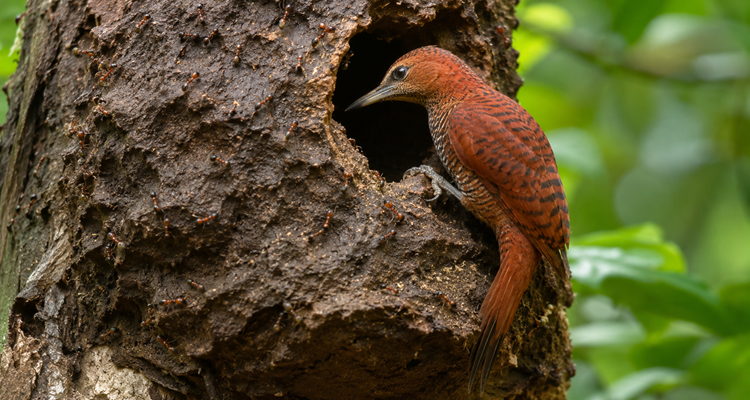
In the forests of Asia, an unusual woodpecker raises its young inside the living colonies of aggressive ants. Scientists are investigating how this unlikely arrangement works and whether the birds gain more than a place to shelter.
Most birds try to keep ants away from their nests. Ants can invade nesting chambers, disturb incubating adults and, in some circumstances, injure vulnerable chicks. Yet one remarkable bird has developed a very different relationship with these insects.
The Rufous Woodpecker (Micropternus brachyurus) regularly excavates nesting chambers inside the large, occupied nests of Crematogaster ants, commonly known as acrobat ants. Rather than abandoning the colony or immediately attacking the birds, the ants can continue living in the same structure.
The arrangement is especially surprising because the woodpecker also eats ants.
Researchers have documented this unusual association in parts of South and Southeast Asia, including India and Sri Lanka. The evidence reveals a fascinating example of animals sharing a space despite having seemingly incompatible interests. But it also leaves an important question unanswered: Why do the ants tolerate a bird that sometimes feeds on their own colony?
A Woodpecker That Chooses an Ant Colony Instead of a Tree Hollow
Most woodpeckers are famous for drilling cavities into trees. Their powerful bills allow them to excavate nesting spaces in trunks and branches, creating sheltered places for eggs and chicks.
The Rufous Woodpecker follows a different approach.
Across parts of its range, it uses the large carton nests constructed by Crematogaster ants. These structures are made from processed plant material and resemble rough, dark, papery masses attached to trees.
The bird cuts an entrance into the ant-built structure and excavates a chamber inside it. This becomes a breeding site where adults can incubate eggs and care for their young.
A habitat account published through the Wildlife Institute of India describes the species nesting in living ant colonies, with the bird creating a hollow inside the carton structure rather than relying on a conventional tree cavity.
This is not simply a case of a bird occupying an abandoned insect nest. The unusual feature is that birds and ants can occupy the structure at the same time.
What makes these ant nests suitable?
A large carton nest offers several potential advantages.
Its enclosed structure provides a sheltered cavity, while its elevated position may make access more difficult for some ground-based predators. The ants themselves can also respond aggressively to disturbances.
These characteristics make the structure an intriguing nesting resource, although researchers have not established how much each feature contributes to the woodpecker’s breeding success.
There is another distinction worth making: the strongest published evidence concerns breeding and nesting inside ant colonies, not routine overnight sleeping by adult birds outside the breeding season. The headline’s reference to sleeping describes sheltering within these nests, rather than a separately verified year-round roosting habit.
Why Don’t the Ants Attack the Birds?
Ant colonies defend their homes because the colony contains valuable resources: workers, reproductive individuals, developing young and stored food.
A large animal excavating a hole into an occupied colony would ordinarily seem like a serious threat.
Yet Rufous Woodpeckers can establish nesting chambers without being driven away.
Scientists have investigated several possible explanations, including the bird’s physical characteristics, the ants’ responses to its feathers and the ecological consequences of sharing a nesting structure.
One particularly interesting line of research concerns smell.
The mystery of the woodpecker’s feathers
A study presented by researchers associated with the University of Colombo examined interactions between Rufous Woodpeckers and Crematogaster ants in Sri Lanka.
The researchers tested how ants responded to feathers from Rufous Woodpeckers compared with feathers from other birds and additional experimental treatments.
They reported a statistically significant attraction of the ants to Rufous Woodpecker feathers.
This is an important observation because ants rely heavily on chemical signals to recognize colony members, navigate their surroundings and respond to threats.
However, the experiment does not establish that the woodpeckers disguise themselves as ants, produce a specific protective chemical or become immune to ant aggression.
The researchers identified an unusual response to the feathers, but the precise mechanism behind the birds’ tolerance remains unresolved.
The distinction matters. Chemical camouflage is an interesting possibility, but it should not be presented as a proven explanation.
The Unexpected Twist: The Birds Also Eat the Ants
The relationship becomes even stranger when feeding behavior is considered.
Rufous Woodpeckers are specialized ant predators. They forage on ants and their developing young, sometimes breaking into ant nests to reach the insects inside.
In a field report published in Indian Birds in 2008, naturalist C. K. Vishnudas described observations of Rufous Woodpeckers attacking Crematogaster colonies in Kerala’s Western Ghats.
Across ten years of opportunistic observations, he recorded 37 attempts by these woodpeckers to break into ant nests. Of those, 31 occurred in shaded coffee plantations and six in natural forest.
He also documented a Rufous Woodpecker feeding its young from a nesting chamber inside an ant nest.
These observations show that the bird’s relationship with the ants is not straightforward cooperation.
The ants provide a nesting structure, but they are also potential prey.
Is this a partnership or exploitation?
Ecologists use several terms to describe relationships between species.
Commensalism occurs when one species benefits while the other experiences no clearly established benefit or harm. Mutualism describes relationships in which both species benefit. Predation, meanwhile, benefits the predator at the expense of its prey.
The Rufous Woodpecker–ant association may involve more than one of these interactions.
The woodpecker gains access to a nesting site and consumes ants. The ants may continue maintaining their colony around the bird’s chamber, but whether they benefit from the bird’s presence is not established.
The Sri Lankan research characterized the association as involving commensalism alongside a predator–prey relationship.
That classification highlights how ecological relationships can be more complicated than a simple division between friends and enemies.
Could the Ants Be Protecting the Woodpeckers?
One possible advantage of nesting among aggressive ants is protection from other animals.
Ants can defend their colonies against intruders, and some bird species appear to benefit from nesting near them.
A broader scientific review of bird–ant relationships, published in Proceedings of the Royal Society B, describes evidence that ants can influence bird nesting success, including cases where aggressive ant colonies may discourage predators.
However, this does not prove that Rufous Woodpeckers consistently experience fewer predator attacks because they nest inside ant colonies. That specific benefit requires more direct testing.
The distinction between a plausible advantage and a demonstrated one is particularly important in wildlife research.
An ant colony is not a guaranteed safe house
Living among ants can also introduce risks.
Ants may bite or otherwise disturb birds, and some species attack eggs or nestlings under particular conditions. The outcome depends on the ant species, the bird species and the circumstances of their encounter.
A review of bird–ant interactions documents relationships ranging from predation and competition to apparent cooperation.
The Rufous Woodpecker is therefore not evidence that ants are universally harmless to nesting birds. It represents a specialized ecological association in which coexistence is possible despite potential conflict.
Other Birds Have Surprising Relationships With Ants
The Rufous Woodpecker is an especially striking example, but it is not the only bird associated with ant colonies.
Research has revealed several ways birds and ants can interact.
| Bird or bird group | Documented relationship with ants |
|---|---|
| Rufous Woodpecker | Excavates breeding chambers inside occupied Crematogaster nests |
| Wood Warbler | Ant colonies sometimes establish themselves within the bird’s nest |
| Tits | Some populations nest near ants when the potential protection from predators outweighs the risks |
| Ant-following tropical birds | Feed on insects and other prey disturbed by moving ant swarms |
These relationships differ substantially. A bird nesting inside an ant colony is not behaving in the same way as a bird following an army-ant swarm to find food.
When ants move into birds’ nests instead
In European forests, scientists have documented the reverse arrangement: ants raising their young inside nests constructed by birds.
A 2021 study of Wood Warblers (Phylloscopus sibilatrix) in Poland’s Białowieża Forest found ant broods in:
24%
2018
10%
2019
27%
2020
Share of Wood Warbler nests containing ant broods in each study year; sample sizes were 92, 68 and 100 nests, respectively. Source: 2021 research in Frontiers in Zoology.
The researchers found that ants appeared to be attracted to the warm conditions created by nesting birds.
Birds generate body heat while incubating eggs and caring for chicks. Their nests can consequently provide favorable temperatures for developing ant larvae and pupae, particularly during cooler or wetter weather.
Importantly, the researchers did not find evidence that the warblers deliberately selected nesting sites to attract ants. The attraction appeared to operate primarily in the opposite direction.
This provides an interesting comparison with the Rufous Woodpecker.
In one relationship, the bird actively excavates a nesting chamber within an ant colony. In the other, ants move into a nest already constructed and occupied by birds.
Both examples demonstrate that nests are not necessarily exclusive homes for a single species.
What Scientists Still Need to Discover
Despite documented observations, several questions remain about the Rufous Woodpecker’s unusual nesting behavior.
One concerns chemical recognition. The reported attraction of Crematogaster ants to woodpecker feathers suggests that the bird’s physical or chemical characteristics may influence ant behavior. But the specific compounds involved, if any, and their effects inside natural colonies have not been conclusively identified.
Another concerns the costs to the ants. A woodpecker may remove some ants while excavating or feeding, but researchers still need to establish how the bird’s presence affects colony survival, reproduction and overall fitness.
There is also the question of breeding success. Does nesting within an occupied ant colony produce more surviving chicks than nesting elsewhere? Comparative field studies could help clarify the benefits and risks.
Finally, the relationship may vary geographically. Different Crematogaster species, colony sizes and environmental conditions could influence how birds and ants interact.
The available research offers valuable evidence, but it does not yet provide a complete explanation for the association.
Why This Unusual Relationship Matters
The Rufous Woodpecker’s nesting behavior reveals something important about biodiversity: ecological relationships rarely fit into perfectly separate categories.
An organism can be a predator in one interaction and a nesting associate in another. A defensive insect colony can be dangerous to some animals while tolerating others.
The bird’s dependence on suitable ant colonies also raises questions about habitat management.
In India’s Western Ghats, observations have documented Rufous Woodpeckers using Crematogaster colonies in shaded coffee plantations as well as natural forest.
This suggests that some agricultural landscapes retaining trees and suitable ant-nesting habitat can provide resources for the species. It does not mean plantations replace natural forests or that all farming systems offer equivalent wildlife habitat.
The 2008 field report specifically highlighted the ecological value of shaded coffee landscapes for these woodpeckers and other insect-eating birds.
Protecting habitat diversity may therefore help preserve not just individual species, but the specialized relationships between them.
A Home Built by One Species, Occupied by Another
The Rufous Woodpecker does something that initially seems improbable. It excavates a breeding chamber inside a living ant colony, raises its young there and can coexist with insects that it also consumes.
Scientists have confirmed the nesting association and documented intriguing ant responses to the bird’s feathers. Yet the precise reasons for the ants’ tolerance remain incompletely understood.
That uncertainty is part of what makes the relationship scientifically interesting.
The forest is not simply a collection of animals competing for territory. It is a network of interactions in which the same species can be a neighbor, a predator and a source of shelter, depending on the circumstances.
For the Rufous Woodpecker, a colony of defensive ants can become an unlikely place to raise the next generation.
And for researchers, that remarkable arrangement remains a small but revealing mystery of the natural world.
This content is published for informational or entertainment purposes. Facts, opinions, or references may evolve over time, and readers are encouraged to verify details from reliable sources.