








The Birds That Remember a Forest Long After Its Trees Are Gone
Some birds carry remarkable maps of their surroundings in their memories. Others carry the seeds from which future forests may grow. Together, these abilities reveal an overlooked connection between animal intelligence, disappearing habitats, and nature’s capacity for renewal.
A forest can disappear in a matter of hours. Trees fall, familiar landmarks vanish, and a landscape that once provided food and shelter becomes an open stretch of ground.
But the disappearance of trees does not necessarily erase every biological connection to the forest that stood there.
Some birds possess extraordinary spatial memories, allowing them to locate hidden food months after storing it. Others transport seeds between surviving woodland patches, helping plants reach places where trees have been lost. Certain species can even contribute to the regeneration of forests following natural disturbances.
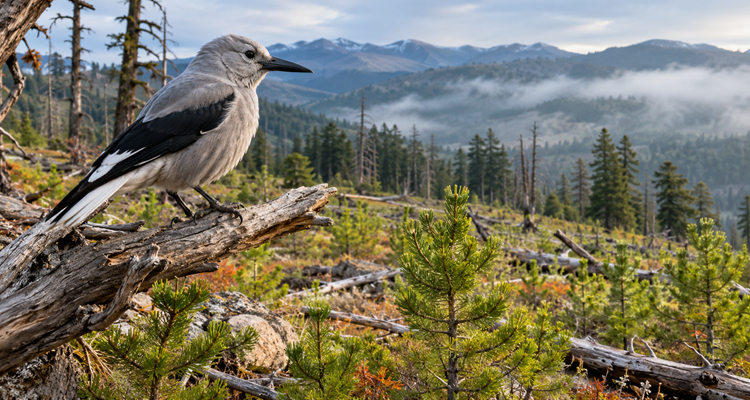
One of the most remarkable examples is the Clark’s nutcracker, a mountain bird whose ability to remember thousands of buried seed stores makes it an important partner in the survival of several pine species.
Yet there is an important scientific distinction behind the poetic idea of a bird remembering a vanished forest: research demonstrates that some birds remember locations and that birds can help regenerate disturbed landscapes. It does not establish that they retain a human-like memory of an entire forest after its destruction.
Understanding that distinction makes their real abilities no less extraordinary.
A bird with a remarkable map in its mind
Unlike birds that rely entirely on whatever food they can find each day, nutcrackers prepare for difficult seasons by hiding enormous quantities of seeds underground.
They carry seeds in a specialized pouch beneath the tongue, fly to suitable storage locations, and bury small groups of seeds in the soil.
According to the U.S. National Park Service, an individual nutcracker may create as many as 20,000 seed caches in a year.
The extraordinary part comes later.
During winter and spring, when snow may cover the mountains and fresh seeds are scarce, the birds return to their hidden food supplies.
They do not simply search at random. They use spatial memory to locate previously buried seeds.
A study published in Animal Behaviour in 1992 tested Clark’s nutcrackers after different periods of time, including an interval of 285 days. The experiment provided evidence of long-lasting memory for cache locations.
This ability raises a fascinating question: what happens when the landscape itself changes?
What happens when familiar landmarks disappear?
A bird’s surroundings are not simply a collection of trees. They contain spatial information.
Rocks, slopes, tree trunks, fallen logs, and other physical features can help an animal establish where important resources are located.
For Clark’s nutcrackers, such landmarks are part of the system used to recover buried seeds.
The Cornell Lab of Ornithology explains that nutcrackers can relocate caches more than nine months after storing them, although their accuracy declines over time.
Wildfires can remove vegetation. Storms can topple trees. Logging can transform familiar woodland into exposed ground. Seasonal snow can conceal many of the features that would ordinarily guide an animal.
Research reviewed by the U.S. Forest Service indicates that nutcrackers use spatial memory and visual cues, while acknowledging uncertainty about how they recover caches when familiar visual features have changed substantially.
This means a bird’s remembered information may remain useful even when some visible landmarks have disappeared, but scientists cannot assume that the bird will navigate an entirely transformed landscape with the same accuracy.
The distinction matters because memory is not an unlimited ability. Its usefulness depends partly on how well stored information matches the environment the animal encounters.
The birds that help a forest return
These birds can also help create the next generation of trees.
Several high-elevation pine species produce relatively large seeds that are not dispersed effectively by wind. Clark’s nutcrackers collect these seeds and transport them across the landscape.
Not every buried seed is recovered.
Some remain underground, where suitable moisture, temperature, and soil conditions may allow them to germinate.
Over time, seedlings can become established trees.
The U.S. Forest Service documents how nutcracker caching contributes to pine regeneration in disturbed habitats, including forest openings created by fire.
This creates an unusual ecological relationship.
The bird depends on pine seeds for food. The pines benefit when birds carry some of those seeds to places where new trees can grow.
Ecologists call such a relationship mutualism: an interaction in which both participating species can benefit.
For Clark’s nutcrackers and certain pines, that relationship can influence where forests develop and how they recover from disturbance.
A landscape that appears empty after a fire may therefore still contain the beginnings of future woodland, sometimes placed there by birds before anyone notices the first seedlings.
Why a bird’s memory matters to an entire ecosystem
It is tempting to think of memory as something valuable only to the animal that possesses it.
For a nutcracker, remembering seed caches certainly improves its ability to survive periods when food is difficult to find.
But that individual advantage can have consequences far beyond the bird.
Consider the sequence.
A nutcracker collects seeds from a mature pine. It carries them to another location and buries them. Months later, it recovers some of the stored food, while other seeds remain in the ground.
If conditions are suitable, some unrecovered seeds may germinate.
The bird’s behavior has effectively moved potential trees across the landscape.
This makes Clark’s nutcrackers important seed dispersers, animals that help plants spread beyond their original locations.
A 2023 study published in Ecology and Evolution examined the relationship between Clark’s nutcrackers and forest communities, emphasizing the importance of whitebark pine in supporting this seed-dispersing bird.
The research also described nutcrackers as mobile ecological links connecting geographically separated conifer populations.
A forest is not only its standing trees. It is also the network of animals, seeds, soil conditions, and ecological interactions that allow those trees to reproduce and persist.
When one part of that network disappears, the consequences can extend well beyond the immediate loss.
When a forest disappears, its birds do not all disappear at once
Forest loss does not affect every bird species in the same way.
Some species depend on mature trees, dense understory vegetation, or specialized nesting sites. Others can survive in woodland edges, secondary forests, or partly disturbed landscapes.
As a result, a landscape may continue supporting some of its former birdlife even after substantial habitat change.
But survival in the short term does not guarantee survival over generations.
Ecologists describe one important phenomenon as extinction debt.
An extinction debt occurs when habitat destruction creates conditions likely to cause future local extinctions, even though some affected species remain present for a time.
A study published in Nature Ecology & Evolution examined 2,880 bird communities across the United States. Researchers found that historical landscape conditions continued to influence present-day bird diversity, revealing delayed responses to land-use change.
In other words, the birds living in a landscape today may partly reflect the habitat that existed there years earlier.
This is a different kind of ecological memory.
It is not necessarily a memory stored in an individual bird’s brain. Instead, it is a legacy of the past preserved in the composition of a living community.
A patch of woodland may still contain species associated with an older, larger forest, even as its reduced habitat makes their long-term persistence increasingly uncertain.
The surprising role of ordinary fruit-eating birds
In tropical landscapes, fruit-eating birds can contribute to forest recovery through a simpler process.
They eat fruit, move across the landscape, and deposit seeds in new locations.
Those seeds may eventually germinate, helping vegetation spread into abandoned fields and other disturbed areas.
Research conducted in Puerto Rico and published in Ecology in 2016 examined seed dispersal in deforested experimental plots.
The researchers identified two especially important species: the Northern mockingbird and the Gray kingbird.
Both are adaptable birds that can use more than one type of habitat.
The study found that their seed-dispersal activities helped accelerate the establishment of woody plants and increased the diversity of seeds arriving in regenerating areas.
This finding highlights a crucial feature of ecological recovery.
A bird does not have to be a forest specialist to help rebuild a forest.
Sometimes the most valuable early contributors are species capable of moving between surviving woodland and open ground.
They provide a biological connection between places where mature trees remain and places where new trees might grow.
Why birds cannot restore every lost forest
There is a limit to what birds can accomplish.
Seeds must first be available. Birds must be able to reach them, transport them, and deposit them somewhere suitable for germination.
The destination must also provide appropriate soil, moisture, light, and protection from repeated disturbance.
If forest fragments become too isolated, seed dispersal may decline.
If large fruit-eating birds disappear, tree species that depend on them to move large seeds may struggle to spread.
A study published in Functional Ecology examined seed-dispersing bird communities across forested and degraded landscapes in Brazil.
Researchers found that many fruit-eating species present in relatively intact forests were absent from surrounding agricultural habitats.
Their analysis suggested that degraded and secondary forests can serve as intermediate habitats, allowing some seed dispersal to occur in stages rather than requiring birds to cross large cleared areas in a single movement.
Bird-assisted regeneration is not a substitute for preventing deforestation. Nor can it replace active restoration where soil damage, invasive species, or missing seed sources make natural recovery unlikely.
A forest’s future may depend on the animals that survived its past
The ecological importance of seed dispersal extends beyond the number of trees that eventually grow.
Different birds transport different seeds. Their movements help determine which plants reach recovering areas and, consequently, what kind of forest may develop.
A 2025 study published in Proceedings of the National Academy of Sciences examined the relationship between animal-mediated seed dispersal and carbon accumulation in regenerating tropical forests.
Its findings showed that disruption of seed dispersal was associated with substantially reduced forest carbon recovery.
Forests store carbon, regulate local conditions, support biodiversity, and provide habitats for countless organisms. Their recovery depends on more than planting trees.
It also depends on restoring the ecological relationships that allow those trees to reproduce and spread.
Protecting seed-dispersing animals is therefore not simply about preserving individual bird species. It can also help preserve processes that make forest recovery possible.
What conservation can learn from the birds
The science suggests several priorities for restoring damaged forest landscapes.
-
Protect surviving mature trees. They provide seeds, food, nesting sites, and important habitat for birds.
-
Maintain connections between forest patches. Hedgerows, secondary woodland, and other vegetated corridors can make movement across fragmented landscapes easier for some species.
-
Conserve seed-dispersing wildlife. Birds and other animals help maintain the biological processes needed for natural regeneration.
-
Allow suitable areas to regenerate naturally. Where seed sources and environmental conditions remain favorable, natural recovery can complement active tree planting.
-
Monitor wildlife as well as vegetation. A recovering tree canopy does not automatically mean that the original forest’s ecological community has returned.
These approaches recognize that a functioning forest is more than a collection of trunks and leaves.
It is a living system whose future depends on the continued interaction of plants, animals, and their surroundings.
The forest that survives in memory
There is something compelling about a bird returning to a place it knew months earlier.
For a Clark’s nutcracker, that journey may be guided by the remembered location of buried seeds.
For a fruit-eating bird crossing a damaged landscape, its movement may carry the possibility of new growth.
For a surviving woodland bird community, its very presence may reveal the ecological influence of a forest that has already been altered.
These are three different phenomena: individual memory, seed dispersal, and ecological legacy. They should not be confused, but together they tell a larger story.
A forest’s disappearance is not always the immediate end of every relationship that sustained it.
Some connections remain in the soil. Others persist in surviving plants and animals. Still others endure in the learned behavior and spatial memories of birds.
Whether those remnants can help a forest return depends on what happens next.
The most remarkable thing about these birds is not that they remember a forest exactly as it once was. It is that their memory, movements, and survival can help shape what grows in its place.
This content is published for informational or entertainment purposes. Facts, opinions, or references may evolve over time, and readers are encouraged to verify details from reliable sources.
Related News
- The Secret Lives of Animals That Begin Only After the Forest Falls Silent
- Mary the Elephant: The Animal They Executed for a Crime She Could Never Understand
- The Animals That Change Their Daily Routine When Humans Stop Watching
- The Forest Has a Warning System That Works Before Most Animals Ever See the Predator