









The Mistakes Students Stop Making Before They Actually Understand Why
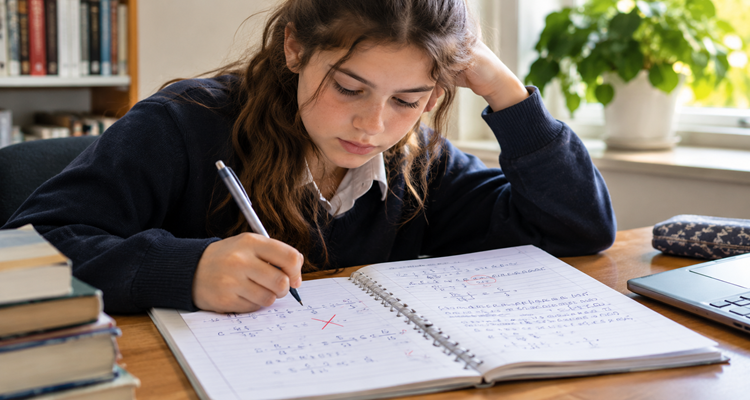
Some of the most important changes in learning happen before students can explain them. A corrected mistake may reveal growing skill, but it does not always mean the underlying concept has been understood.
A student solves a mathematics problem incorrectly on Monday. On Tuesday, the teacher points out the error and demonstrates the correct method. By Wednesday, the student completes a similar problem without making the same mistake.
It looks like progress, and it probably is.
But when asked why the method works, the student struggles to explain. Change the numbers, rearrange the question, or introduce an unfamiliar example, and the old confusion may return.
This reveals an important distinction in education: students can learn to avoid a mistake before they fully understand the reasoning behind the correct answer.
They may recognize a familiar pattern, remember a correction, imitate a demonstrated procedure, or respond to feedback. These abilities are valuable parts of learning. Yet none of them, by itself, proves that a student has developed a flexible understanding of the subject.
For teachers, parents, and students, recognizing this difference can change how progress is measured and how learning is supported.
Why a Correct Answer Does Not Always Mean Understanding
Consider a student learning to add fractions.
Initially, the student writes:
The student has added the numerators and denominators separately, applying a familiar operation in an inappropriate way.
After correction, the student learns to find a common denominator:
The next five problems are answered correctly.
Has the student understood fractions?
Possibly. But another explanation is that the student has memorized the steps without understanding why the denominators must represent equal-sized parts before the quantities can be combined.
A student with stronger conceptual understanding could explain that one-half and one-third refer to differently sized pieces of the same whole. Converting both fractions into sixths makes the pieces comparable.
The distinction matters because performing a procedure and understanding its meaning are related but different accomplishments.
A student might become proficient at a procedure through practice and gradually develop the conceptual knowledge that explains it. Another student might understand the concept but make occasional computational errors.
Neither situation can be judged reliably from one answer.
The Mistakes That Often Disappear First
Some errors are relatively easy to correct because they involve recognizable routines, clear feedback, or specific instructions. Their disappearance may indicate useful learning without necessarily establishing deeper understanding.
1. Repeating a familiar procedural error
A student repeatedly forgets to change the sign when subtracting a negative number.
After several corrections, the student remembers the rule and stops making the mistake.
That improvement matters. The student has learned a procedure that can support further mathematical work.
But the student may still be unable to explain why subtracting a negative number is equivalent to adding its positive counterpart.
To investigate understanding, a teacher might use a number line or ask the student to compare related expressions.
The important question is not whether the memorized rule is useful. It is whether the student can connect the rule to the mathematical relationship it represents.
2. Choosing an answer that looks familiar
Multiple-choice questions can reward recognition.
A student may learn that certain words, diagrams, or question structures usually accompany a particular answer. Over time, this recognition can improve performance.
For example, a science student might correctly identify evaporation as the process in which liquid water becomes water vapor.
Yet when asked why a wet towel can dry without boiling, the student may struggle to connect the term to the movement and escape of molecules at the liquid’s surface.
Recognizing the correct vocabulary is a legitimate achievement. Explaining the mechanism requires an additional level of understanding.
3. Avoiding mistakes after repeated correction
Feedback can change behavior quickly.
A student who repeatedly receives comments about missing units may begin writing centimeters, kilograms, or seconds beside every numerical answer.
That is a useful habit.
However, the student might still be uncertain about why units matter, how they relate to measurement, or how to check whether a calculated answer has sensible dimensions.
The correction has improved the student’s work. The remaining task is to connect that improvement to meaning.
4. Following a successful example too closely
Worked examples can help students learn unfamiliar procedures by showing how a problem is solved.
But students sometimes become dependent on the visible structure of an example.
A student might solve a physics problem correctly when the unknown quantity appears in the same position as it did in the teacher’s demonstration.
When the problem asks for a different variable, the student may not know how to rearrange the relationship.
This does not mean worked examples are ineffective. It means students may need opportunities to compare examples, explain decisions, and solve problems that differ from the original demonstration.
5. Learning which answers teachers expect
Students also learn classroom expectations.
They discover which explanations receive approval, which words are rewarded, and how answers should be presented.
A student might learn to write that a historical event had political, economic, and social causes because that structure consistently earns positive feedback.
Yet the student may still have difficulty identifying which causes mattered most in a particular situation or explaining how they interacted.
A well-organized answer can therefore demonstrate progress in academic communication without necessarily demonstrating equally strong historical reasoning.
The solution is not to discourage clear structures. It is to ensure that students use them to organize genuine thinking rather than replace it.
Why Students Can Improve Before They Can Explain
Learning is not a single process in which understanding always comes first and correct performance follows.
Knowledge and skill can develop through several interacting processes.
One involves procedural knowledge: knowing how to carry out a task.
Another involves conceptual knowledge: understanding the principles, relationships, or meanings that help explain why a procedure works.
A third involves recognizing when and where knowledge should be applied.
These abilities can develop at different rates.
A student may learn a mathematical algorithm through repeated practice, then begin to understand its logic after seeing it used in different situations. Another student may first develop an intuitive grasp of a concept and later learn an efficient formal procedure.
Research by Bethany Rittle-Johnson, Robert Siegler, and Martha Alibali has described conceptual and procedural knowledge as developing through a reciprocal relationship. Growth in one can support growth in the other.
That challenges a simplistic view in which students must always understand a principle completely before practicing a procedure—or must always master a procedure before exploring its meaning.
In many cases, learning develops through movement between doing, noticing, explaining, and revising.
The Difference Between Remembering a Correction and Understanding It
Imagine two students who initially make the same algebra mistake.
Both are taught how to solve:
Both subsequently produce the correct answer:
The first student remembers a sequence: divide by three, subtract two, and write the answer.
The second student can also explain that dividing both sides by three preserves equality, leaving \(x+2=6\), and that subtracting two from both sides isolates the unknown.
On the original question, their performance looks identical.
To discover whether their understanding differs, a teacher could ask them to solve:
This expression changes the nature of the task. Instead of producing a single value, the student must recognize that both sides are equivalent for every value of \(x\).
A student relying on the expectation that every equation has one numerical solution may become confused.
A student who understands equality as a relationship has a stronger basis for recognizing what makes this equation different.
This is why unfamiliar examples can reveal aspects of learning that routine exercises conceal.
It is also why a student should not be judged as lacking understanding simply because one unfamiliar problem proves difficult. Reading demands, anxiety, working memory, and the novelty of the presentation can all affect performance.
The goal is to gather better evidence, not to turn every question into a trap.
What Educational Research Tells Us About This Gap
The distinction between correct performance and deeper understanding is supported by several areas of learning research.
In a 2001 study published in the Journal of Educational Psychology, Rittle-Johnson, Siegler, and Alibali investigated how conceptual understanding and procedural skill develop in children learning about decimal fractions.
Their experiments with fifth- and sixth-grade students found evidence of a two-way relationship: conceptual knowledge helped predict improvements in procedural knowledge, while procedural gains were associated with later improvements in conceptual knowledge.
The findings support an important possibility: learning how to perform a task can contribute to understanding why it works, rather than merely following understanding.
A student who succeeds only when a problem closely resembles a practiced example may have learned something useful, but their knowledge may not yet be flexible enough for unfamiliar situations.
Importantly, transfer is not an all-or-nothing test. Students sometimes need additional support or experience with a new situation before they can apply what they already know.
Together, these findings suggest that correct answers, explanations, retention, and application provide different kinds of evidence about learning.
How Teachers Can Tell Whether Understanding Is Developing
Teachers do not need to abandon routine exercises or demand elaborate explanations for every answer.
Instead, they can use a combination of questions that reveal different aspects of students’ knowledge.
| What to check | Example question | What it may reveal |
|---|---|---|
| Procedural accuracy | Can you solve this problem? | Whether the student can perform the task |
| Explanation | Why does this step work? | Whether the student understands relevant relationships |
| Error detection | What is wrong with this solution? | Whether the student can evaluate reasoning |
| Transfer | Can you solve a different version? | Whether knowledge applies beyond a familiar example |
| Retention | Can you solve it next week? | Whether the learning persists over time |
No single question gives a complete picture. A more dependable assessment considers several kinds of evidence, ideally across more than one occasion.
Ask students to compare two solutions
Instead of asking only for the correct answer, present two methods.
One might be valid but inefficient. Another might contain a subtle misconception.
Ask students which method works, whether both are acceptable, and how they know.
This encourages attention to the relationships behind the procedure rather than only the final result.
Change one important feature of the problem
A student who has mastered a familiar format should gradually encounter meaningful variations.
In mathematics, this might mean changing which quantity is unknown.
In science, it might mean applying a principle to a different physical situation.
In reading, it might mean identifying an author’s argument in a text with an unfamiliar structure.
The variation should be purposeful and appropriate to the student’s current knowledge. Making a problem unnecessarily complicated does not automatically make it a better assessment.
Ask for predictions before explanations
Students can sometimes reveal their reasoning more clearly through a prediction than through a formal definition.
For example, before demonstrating what happens when two objects of different masses fall in a vacuum, a teacher could ask students to predict the outcome and explain their expectations.
The prediction helps reveal existing ideas that instruction can address.
When the result differs from a student’s expectation, the teacher can guide the student toward a more accurate explanation rather than simply supplying the correct statement.
Why Practice Still Matters Even Without Complete Understanding
It would be a mistake to conclude that memorization, repetition, and procedural practice are unimportant.
Students need reliable knowledge and skills that they can use without repeatedly reconstructing every step.
Fluency with basic arithmetic, vocabulary, spelling, and familiar procedures can make more demanding tasks manageable.
The problem arises when successful repetition is treated as the end of learning rather than one part of it.
A major 2013 review by John Dunlosky and colleagues examined ten commonly used learning techniques. The researchers rated practice testing and distributed practice spreading learning opportunities over time—as particularly useful across a broad range of learning conditions.
The review also discussed self-explanation, in which learners explain their reasoning or connect new material to existing knowledge, as a potentially valuable technique, although its evidence base was more limited than that of practice testing and distributed practice.
A later meta-analysis published in Frontiers in Education also found strong overall support for distributed practice and practice testing among the techniques it examined.
For classroom practice, this points toward a balanced approach: help students become accurate and fluent, but also create opportunities to explain, compare, remember, and apply what they have learned.
When Fewer Mistakes Can Create False Confidence
An especially interesting problem occurs when students interpret improved performance as proof that they have mastered a subject.
Suppose a student completes twenty nearly identical exercises.
The first five are difficult. The next five become easier. By the final ten, the student works quickly and accurately.
That experience can create a reasonable sense of accomplishment.
However, the improvement may partly reflect growing familiarity with the immediate task. The student has repeatedly encountered the same cues, procedures, and response patterns.
When those cues disappear, performance may decline.
This does not make the original practice worthless. It means that immediate fluency and durable learning are not identical.
Research on learning strategies helps explain why revisiting material after a delay can be useful. Distributed practice generally supports longer-term retention better than concentrating the same learning opportunities into one short period.
Students can therefore benefit from returning to a topic after several days, attempting problems without looking at worked examples, and mixing previously learned material with newer tasks.
These activities provide information that a successful practice session alone cannot.
What Students Can Do When They Keep Getting the Right Answer
Students do not need to distrust every correct answer. Instead, they can use success as an opportunity to check what they actually know.
After solving a problem, they can ask themselves:
-
Could I explain this answer without repeating the teacher’s exact words?
-
Would I recognize when this method should not be used?
-
Can I identify why a plausible alternative answer is incorrect?
-
Could I solve a related problem without looking at an example?
-
Would I still remember the method after a few days?
A student does not need to answer every question perfectly.
The purpose is to identify the next useful step.
If the procedure is accurate but the explanation is weak, the student can explore the underlying principle.
If the explanation is strong but execution is unreliable, additional procedural practice may help.
If both are strong in familiar examples but weaker in unfamiliar ones, the student may benefit from varied applications.
This approach treats mistakes as information about learning rather than simply as evidence of failure.
The Important Role of Feedback
Feedback is often most useful when it helps students understand what to change and why.
Consider two responses to a student’s incorrect answer.
The first says:
Incorrect. The answer is 24.
The second says:
You multiplied correctly, but you treated the two quantities as though they used the same unit. Check the conversion before calculating again.
Both identify a problem, but the second gives the student more information about the reasoning that needs attention.
Effective feedback need not always be lengthy. Sometimes a short hint or a carefully chosen question is enough.
What matters is that feedback helps the learner make progress toward the intended knowledge or skill.
There is also a difference between correcting a mistake for a student and helping the student recognize the mistake independently.
A student who can eventually detect and repair an error without external prompting has developed a valuable capacity for monitoring their own work.
Why Understanding Is Not Always Easy to Put Into Words
There is one more complication: students may understand more than they can explain verbally.
A younger child might successfully compare quantities using objects but struggle to describe the mathematical principle in formal language.
A student learning in an additional language might reason accurately while finding the required academic vocabulary difficult.
Another student might demonstrate understanding through a diagram, experiment, or practical task more effectively than through an immediate spoken explanation.
For this reason, the inability to give a polished explanation should not automatically be treated as evidence of shallow understanding.
Teachers can look for understanding through different forms of response, including demonstrations, diagrams, comparisons, written reasoning, and appropriate applications.
The aim is to assess the intended knowledge rather than accidentally measuring only verbal confidence or familiarity with a particular assessment format.
The Real Sign of Progress Is Greater Flexibility
A student who stops making a familiar mistake has achieved something meaningful.
The student may have learned a rule, improved attention, strengthened recall, or developed a more reliable procedure.
Those improvements deserve recognition.
But deeper learning becomes more visible when students can use their knowledge flexibly: recognizing when a method applies, explaining important relationships, identifying errors, and adapting to problems that do not look exactly like the ones they practiced.
This kind of understanding does not always arrive in a sudden moment of insight. It can emerge gradually as practice, feedback, reflection, and new experiences reinforce one another.
The disappearance of a mistake may therefore be neither the beginning nor the end of understanding. It may be one step in a longer process.
And that leads to a more useful question for education.
Instead of asking only, Has the student stopped getting this wrong?
We can also ask, What can the student now understand, explain, recognize, and do that was not possible before?
That question gives learning room to become more than the absence of errors.
The information presented in this article is based on publicly available sources, reports, and factual material available at the time of publication. While efforts are made to ensure accuracy, details may change as new information emerges. The content is provided for general informational purposes only, and readers are advised to verify facts independently where necessary.
Related News
- The Skills You Never Realise You Learned Until the Person Who Taught You Is Gone
- The Knowledge That Vanishes When Nobody Needs to Teach It Anymore
- The Questions Children Stop Asking When School Teaches Them to Be Correct
- The Knowledge You Gain Outside the Classroom Can Change What You Learn Inside It