










Why Students Need to Learn When to Stop Studying
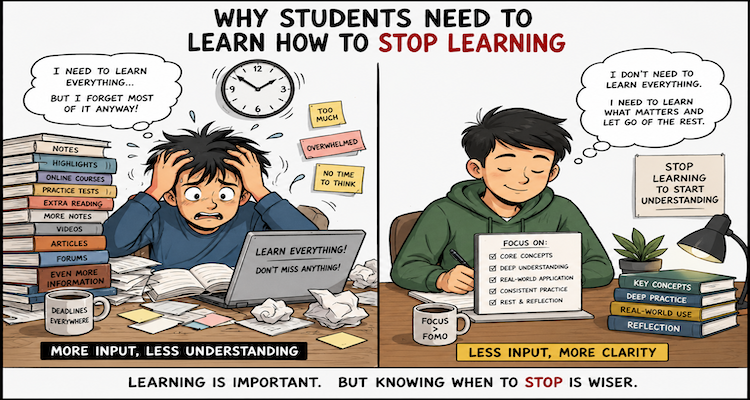
A student can spend three hours with a textbook open and still learn less than someone who spends one hour studying differently. The problem is not always a lack of effort. Sometimes the problem is knowing when to stop taking information in and start doing something with it.
Research on learning has repeatedly identified a counterintuitive pattern: methods that feel easy and productive can produce weaker long-term learning, while methods that feel harder can produce better retention and transfer. Retrieval practice, spaced study and other forms of “desirable difficulty” can make students feel less fluent during practice even as they improve what they can remember later.
That makes “stop learning” an intentionally provocative phrase. Students should not stop learning. They need to learn when to stop consuming explanations, rereading notes and collecting more information and when to stop studying and test what they actually know.
Key Takeaways
- More exposure to information does not automatically produce better learning or stronger understanding.
- Retrieval practice forces students to discover what they can actually recall rather than what merely looks familiar.
- Productive struggle can improve conceptual understanding and transfer when it is followed by effective instruction.
- Students often misjudge learning because familiarity and confidence can feel like mastery.
- A useful study session should include deliberate stopping points where students retrieve, explain, solve and apply.
- Learning efficiently requires knowing not only what to study, but when additional study has diminishing value.
The Difference Between Studying and Learning
Studying is an activity. Learning is a change in what a student can understand, remember or use.
The distinction matters because many familiar study behaviors provide immediate evidence that something is happening without necessarily demonstrating durable learning.
Rereading a chapter can make the material feel increasingly familiar. Highlighting can make a page look organized. Watching another explanation can make a difficult concept seem clearer. None of those experiences, by themselves, proves that a student can reproduce the idea without assistance or use it in a new situation.
A major review of learning techniques published in Psychological Science in the Public Interest rated rereading and highlighting as relatively low-utility strategies compared with practice testing and distributed practice. The authors did not argue that rereading is completely useless; rather, its benefits were less consistent than those of more active approaches.
That distinction suggests a better question for students:
“What can I do with this knowledge without looking at the answer?”
Once that question becomes part of studying, the meaning of “stop” changes.
Stop Rereading and Start Retrieving
One of the clearest findings in learning research concerns retrieval practice: attempting to recall previously studied information can strengthen later retention.
A 2021 systematic review examined 50 experiments involving more than 5,000 participants in actual school and classroom settings. The majority of the reported effect sizes showed medium or large benefits from retrieval practice, although the researchers also noted limitations in the existing evidence base, including the small proportion of studies conducted outside WEIRD Western, educated, industrialized, rich and democratic countries.
The practical difference is simple.
A student studying biology might read a page about cellular respiration several times. An alternative is to close the book and answer:
- What is cellular respiration?
- What are its major stages?
- Where does each stage occur?
- Why is oxygen important in aerobic respiration?
- Can I explain the process without looking at my notes?
The second approach may feel worse.
That is precisely why it can be useful.
Research on “desirable difficulties” describes learning conditions that initially make performance harder but can improve long-term retention and transfer. Spacing, retrieval practice and interleaving are among the commonly studied examples.
The student who struggles to reconstruct an answer has obtained something that rereading can hide: information about what has not yet been learned well enough.
The Moment of Struggle Is Information
Students often interpret difficulty as evidence that they are failing.
Sometimes it is.
But sometimes difficulty is evidence that the brain is being required to retrieve, discriminate, connect or apply information rather than simply recognize it.
This distinction is important.
Research on desirable difficulties shows that performance during learning is not always a reliable measure of later learning. A method that produces smooth, accurate performance during practice can produce weaker delayed performance than a more challenging method.
That creates an uncomfortable situation for students and teachers: the activity that looks better in the classroom may not always be the activity that produces the strongest learning later.
A student who answers every question correctly while following an example may feel highly competent. A student who struggles to solve a new problem independently may feel less successful.
Yet the second student may be doing more cognitively demanding work.
The answer is not to make every lesson unnecessarily difficult. Desirable difficulty is not the same thing as confusion, poor teaching or arbitrary struggle. The challenge has to be appropriate to the learner and the task.
Sometimes Students Should Try Before They Are Taught
Another important line of research comes from “productive failure.”
In a 2014 study of mathematical learning, Manu Kapur compared students who were taught a concept before solving problems with students who attempted to solve problems before receiving formal instruction. Both approaches produced strong procedural knowledge, but the students who attempted problem solving first showed greater conceptual understanding and better transfer to novel problems in the reported experiments.
The finding does not mean teachers should abandon instruction and simply let students struggle.
The important sequence is different:
Attempt → encounter limitations → receive instruction → reorganize understanding → apply again.
The failed attempt can expose misconceptions and create a need for the explanation that follows.
This is one reason “stop learning” can also mean knowing when to stop being a passive recipient of explanations.
Before watching the fifth tutorial on a programming concept, for example, a student might first attempt to build a small program using what they already know. The errors then become specific questions.
Instead of asking, “How does this work?”
the student can ask:
“Why did my approach fail here?”
That is a much more productive learning problem.
Students Also Need to Stop When They Think They Know
There is another reason stopping matters: students are not always accurate judges of their own learning.
Research on metacognitive monitoring has found that learners can overestimate their performance, while interventions designed to improve monitoring accuracy can produce improvements. A 2020 study, for example, reported that metacognitive training improved monitoring and performance beyond the effects of repeated testing in its experimental context.
A 2024 meta-analysis covering 35 studies found a small overall positive effect of interventions intended to improve students’ monitoring accuracy, while also finding differences depending on the type of intervention and learner group.
This explains a familiar study experience.
A student reads a definition five times and thinks:
“I know this.”
Then the book closes.
The definition disappears.
The problem was not necessarily memory failure alone. The student had been judging familiarity with the material as evidence of mastery.
A better stopping rule is therefore not:
“I have read this enough.”
It is:
“I can explain this without the material, solve a new problem with it, or teach the idea clearly.”
The Skill Students Need Is Not Less Learning
The phrase “stop learning” can easily be misunderstood.
The goal is not intellectual laziness. It is not encouraging students to study less regardless of the subject. It is not an argument against reading, lectures, teachers or explanations.
It is an argument for better transitions between learning activities.
A useful study cycle might look like this:
- Learn: Read, listen to an explanation or study an example.
- Stop consuming: Put the material away.
- Retrieve: Write or say what you remember.
- Check: Compare your answer with reliable material.
- Diagnose: Identify what you misunderstood or forgot.
- Apply: Solve a problem or use the concept in a new context.
- Return later: Revisit the material after some time rather than immediately repeating the same exposure.
The research literature supports several parts of this approach, particularly retrieval practice and distributed practice.
The important change is that studying stops being measured mainly by time spent exposed to information.
What This Means for Students in an AI-Saturated Classroom
The question becomes even more relevant when information is easy to obtain.
A student can now ask an AI system for an explanation, request another explanation, generate examples, obtain a summary and ask for a simpler version almost instantly. That convenience can be useful, but it also creates a new learning risk: continuing to receive explanations can feel like continuing to learn.
The critical skill is knowing when to close the explanation and attempt the task independently.
For example, a student learning programming could ask an AI assistant to explain recursion. That may provide an efficient introduction. But the learning test begins afterward:
Can the student explain recursion without the AI?
Can they write a recursive function without copying the generated code?
Can they identify why a recursive solution fails?
Can they modify it for a slightly different problem?
Can they decide when recursion is appropriate rather than merely reproduce an example?
Those questions move the student from information consumption to knowledge performance.
AI can therefore become either a shortcut around thinking or a tool that supports thinking, depending on what happens after the explanation.
The same principle applies outside technology. A history student can stop reading and reconstruct an argument. A language learner can stop reviewing vocabulary and retrieve words from memory. A physics student can stop watching worked examples and attempt a new problem.
The critical moment is the transition.
A Better Definition of “Done Studying”
Students rarely receive a clear stopping rule.
They are told to revise more, practice more and prepare more. That advice makes sense when a deadline is approaching, but “more” is not a particularly precise learning strategy.
A better definition of completion is performance-based.
A student may be ready to move on when they can do some combination of the following:
- Explain the central idea without notes.
- Retrieve important facts or concepts after a delay.
- Solve representative problems independently.
- Explain why an answer is correct.
- Recognize where their own understanding is uncertain.
- Apply the concept to an unfamiliar example.
- Correct an error after receiving feedback.
This does not mean every topic requires perfect mastery before moving forward. Learning is cumulative, and some concepts become clearer only after students encounter related ideas later.
The point is to replace time as the only measure of studying with evidence of what the student can actually do.
The Educational Lesson: Teach Students How to Stop
Schools often teach students what to learn.
They should also teach students how to regulate learning itself.
That includes recognizing when rereading has stopped adding much, when another explanation is unnecessary, when a difficult problem should be attempted before asking for help, when retrieval reveals a gap, and when enough information has been gathered to begin applying it.
This is closely connected to metacognition: students need to monitor their own understanding and make decisions about what to do next. Research suggests that such monitoring is important but imperfect, and that it can be improved through targeted interventions.
The deeper lesson is therefore not that students should spend less time learning.
It is that learning requires knowing when one kind of learning activity has finished and another should begin.
A student who continually consumes information can remain busy without becoming more capable.
A student who knows when to close the book, put away the notes, stop asking for explanations and attempt the problem has created an opportunity to discover what they actually know.
That moment of stopping may be where much of the real learning begins.
Conclusion
Students do not need to stop learning. They need to stop confusing continued exposure with continued learning.
The evidence on retrieval practice, spacing, desirable difficulties, productive failure and metacognitive monitoring points toward a more active model: learn something, step away from the source, retrieve it, test it, struggle with it, correct it and apply it.
The most useful stopping point is therefore not the moment when a student feels familiar with the material.
It is the moment when they are ready to find out whether they can use it without help.
That is a small change in study behavior, but a significant change in what students are being taught to do: not simply collect knowledge, but become capable of retrieving, questioning and using it.
The information presented in this article is based on publicly available sources, reports, and factual material available at the time of publication. While efforts are made to ensure accuracy, details may change as new information emerges. The content is provided for general informational purposes only, and readers are advised to verify facts independently where necessary.