





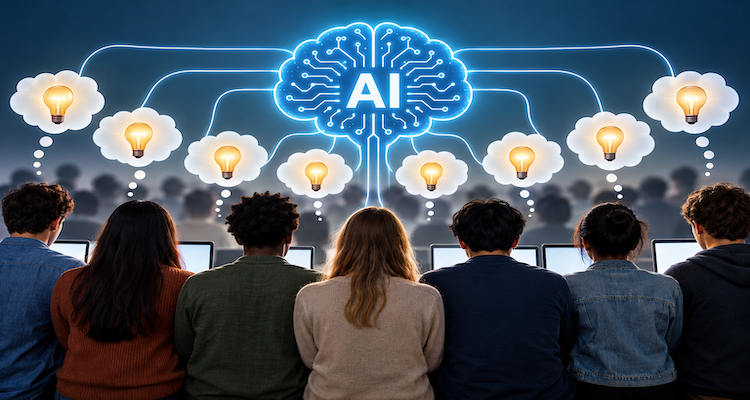



Why AI Could Make Human Taste More Valuable
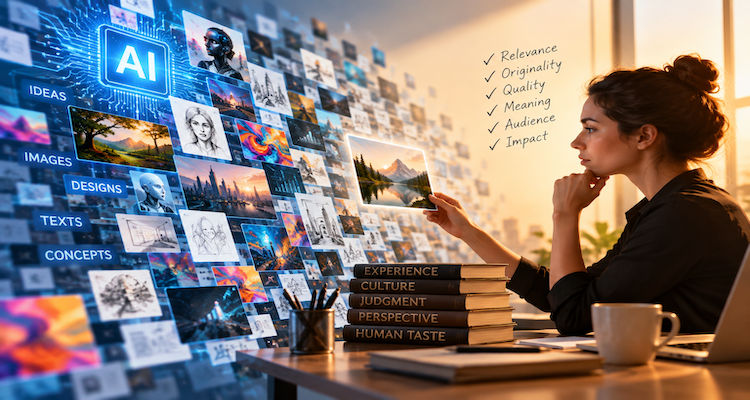
Generative AI is making something that once required considerable time increasingly cheap: producing things.
A marketer can generate dozens of campaign concepts. A designer can explore hundreds of visual directions. A writer can produce multiple versions of an article in minutes. A product team can ask an AI system for ideas, alternatives, names and explanations almost without friction.
That abundance creates an unexpected problem.
When everyone can generate more, generation itself becomes less distinctive. The scarce resource may shift from the ability to produce an option to the ability to recognize which option is worth keeping.
That is where human taste becomes more valuable.
Taste, in this context, does not simply mean liking expensive clothes, good films or sophisticated design. It means having a developed sense of what is appropriate, interesting, meaningful, memorable or worth pursuing and being able to make choices among many plausible alternatives.
AI may make those choices more important, not less.
When production becomes abundant, selection becomes difficult
For much of the digital era, producing content was a bottleneck.
Writing a polished article took time. Creating an illustration required technical skills. Producing a marketing campaign involved teams of people. Even generating a large number of alternatives could be expensive.
Generative AI changes the economics of that process.
Research from the U.S. National Bureau of Economic Research found that generative AI adoption was already unusually rapid: by late 2024, nearly 40% of Americans aged 18–64 surveyed were using generative AI, while 23% of employed respondents had used it for work during the previous week.
The significance is not merely that AI can produce more. It is that the cost of exploring possibilities is falling.
That changes what humans need to contribute.
Imagine a creative director receiving 500 possible campaign concepts instead of five. The challenge is no longer simply imagination. It is knowing which three deserve attention, which 50 should be rejected immediately and whether the best-looking idea actually fits the brand.
The bottleneck moves from making options to judging them.
AI can improve creativity while making creative work more similar
There is an important paradox here.
AI assistance can genuinely improve individual creative performance. A 2026 experimental study involving 302 university students found that access to ChatGPT improved performance on creative picture-ideation tasks, although the size of the benefit varied with participants’ existing creative potential.
But better individual results do not necessarily mean greater collective originality.
A 2025 study examining 2,200 college-admissions essays found that each additional human-written essay contributed more new ideas to the overall collection than an additional GPT-4-generated essay. The researchers concluded that widespread LLM use could reduce the diversity of creative ideas even when individual AI-assisted outputs appear strong.
Other experiments have reported a similar tension: AI-assisted stories can be judged as better written while becoming more alike.
This distinction matters.
If ten people independently use the same powerful system to solve the same problem, they may all receive competent answers. Competence rises. Difference can fall.
And once competent output becomes abundant, difference becomes more valuable.
Taste is partly the ability to resist the obvious
AI systems are exceptionally good at giving users plausible possibilities. But a plausible possibility is not necessarily an original or appropriate one.
Human taste often reveals itself through rejection.
A good editor knows when a sentence is technically correct but lifeless. A good designer can see that a visually impressive layout feels wrong for the audience. A good filmmaker may understand that a conventional ending would weaken the entire story. A good entrepreneur can recognize that a technically attractive product solves a problem nobody urgently has.
These judgments are difficult to reduce to a checklist because they depend on context.
They draw on accumulated exposure, cultural awareness, personal experience, professional standards and an understanding of what an audience actually cares about.
That does not make human taste magical or infallible. People have biases, blind spots and fashionable prejudices too.
But it does make taste a potentially important differentiator in an environment filled with machine-generated options.
The most valuable human may be the person who knows what not to make
There is a temptation to think that AI will reward people who can produce the most.
The more interesting possibility is that it will reward people who can choose well.
Consider a hypothetical magazine editor. Before generative AI, the editor might spend much of the day commissioning, drafting, rewriting and coordinating production. With AI handling some of those tasks, the editor could theoretically review far more potential stories.
But that creates a new responsibility.
Which story deserves publication?
Which angle has already been exhausted?
Which statistic changes the reader’s understanding?
Which argument sounds impressive but is actually weak?
Which image communicates something rather than merely looking attractive?
Which piece has a point of view?
The editor’s value increasingly lies in answering those questions.
The same pattern can appear in software, advertising, product design, filmmaking, architecture, fashion and even ordinary office work.
AI can increase the number of things a person can make. Taste determines what is worth making.
Taste also needs experience
There is a danger in treating taste as something that can simply be added to an AI workflow through better prompting.
Prompting can help. But judgment usually develops through exposure and practice.
Someone who has read thousands of articles develops a different sense of structure from someone who has read a few dozen. A designer who has studied decades of visual work has a larger reference library than someone encountering design principles for the first time. A developer who has maintained software for years recognizes failure patterns that may not be obvious in a generated code sample.
This is one reason excessive delegation can be problematic.
A 2025 experiment involving 225 university students found that ChatGPT-assisted creative writing improved several measures of output performance while making the task feel less effortful and less intellectually demanding to participants.
The lesson is not that people should stop using AI.
It is that outsourcing every difficult judgment can weaken the very experience through which judgment develops.
If AI always chooses the restaurant, writes the first idea, selects the photograph, proposes the product direction and explains the argument, the user may become faster without necessarily becoming better at choosing.
That distinction could become increasingly important.
The future may belong to people with strong filters
The emerging advantage may therefore be neither purely human creativity nor pure AI capability.
It may be human direction combined with machine abundance.
Recent research on human-AI collaboration supports this more nuanced view. A 2025 NBER field experiment involving 776 professionals found that AI could substantially improve performance on product-innovation work, with individuals using AI matching the performance of teams without AI in the experiment.
At the same time, research into creative collaboration suggests that the way humans participate matters. One study found that designs preserving human creative input produced stronger outcomes than workflows in which people were mainly reduced to confirming AI output.
This points toward a useful division of labor.
AI can expand the search space. Humans can define the destination.
AI can produce variations.
Humans can establish standards.
AI can surface possibilities.
Humans can decide which possibilities matter.
AI can make mediocre production cheap.
Humans can make meaningful selection valuable.
That does not mean every human decision will be superior. Nor does it mean AI-generated work will inevitably become generic. Research is already exploring ways to deliberately increase diversity in AI-assisted creative processes, including the use of varied AI personas and prompts.
The future is therefore unlikely to be a simple contest between “human creativity” and “machine creativity.”
It may instead be a contest between indiscriminate generation and intelligent selection.
And that is why human taste could become more valuable precisely when AI becomes better at making things.
When everyone has access to an almost limitless supply of competent possibilities, the rare skill is knowing which possibility deserves to exist.
The next generation of creative advantage may belong not to the person who can produce the most but to the person whose choices make the abundance meaningful.
This content is published for informational or entertainment purposes. Facts, opinions, or references may evolve over time, and readers are encouraged to verify details from reliable sources.