









The AI Problem Nobody Notices Until Everyone Starts Thinking the Same Way
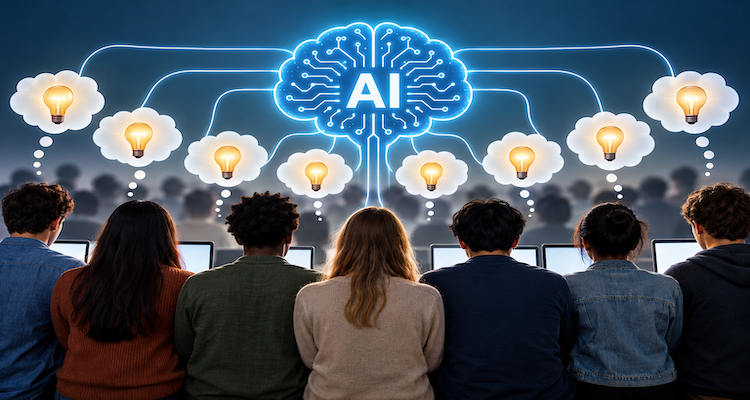
Imagine asking 100 people to develop an idea for a new business, write a short story, or explain a complicated social issue. Each person brings a different background, set of experiences, and way of understanding the world.
Now imagine that all 100 people turn to artificial intelligence for help.
Their answers might become clearer. Their ideas might sound more professional. Some people may discover possibilities they would never have considered alone.
But something less obvious could happen, too: their ideas might begin to resemble one another.
The problem is not necessarily that artificial intelligence produces bad ideas. It is that a tool capable of helping millions of people think and create could gradually make their outputs more alike.
Researchers have begun investigating this possibility, known as cognitive and creative homogenisation. The concern deserves attention because the value of human intelligence lies not only in producing good answers, but also in producing different answers to the same question.
And as AI becomes part of everyday writing, education, business, and decision-making, that difference may matter more than we realise.
When Better Individual Results Produce a Less Diverse World
One of the most interesting findings in AI research is that improvements for individuals do not necessarily translate into improvements for society as a whole.
A 2024 study published in Science Advances, by researchers Anil R. Doshi and Oliver P. Hauser, examined how generative AI affected people’s creative writing.
The researchers conducted an experiment involving 293 participants who wrote short stories. Some participants received ideas generated by AI, while others worked without AI assistance.
The results revealed a striking trade-off. AI-assisted stories were generally judged to be more creative, better written, and more enjoyable, particularly when the writers were less naturally creative. Yet the AI-assisted stories were also more similar to one another than stories written without AI assistance. Read the study in Science Advances.
In other words, AI helped individuals improve their work while potentially reducing the variety of work produced by the group.
This distinction is important.
If one writer uses AI to develop a stronger story, the outcome may be beneficial. If thousands of writers use similar systems to develop their stories, however, the collective result could contain fewer genuinely different ideas.
The same tension could arise in marketing, product design, journalism, education, and other fields where originality matters.
The question is not simply whether AI makes each person more productive. It is whether widespread AI use makes the entire population more productive at producing similar things.
That is a much bigger question than individual performance.
Why Different People Can End Up With Similar Ideas
Human beings do not approach problems from identical starting points.
A teacher might interpret a problem through the needs of students. An engineer might look for a technical solution. An entrepreneur might focus on commercial opportunities, while an artist might see a chance to challenge established assumptions.
These differences are not distractions from good thinking. They are often the source of new ideas.
Generative AI introduces a different dynamic.
Large language models learn patterns from enormous collections of existing material. They use those learned patterns to generate responses that fit a prompt. Although their outputs can be varied, the systems may repeatedly favour familiar approaches, widely represented concepts, and conventional ways of expressing ideas.
When different people ask similar questions of the same model, they can receive overlapping suggestions.
Researchers have found evidence of this effect in controlled experiments.
A 2024 study by Barrett R. Anderson, Jash Hemant Shah, and Max Kreminski compared people’s creative ideas when they used ChatGPT with ideas produced using a non-AI creative tool.
The study involved 33 participants in its final analysis. Although ChatGPT users generated more detailed ideas and performed better on some measures of creative productivity, their ideas were more similar to one another at the group level. The researchers did not find the same difference in similarity within each individual participant’s set of ideas. Read the research paper.
The distinction reveals a subtle risk.
A person may feel creative because AI helps them generate more possibilities. Yet if many people receive similar starting points, their individual improvements may not translate into greater collective diversity.
This does not mean that AI always produces predictable results. The effects depend on the task, the model, the prompts, and how people use the output.
But it does suggest that measuring creativity only by the quality or quantity of individual results misses something important.
We also need to ask how different those results are from everyone else’s.
The Hidden Influence of a Helpful Answer
AI does not need to force anyone to accept an idea to influence how they think.
Sometimes, the influence begins simply by providing a starting point.
Imagine a designer who wants to create a new product. Before consulting AI, the designer might explore unusual materials, personal experiences, customer frustrations, and unconventional solutions.
After asking an AI assistant for suggestions, the designer receives five polished concepts.
Those concepts may be useful. They may also establish an initial frame for the problem.
Instead of exploring the entire range of possibilities, the designer may begin refining the options already presented.
This is related to a phenomenon known as fixation: early examples or proposed solutions can constrain the ideas people consider later.
A similar effect can occur in writing. Once an AI system supplies an introduction, an argument, or a set of recommendations, it becomes easier to develop that material than to abandon it and start from a completely different perspective.
The danger is not that users necessarily accept every suggestion. It is that the suggestions can influence which possibilities receive attention in the first place.
A separate line of research highlights another concern: the language models used in collaborative writing can influence the content people produce.
In a study presented at the International Conference on Learning Representations in 2024, Vishakh Padmakumar and He He found that writing with an instruction-tuned language model reduced the lexical and content diversity of argumentative essays compared with writing without assistance. Their experiments did not find the same statistically significant reduction when participants used a base language model, illustrating that the effect can depend on the system involved. Read the ICLR study.
Together, these findings suggest that AI can influence not only what people write, but also the range of ideas they consider and ultimately express.
The effect may be subtle enough that users never notice it.
Their work looks better. Their arguments sound clearer. Their productivity increases.
Nothing appears to be wrong.
Yet the distance between their ideas and those of other people may be shrinking.
When Similar Thinking Becomes a Problem for Society
Creative diversity is not merely an artistic preference. Different perspectives can help groups identify problems, challenge assumptions, and discover solutions that a more uniform group might overlook.
Consider a company developing a new product.
If every team independently explores the problem, one group might identify a technical limitation, another might discover an overlooked customer need, and a third might challenge the assumptions behind the original idea.
Now imagine that every team begins its work by consulting the same AI system and receives similar recommendations.
The teams may become more efficient at evaluating familiar solutions. However, they could be less likely to explore alternatives that fall outside the model’s initial suggestions.
This is a hypothetical example, not proof that AI-assisted organisations will necessarily make worse decisions. AI can also introduce unfamiliar ideas, identify overlooked evidence, and help people challenge their own assumptions.
The risk emerges when the same tool becomes the default starting point for everyone.
At scale, a small tendency toward similarity could become more consequential if it influences what gets published, taught, funded, designed, or recommended.
The concern extends beyond creative industries. If people increasingly rely on similar systems to interpret complicated questions, the range of arguments entering public discussion could narrow.
That possibility should not be confused with evidence that AI is already making everyone think identically. Research on creative outputs cannot, by itself, establish that people’s underlying beliefs or reasoning have become uniform across society.
Nevertheless, the distinction between producing similar content and thinking identically may become harder to maintain when the same systems repeatedly shape how people formulate and express their ideas.
The issue is therefore not simply whether AI can generate diverse answers.
It is whether people and institutions will preserve meaningful diversity when using AI becomes the easiest and most familiar way to approach a problem.
The Solution Is Not to Stop Using AI
Artificial intelligence can make knowledge more accessible, help inexperienced creators overcome blank-page anxiety, and enable people to explore ideas beyond their immediate expertise.
Rejecting these benefits would be unnecessary.
A more useful response is to change how we work with the technology.
Start with independent thinking. Before asking AI to solve a problem, write down your own interpretation, questions, or possible solutions. This creates a starting point that is not entirely shaped by the model’s suggestions.
Ask for alternatives, not just improvements. Instead of requesting the best answer, ask for several approaches based on different assumptions, priorities, or perspectives. Compare them critically rather than automatically selecting the most polished option.
Look for missing perspectives. Ask what the initial answer overlooks, which assumptions it makes, and how someone with a different background or set of priorities might approach the problem.
Use AI to challenge your ideas. Ask it to identify weaknesses in your reasoning, present counterarguments, or develop the strongest case against your preferred conclusion. This can turn AI from a convenient source of answers into a tool for intellectual exploration.
Preserve human judgment and experience. An AI-generated suggestion should be a candidate for consideration, not an automatic replacement for independent analysis. Personal knowledge, professional expertise, cultural context, and firsthand experience can reveal details that a generic response misses.
These practices do not guarantee original thinking. Even a long list of AI-generated alternatives may remain within a narrow range of familiar ideas.
However, they help make the process more deliberate.
The objective is not to force AI to be different for the sake of difference. It is to ensure that the technology expands the range of possibilities people consider rather than quietly defining the boundaries of that range.
The Real Measure of AI Progress
For years, technological progress has been measured through familiar indicators: speed, accuracy, productivity, cost, and the quality of individual results.
These measures remain important. But they may be insufficient for a technology that increasingly participates in human creativity and decision-making.
We should also ask whether AI helps people discover ideas they would not otherwise have considered. Whether it supports perspectives that are less widely represented. Whether it encourages independent judgment rather than dependence on ready-made answers.
And whether the benefits of AI remain meaningful when millions of people use similar systems simultaneously.
A tool can improve individual performance while making the collective output less varied. The research on AI-assisted creativity offers evidence that this trade-off is possible, although its size and consequences depend on the context.
That is why the issue deserves attention before uniformity becomes an accepted feature of everyday work.
The most valuable contribution of human intelligence has never been that everyone can produce the same correct answer. It is that people can approach the same question from different directions, challenge one another’s assumptions, and discover possibilities that no single perspective would reveal.
Artificial intelligence can support that process.
But if we use it mainly to produce faster versions of familiar answers, we risk overlooking one of its most important responsibilities: helping us explore what we have not yet considered.
The future of AI should not be judged only by how intelligently it answers our questions. It should also be judged by whether it helps us keep asking different ones.
After all, progress depends not only on how well we think, but on how much room we leave for thinking differently.
Where Curiosity Finds Context.
This content is published for informational or entertainment purposes. Facts, opinions, or references may evolve over time, and readers are encouraged to verify details from reliable sources.