









Why People Are Designing Their Lives Around Energy Instead of Time
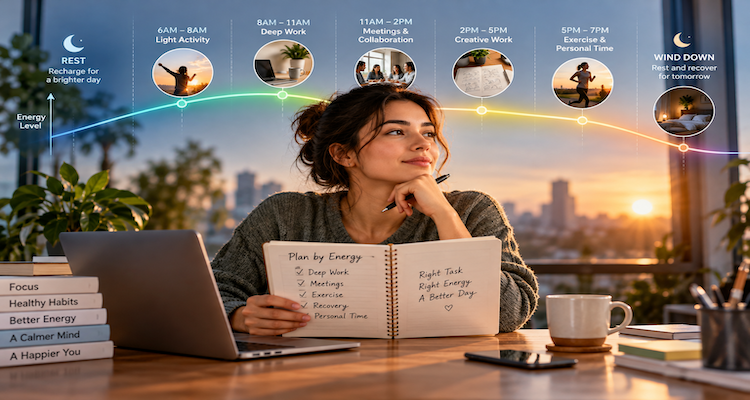
A calendar can tell you when to work, exercise, study or relax. It cannot tell you whether you will have the mental clarity to do those things well. That difference is changing how people think about productivity, personal routines and the relationship between time and performance.
The idea of energy-based living begins with a simple observation: an hour spent feeling alert and focused can be very different from an hour spent fighting fatigue and distraction. People are increasingly interested in arranging demanding tasks around their natural rhythms, protecting periods of concentration and treating recovery as part of productive work rather than an interruption.
This approach does not mean abandoning schedules or working only when motivation appears. It means understanding that time is a fixed resource, while the capacity to use it effectively changes throughout the day. Research into sleep patterns and chronotypes offers a scientific basis for part of this idea, although it does not support every popular claim about energy management.
Key Takeaways
- Time management allocates hours, while energy management considers the mental and physical capacity available to use them.
- Research suggests that people’s preferred sleep-wake rhythms can influence performance at different times of day.
- Matching demanding tasks to periods of greater alertness may help some people work more effectively.
- Breaks and recovery deserve a place in daily planning rather than being treated as rewards for finishing everything.
- Energy tracking can reveal personal patterns, but sleep, workload, health and workplace demands also matter.
- Energy-based planning works best alongside realistic deadlines, consistent routines and adequate rest.
Why Managing Time Does Not Always Improve Productivity
Traditional time management focuses on calendars, deadlines, task lists and priorities. These tools remain useful because they help people coordinate responsibilities and decide what deserves attention.
However, having time available does not guarantee having the capacity to use it well.
Consider two hours allocated to writing a report. During the first hour, someone may be alert, organized and able to evaluate complicated information. During the second, the same person may struggle to concentrate, reread paragraphs repeatedly or make avoidable mistakes.
The clock records two equal periods. The experience of working through them may be very different.
This distinction is particularly relevant to tasks that require sustained attention, complex reasoning, creativity or careful decision-making. When concentration declines, simply extending the working period may not produce an equivalent improvement in results.
Energy-based planning asks a different question: What kind of work can I reasonably do well with the attention and physical capacity I have at this moment?
The answer will not always be the same. Some tasks require deep concentration, while others involve routine administration, organizing files, responding to straightforward messages or preparing materials for later work.
Matching tasks to available capacity can make a schedule more realistic without pretending that difficult responsibilities can always be postponed.
What Science Says About Personal Energy Rhythms
The idea of planning around energy has a scientific connection to chronobiology, the study of biological rhythms.
One important concept is chronotype: an individual’s tendency toward earlier or later sleep-wake timing. People commonly describe themselves as morning people or night owls, although real patterns are more varied than these two labels suggest.
Research indicates that the time of day can influence alertness and certain aspects of cognitive performance, and that the relationship differs between individuals.
A 2018 study published in Sports Medicine Open examined 56 healthy volunteers classified as early or late chronotypes. Researchers assessed cognitive and physical performance at different times of day and found differences in performance patterns between the groups. The late chronotypes performed less well on the measured tasks in the morning than the early chronotypes.
A 2023 study of high school students also found that morning-type students performed better than evening-type students on a measure of crystallized intelligence during morning classes, while the same difference was not observed in afternoon classes.
These findings help explain why a rigid timetable may not suit everyone equally well. They do not establish that every individual has one universal daily peak or that scheduling work around subjective energy will automatically improve productivity.
Performance also depends on sleep duration, task difficulty, stress, environment and the amount of time a person has already spent working. Chronotype is one consideration, not a complete explanation of how people function.
The practical lesson is to observe individual patterns rather than assume that the earliest hours are always the most productive.
From Filling the Calendar to Matching Tasks With Capacity
Energy-based planning becomes useful when it changes everyday decisions.
Instead of dividing the day only into blocks of available time, a person can consider the demands of each task and the conditions needed to complete it well.
For example, someone who notices stronger concentration later in the morning might reserve that period for writing, analysis or programming. Routine emails and administrative work could be handled during a less demanding period, provided deadlines and colleagues’ needs allow it.
A student might use a period of greater alertness for difficult concepts and leave familiar revision tasks for another session. Someone working irregular shifts may need to build a routine around sleep and recovery rather than conventional office hours.
These are examples of how the principle could be applied, not guarantees of improved results. The appropriate schedule depends on the individual and the work involved.
A useful distinction is between three kinds of capacity:
- Mental energy: The ability to concentrate, reason, learn and make decisions.
- Physical energy: The capacity to move, exercise or perform physically demanding tasks.
- Emotional energy: The effort involved in managing pressure, conflict, uncertainty or demanding social interactions.
These categories overlap, but they help explain why someone might feel physically rested yet mentally distracted, or mentally focused but emotionally drained after a difficult meeting.
The goal is not to measure every feeling or assign a score to every hour. It is to recognize recurring patterns and use that information when making practical choices.
Why Rest Belongs Inside a Productive Schedule
A schedule that contains only work can overlook the conditions required to sustain that work.
Breaks provide opportunities to step away from a task, move around, eat, drink water or allow attention to shift. Sleep supports normal cognitive and physical functioning, while insufficient sleep can undermine alertness and performance.
Yet recovery is often treated as something that happens only after every task is complete. In practice, an endless list makes that condition difficult to satisfy.
A more realistic approach includes recovery in the plan itself. This might mean taking a short break between demanding tasks, protecting a regular sleep opportunity or avoiding a meeting immediately after a period of intense concentration.
There is no single break schedule that works for every person and task. Someone performing safety-critical work, for instance, faces different demands from someone reading a book or preparing a presentation.
Nor should energy management become another reason to judge people for feeling tired. Fatigue can reflect workload, inadequate sleep, stress, health factors or circumstances beyond an individual’s control. It is not necessarily evidence of poor discipline.
The objective is to create conditions in which useful work can be sustained, rather than to demand constant high performance from a person whose capacity naturally fluctuates.
How to Experiment With Energy-Based Living
People do not need specialized software, wearable devices or an elaborate productivity system to begin exploring the idea.
A simple experiment over one or two weeks can provide a starting point.
First, record a few observations. At several points during the day, note whether concentration feels low, moderate or high. Record the type of task being performed and, when relevant, whether sleep or workload was unusual.
Second, look for patterns rather than isolated experiences. One unproductive morning does not establish a personal rhythm. Repeated observations may reveal that certain tasks feel easier at particular times or that concentration consistently declines after long meetings.
Third, adjust one part of the schedule. Move a demanding task to a period when concentration is usually stronger, if practical. Keep deadlines, collaboration needs and other constraints in mind.
Fourth, assess the result. Consider whether the task was completed more accurately, required less rework or felt easier to sustain. Subjective comfort is useful information, but it is not the same as objectively better performance.
Finally, revise the routine. If the change does not help, try another arrangement. The purpose is to learn what works under real conditions, not to force daily life into a supposedly perfect productivity formula.
People with fixed shifts, caregiving duties, unpredictable workloads or limited control over their schedules may have less flexibility. Even small adjustments, such as placing a short planning task before a demanding meeting or protecting a brief recovery period, may be more realistic than redesigning an entire day.
The Limits of Treating Energy as a Personal Resource
Energy-based living has an important limitation: not every responsibility can be moved to a preferred time.
Customer service, healthcare, education, manufacturing and many other forms of work depend on shared schedules. Meetings require coordination. Deadlines sometimes arrive during periods of low alertness. Families and personal commitments create demands that cannot always be rearranged.
There is also a risk of turning normal fluctuations in energy into a new form of self-monitoring pressure. Someone who constantly evaluates whether they feel sufficiently energized may spend more time tracking productivity than doing meaningful work.
The language of energy can also be misleading when it suggests that all fatigue can be overcome through better planning. A calendar cannot compensate fully for inadequate sleep, excessive workloads or persistent exhaustion.
A balanced approach therefore combines personal observation with structural changes where possible. Employers can consider whether meeting schedules, shift patterns and workloads allow people to perform effectively. Individuals can protect reasonable recovery time and make better use of the flexibility they have.
Energy management should improve the relationship between people and their responsibilities, not imply that every productivity problem is an individual’s fault.
Conclusion
Designing life around energy rather than time is best understood as an adjustment to conventional planning, not a rejection of it.
Time still determines when responsibilities must be completed. Energy helps people think about how to approach those responsibilities, when to attempt demanding work and when recovery may be necessary.
Research on chronotypes supports the idea that people can differ in their patterns of alertness and performance. The next step is personal experimentation: observing recurring patterns, making modest changes and evaluating whether those changes improve the quality of work and everyday life.
The most useful schedule is not necessarily the one that fills every available hour. It is the one that respects real constraints while making thoughtful use of the attention, capacity and recovery that people need to meet them.
This content is published for informational or entertainment purposes. Facts, opinions, or references may evolve over time, and readers are encouraged to verify details from reliable sources.