









The Children Who Learn to Read a Language They Cannot Speak
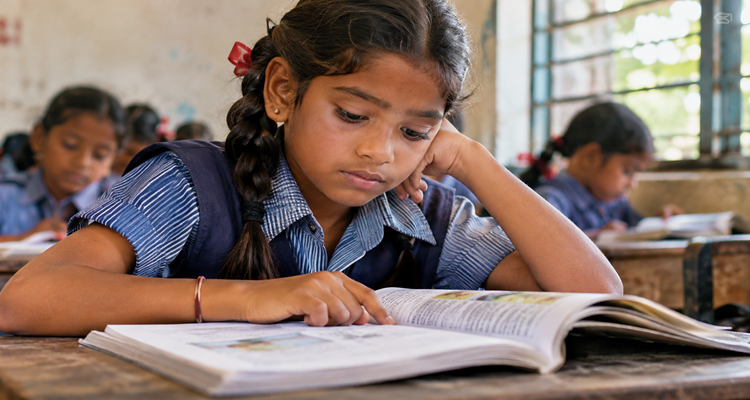
In classrooms around the world, some children learn to recognize letters, pronounce words, and pass reading examinations in languages they barely understand. Their struggle reveals an important distinction in education: learning to read words is not always the same as learning what those words mean.
A child opens a textbook and begins reading aloud. The pronunciation is careful. The sentences sound familiar because they have been repeated many times. When the teacher asks the child to explain the passage, however, the reading stops.
The child can reproduce the words but cannot explain the story.
This situation illustrates a problem that can arise when the language of schooling differs from the language a child understands best. It is especially important in multilingual societies, where a child’s home language, community language, and classroom language may be different.
The central issue is not that children are incapable of learning another language. Many do, often successfully. The problem emerges when schools expect children to learn new concepts through a language they have not yet had sufficient opportunity to understand.
In such circumstances, reading can become an exercise in recognizing symbols and reproducing sounds rather than making meaning.
Reading a Word Is Not the Same as Understanding It
Reading involves several connected abilities. Children must learn how written symbols represent language, recognize words accurately, understand vocabulary, interpret sentences, and connect ideas across a passage.
Researchers often explain reading comprehension through the Simple View of Reading, a framework associated with Philip Gough and William Tunmer. It describes reading comprehension as depending on two essential components: decoding and language comprehension.
Decoding allows a reader to identify written words. Language comprehension allows the reader to understand the language those words represent.
A child may become reasonably skilled at the first without having developed the second to the same degree.
Consider a student who reads the sentence:
The farmer harvested the crops before the storm arrived.
The student might pronounce every word correctly but have little understanding of harvested, crops, or the relationship between the approaching storm and the farmer’s decision.
The difficulty is not necessarily with recognizing letters. It may be with vocabulary, background knowledge, grammar, or the language used to express the idea.
This distinction matters because a classroom assessment that measures only accurate oral reading can overlook substantial gaps in comprehension.
It also explains why a child who appears fluent while reading aloud may struggle to answer even a straightforward question about the passage.
When the Language of School Is Different From the Language of Home
Millions of children grow up in communities where more than one language is used. Their families may speak a regional language, a minority language, or a local variety that differs from the official language of education.
When they enter school, they may encounter unfamiliar vocabulary and grammatical structures at the same time they are learning mathematics, science, history, and literacy.
For some children, the school language is already familiar through television, conversation, preschool, or community life. For others, the classroom provides their first sustained exposure.
These experiences should not be treated as equivalent.
A child who understands a lesson in their home language may struggle to follow the same explanation in an unfamiliar language. The resulting difficulty can be mistaken for a lack of subject knowledge.
Imagine a student who understands how seeds grow because they have watched plants develop at home. If a science lesson introduces germination entirely through unfamiliar vocabulary, the student may be unable to demonstrate that understanding.
The barrier is linguistic, even though the assessment may appear to measure science.
This is one reason language-of-instruction policies have consequences beyond language classes. They influence how children access almost every subject taught in school.
The Hidden Difference Between Memorization and Literacy
Repetition can help children develop important reading skills. Practicing letter patterns, common words, and pronunciation can make word recognition faster and more accurate.
Memorization is not inherently harmful. The difficulty arises when remembering the wording of a passage becomes a substitute for understanding it.
A student may learn a textbook paragraph, repeat a prepared answer, or recognize a familiar examination question without being able to explain the underlying idea independently.
Three classroom situations may look similar but represent different levels of learning:
-
A child reads a sentence accurately but cannot explain its meaning.
-
A child understands a memorized passage but struggles with a new passage containing unfamiliar vocabulary.
-
A child reads an unfamiliar passage, explains its main idea, and applies the information to a new question.
All three children may appear to be participating in reading activities, but their comprehension and ability to transfer knowledge differ.
Effective literacy education therefore needs to examine what children understand, not simply what they can reproduce.
Why Children Can Appear to Be Doing Well
A child’s reading performance is often judged through visible behaviors: answering when called upon, reading aloud, completing written exercises, and receiving marks.
These indicators can provide useful information, but they do not reveal the whole picture.
A child may have learned how to respond to familiar classroom routines without fully understanding the language used in them. In other cases, a student may understand the subject but lack the confidence or vocabulary to explain an answer in the required language.
This creates two possible assessment errors.
First, teachers may overestimate comprehension because a child reads fluently or reproduces correct answers.
Second, they may underestimate the child’s knowledge because the student cannot express that knowledge in the language of instruction.
The first can allow learning gaps to persist. The second can lead educators to overlook abilities that children already possess.
A more informative assessment combines word recognition, unfamiliar-text reading, comprehension questions, oral explanation, and opportunities to demonstrate knowledge through a familiar language when appropriate.
What Research Says About Learning in a Familiar Language
The case for using languages children understand is not simply a matter of cultural preference. It is also grounded in research on language development, literacy, and educational access.
UNESCO has long supported multilingual education that builds on learners’ existing languages, particularly during the early years of schooling.
Its guidance emphasizes the importance of education in languages children understand, while recognizing that multilingual education requires planning, suitable materials, and adequately prepared teachers.
The World Bank’s 2021 report on language of instruction likewise argues that teaching children in languages they understand can support foundational learning.
The underlying educational logic is straightforward: when students understand the language of instruction, they can devote more attention to the concepts being taught rather than struggling to interpret every explanation.
However, this does not mean that using a home language automatically produces better outcomes in every setting.
The quality of instruction, teacher proficiency, availability of books, curriculum design, and continuity between school stages all influence results.
Multilingual classrooms also present practical challenges. A single class may contain children who speak several home languages, making it difficult to select one language that serves everyone equally.
The strongest policy response is therefore not necessarily to replace one language with another. It is to design instruction that helps children learn effectively while progressively developing proficiency in additional languages.
Learning Another Language Is Not the Problem
It would be a mistake to interpret these concerns as an argument against bilingualism or multilingualism.
Knowing more than one language can expand access to education, literature, employment, relationships, and cultural experiences.
The important distinction is between learning an additional language and being required to learn every subject through that language before understanding it sufficiently.
These are different educational tasks.
In a well-supported multilingual classroom, children can develop literacy in a familiar language while receiving systematic instruction in another. Teachers can gradually introduce new vocabulary, explain unfamiliar concepts, and increase the complexity of material as students’ proficiency grows.
For example, a teacher introducing a science concept might first establish the idea through familiar language, demonstrations, and discussion. The teacher can then introduce the corresponding terminology in the additional language.
Over time, students learn both the concept and the language needed to discuss it.
This approach does not require treating the home language and the school language as competitors. Each can contribute to learning.
The challenge is ensuring that the transition does not move faster than children’s comprehension.
The Scale of the Language Barrier
The challenge is not confined to a small number of schools.
In its 2025 multilingual education reporting, UNESCO estimated that approximately 40% of people worldwide lack access to education in a language they speak and understand fluently. The figure reflects a broad problem of linguistic access, rather than a direct measurement of how many children can decode text without understanding it.
The World Bank’s 2021 Loud and Clear report estimated that nearly 37% of students in low- and middle-income countries were taught in languages they did not understand.
These figures describe different populations and methodologies, so they should not be treated as interchangeable. Together, however, they show that language mismatch is a significant educational concern.
India offers a particularly revealing example.
Children may grow up speaking one language at home, encounter another in their neighborhood, and attend a school where English or a different regional language is used for instruction.
India’s National Education Policy 2020 recommends that the home language, mother tongue, local language, or another familiar language be used as the medium of instruction wherever possible until at least Grade 5, preferably Grade 8.
UNESCO’s Bhasha Matters report examines both the promise and practical challenges of multilingual education in India, including teacher preparation, educational materials, and the use of familiar languages across subjects.
The distinction between policy and classroom reality is crucial. A recommendation to teach in familiar languages does not, by itself, ensure that every school has teachers, textbooks, and assessments capable of implementing it.
What Happens When Understanding Comes Too Late?
When children spend years studying through a language they do not sufficiently understand, the possible consequences extend beyond reading lessons.
They may struggle to follow explanations, ask questions, or demonstrate what they know. Over time, gaps in foundational understanding can make later lessons more difficult.
A mathematics student who cannot understand a word problem may fail to solve it despite possessing the necessary calculation skills.
A student learning history may remember dates and names without understanding why events occurred.
A science student may memorize definitions without being able to explain the processes they describe.
These examples illustrate how language barriers can interfere with subject learning. They do not mean every child studying in an additional language will experience these outcomes.
Some students receive strong language support and develop high proficiency. Others benefit from bilingual teachers, supplementary instruction, or language-rich environments outside school.
The outcome depends partly on how schools respond to differences in language proficiency.
There is also an emotional dimension. Children who repeatedly struggle to answer questions may become reluctant to participate, especially when errors are met with embarrassment rather than constructive support.
A classroom that recognizes linguistic differences can respond differently. Instead of assuming silence means ignorance, teachers can investigate whether students understand the concept but lack the language needed to express it.
How Schools Can Help Children Read for Meaning
Improving comprehension does not require abandoning additional-language education. It requires connecting language development to subject learning.
Several approaches can help.
Build understanding before introducing difficult terminology
Teachers can use familiar objects, demonstrations, pictures, and discussions to introduce new concepts.
When students understand the idea, unfamiliar vocabulary becomes easier to learn because it connects to something meaningful.
Make room for familiar languages
Where feasible, teachers can allow students to discuss ideas in a language they understand before expressing those ideas in the language of instruction.
This can help distinguish conceptual understanding from language proficiency.
It also allows students to use existing knowledge rather than treating everything they have learned outside school as irrelevant.
Teach the additional language explicitly
Children need structured opportunities to develop vocabulary, listening comprehension, grammar, pronunciation, and reading fluency.
Simply exposing them to difficult textbooks does not guarantee that these abilities will develop at the pace required.
Assess comprehension separately from pronunciation
Teachers can ask students to explain a passage in their own words, describe its main idea, make an inference, or connect it to a familiar situation.
Questions should be appropriate to the child’s language proficiency and the skill being assessed.
Support teachers and families
Multilingual instruction requires more than translated textbooks. Teachers need preparation, suitable learning materials, and strategies for classrooms containing multiple languages.
Families can support learning through storytelling, conversation, and reading in languages they know well. They do not need to abandon their strongest language to help children develop literacy.
UNESCO’s 2025 multilingual education guidance emphasizes system-wide planning, including language policies, teaching resources, and inclusive classroom practices.
The Question Education Must Ask
The title of this article describes an apparent contradiction: children learning to read a language they cannot speak.
Yet speaking, understanding, decoding, and reading comprehension are related but distinct abilities. A child may understand a language better than they can speak it, pronounce written words without understanding them, or possess strong knowledge that they cannot yet express in the school language.
Recognizing these differences is essential.
Schools should not assume that accurate pronunciation proves comprehension. Nor should they assume that difficulty speaking the language of instruction indicates a lack of intelligence or knowledge.
The purpose of literacy education is not simply to produce children who can pronounce the words printed on a page.
It is to help them interpret those words, question their meaning, connect them to what they know, and use what they read to understand the world.
A child who reads aloud without understanding may be demonstrating a genuine and valuable developing skill. But that skill should be the beginning of literacy, not its final destination.
The measure of successful reading education is not only whether children can say the words. It is whether those words become meaningful to them.
The information presented in this article is based on publicly available sources, reports, and factual material available at the time of publication. While efforts are made to ensure accuracy, details may change as new information emerges. The content is provided for general informational purposes only, and readers are advised to verify facts independently where necessary.
Related News
- The Questions That Make Students Smarter Even When Nobody Tells Them the Answers
- The Websites That Quietly Change Their Prices Depending on How You Arrived
- The Knowledge You Can Explain Perfectly but Cannot Use When It Matters Most
- The Students Who Understand a Lesson Only After They Stop Trying to Memorise It