









The Websites That Quietly Change Their Prices Depending on How You Arrived
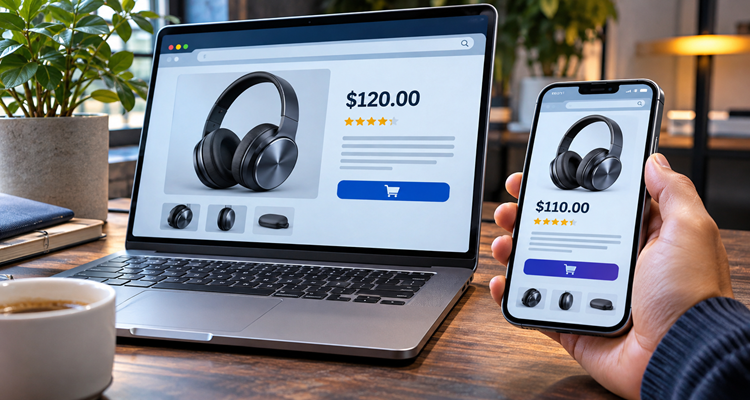
The same product, the same website, and sometimes a different price. How referral links, shopping data, and invisible pricing systems can influence what you pay online.
Imagine finding a hotel room for $180 through a comparison website. You open the hotel’s website directly, search for the same room and dates, and discover a price of $195.
Perhaps the comparison website offered a special rate. Perhaps the hotel’s booking system updated its prices between searches. Or perhaps the website recognized where you came from and displayed a different offer.
All three explanations are possible.
Online prices are not always fixed numbers attached permanently to products. They can depend on promotional campaigns, booking channels, customer eligibility, location, demand, and increasingly sophisticated pricing software.
In some cases, the path a customer takes to reach a website can influence the offer they see.
The practice raises a surprisingly important question: When two people visit the same website, are they necessarily being offered the same deal?
The answer is no. But understanding why requires separating ordinary discounts from a more controversial development: pricing systems that use information about individual shoppers to decide what to charge them.
Your Journey to a Website Can Become Part of the Price
When someone visits an online store, the website may receive more information than the product they want to purchase.
Depending on the browser, privacy settings, and tracking technology involved, the retailer may be able to identify the visitor’s referral source, advertising campaign, approximate location, device characteristics, or previous interactions with the site.
Some of that information helps websites function. Other information supports marketing, personalization, and commercial decisions.
Consider three hypothetical customers looking for identical headphones:
-
Customer A visits the retailer directly and sees a price of $120.
-
Customer B arrives through a promotional email and receives a $15 discount.
-
Customer C clicks a comparison-shopping advertisement and sees a special $110 offer.
These are illustrative examples, not observations of a particular retailer.
The important distinction is that the retailer does not necessarily have to change its standard product price to create different outcomes. It can apply a discount, recognize a promotional link, or present a channel-specific offer.
That means a website’s advertised price may be only one part of its pricing system.
What Websites Can Learn From the Way You Arrived
A website can sometimes determine how a visitor reached it through several technical mechanisms.
1. Referral information
Browsers may send an HTTP Referer header identifying the page that directed someone to a website.
This information is subject to browser policies, website settings, and privacy protections. It is not always available, and it does not necessarily reveal the complete browsing journey.
Still, when referral information is available, it can help businesses understand which websites are sending them customers.
2. Tracking parameters in links
An advertisement or promotional email might contain a URL with campaign information.
For example:
example.com/product?utm_source=newsletter
The utm_source parameter identifies a marketing source. It does not automatically change the price, but a website could use campaign information to determine which promotion or landing-page experience to present.
A referral link may also contain an affiliate identifier or a special promotional code.
3. Cookies and customer accounts
Cookies and logged-in accounts can help websites remember previous visits, shopping carts, membership status, and promotional eligibility.
A returning customer may see an offer unavailable to a first-time visitor, or the reverse.
Not every personalized offer is based on tracking. Some discounts are explicitly connected to loyalty programs or account membership.
4. Location and regional settings
A website may infer a visitor’s approximate location from their IP address or use location information supplied through an account.
This can affect currency, shipping costs, taxes, product availability, and regional promotions.
A price difference caused by different taxes or delivery conditions is not necessarily an example of personalized pricing.
The more significant question is whether the business is using information about the customer to influence the underlying offer.
The Evidence: Pricing Based on Consumer Data Is Not Just a Theory
In January 2025, the US Federal Trade Commission published initial findings from an investigation into what it calls surveillance pricing.
The investigation examined companies providing technologies that retailers can use to tailor prices and promotions using consumer information.
According to the FTC, the systems examined could use data such as location, browsing history, shopping behavior, and other consumer characteristics to inform pricing decisions.
The agency also described how detailed behavioral information, including interactions with shopping carts and websites, could influence pricing or the products presented to consumers.
The FTC’s review covered intermediary companies serving at least 250 business clients across sectors including retail.
This was an important finding because it showed that personalized pricing technology extends beyond simple coupons and familiar loyalty discounts.
However, the investigation had an important limitation.
The FTC’s published discussion included hypothetical illustrations designed to explain the capabilities of these systems. It did not establish that every retailer using such technology charged particular customers more, nor did it identify a universal pattern of price increases.
The evidence supports the existence and commercial use of sophisticated pricing tools. It does not justify assuming that every unexpected price difference is caused by surveillance.
Hotel Booking: Where Different Routes Can Lead to Different Deals
Travel booking offers a particularly useful example because customers can often compare the same hotel room across several sales channels.
A hotel may distribute rooms through its own website, online travel agencies, and comparison platforms.
These channels can involve different commissions, promotions, contractual conditions, and booking arrangements.
Research has documented meaningful differences between prices offered through these channels.
A study published in The Journal of Law and Economics in 2023 examined changes to hotel price-parity arrangements in Europe. The researchers found that direct hotel sales became relatively cheaper than online travel agency sales for midlevel and luxury hotels following the regulatory changes they studied.
Other research examining London hotel prices found that prices for comparable hotel rooms varied across booking platforms, with differences sometimes persisting close to the stay date.
These findings establish that the booking channel can matter.
They do not prove that a hotel secretly raises its price simply because a visitor arrived through a particular search engine.
That distinction is essential.
What happens when you click a hotel price on Google?
Google’s hotel referral policies explicitly recognize that room rates may depend on user context, including country and language.
Its rules require participating booking partners to maintain consistency between the offer selected through Google and the corresponding booking experience.
This illustrates two realities of modern online pricing.
First, booking systems can carry contextual information between websites.
Second, platforms may impose rules intended to prevent customers from being shown one price before clicking and an inconsistent price afterward.
The presence of referral-sensitive technology does not automatically mean a consumer is being deceived.
Dynamic Pricing and Personalized Pricing Are Not the Same Thing
One reason online pricing can seem mysterious is that several different practices are often described as if they were identical.
They are not.
| Pricing method | What changes the offer? | Example |
|---|---|---|
| Dynamic pricing | Demand, inventory, or time | A hotel room becomes more expensive as availability decreases |
| Channel-based pricing | Sales platform or promotion | A direct booking rate differs from a travel agency rate |
| Personalized pricing | Information about a customer or customer segment | An algorithm selects a different price using behavioral data |
| Personalized discounts | Eligibility or customer profile | A customer receives a targeted coupon |
| Personalized ranking | Which offers appear most prominently | A shopping page displays more expensive products first |
The final category is especially easy to overlook.
A website does not have to change the price of a particular product to influence how much someone spends.
It can change which products the customer sees first.
For example, a shopper looking for a basic household item might be presented with premium versions above less expensive alternatives.
The FTC’s 2025 findings discussed the ability of pricing intermediaries to influence product presentation using consumer information.
A customer could therefore experience a more expensive shopping journey without any single product being sold at a different price.
Why Would a Business Offer Different Prices?
Different pricing strategies can serve different commercial purposes.
A retailer might offer a discount to visitors arriving from a comparison website because those customers are actively comparing competitors.
A business might reward newsletter subscribers to encourage repeat purchases.
A hotel may offer a direct-booking promotion to reduce reliance on intermediaries.
These practices can benefit customers when they produce genuine discounts.
The more controversial possibility arises when pricing technology estimates how much an individual customer is willing to pay.
In economic terms, this relates to price discrimination: charging different prices for similar goods or services under conditions not fully explained by differences in cost.
The term does not automatically imply unlawful discrimination. Economists use it to describe a broad range of pricing practices, including familiar student discounts and more sophisticated customer segmentation.
The concern with opaque personalized pricing is that customers may not know whether their personal information is helping determine the offer.
A shopper who sees $150 may have no reliable way to discover whether another visitor would see $135 under otherwise identical conditions.
That uncertainty weakens the assumption that an advertised price is the same opportunity available to everyone.
How to Check Whether Your Shopping Route Affects the Price
Consumers cannot easily inspect a retailer’s internal pricing algorithms.
However, they can perform a practical comparison before making an expensive purchase.
A five-step price comparison checklist
Interactive
0 of 5 completed
For a meaningful comparison, keep as many variables constant as possible.
Check the exact product model, size, color, quantity, travel dates, room type, cancellation policy, and delivery destination.
Compare prices within a short period because inventory and promotional conditions can change.
If you find a difference, repeat the comparison rather than immediately assuming the website is targeting you.
A private browsing window can reduce the influence of existing cookies and account sessions, but it does not make you anonymous. Websites may still observe your IP address, browser characteristics, and information you submit.
Likewise, clearing cookies does not guarantee a lower price.
The objective is to identify an actual difference, not rely on the popular assumption that incognito mode automatically unlocks better deals.
A Price Difference Does Not Prove Manipulation
Suppose you open a product through an advertisement and see $90. You then visit the website directly and see $100.
There are several possible explanations.
The advertisement may contain a valid promotional discount. The website may be testing different offers. One page may display a cached price. Or the product configuration may differ.
The website could also be using information about the visitor or referral channel.
Without further evidence, it is impossible to identify the exact cause.
A stronger test would compare identical products under controlled conditions, repeat the experiment, and check whether the difference consistently follows the referral route.
Even then, observing a pattern would not necessarily reveal the retailer’s internal decision-making.
This is why broad claims that particular websites secretly charge users more based on their devices, browsing histories, or referral sources should be supported by direct evidence rather than isolated screenshots.
Is Personalized Pricing Legal?
The answer depends on the jurisdiction, the information used, and how the pricing practice is implemented.
Different prices are not automatically illegal.
Businesses commonly offer promotional discounts, membership prices, regional rates, and other differentiated offers.
However, consumer protection, privacy, competition, and anti-discrimination laws can impose limits.
European Union rules
The European Union has introduced a specific transparency requirement for certain forms of personalized pricing.
Under changes made through Directive (EU) 2019/2161, consumers must be informed when a price has been personalized on the basis of automated decision-making, where the relevant consumer-information obligations apply.
The legislation distinguishes this from ordinary dynamic pricing driven by market demand when it does not involve automated personalization.
This does not mean every price difference must be disclosed as personalized pricing.
Nor does the disclosure requirement prohibit all personalized prices.
It means that certain automated personalization practices carry additional transparency obligations.
United States
In the United States, there is no single nationwide rule that prohibits every form of personalized pricing.
Federal and state consumer protection laws may apply to deceptive or unfair practices, while other laws may become relevant depending on the data and circumstances involved.
The FTC’s surveillance pricing investigation demonstrates regulatory concern about the privacy and consumer protection implications of these systems.
But the existence of an investigation should not be confused with a legal finding that all personalized pricing technologies violate the law.
The Bigger Issue Is Not Always Paying More
It is tempting to frame personalized pricing entirely as a system designed to make customers spend more.
That would be incomplete.
Targeted pricing can also result in discounts that would otherwise be unavailable.
A business might offer a lower price to a customer who appears unlikely to purchase at the standard rate.
A promotional campaign might make a product more affordable to a particular group of shoppers.
The central issue is not simply whether prices differ.
It is whether customers understand the conditions under which those differences occur and have a fair opportunity to compare offers.
Transparent promotional pricing gives consumers useful information.
Opaque pricing systems can make comparisons harder because customers may not know whether they are seeing a standard rate, a temporary discount, or a price selected using their personal data.
That distinction becomes increasingly important as automated systems make it easier for businesses to test and adjust offers.
What This Means for the Future of Online Shopping
For decades, consumers have been encouraged to compare prices before buying.
That advice still works, but the meaning of comparison is becoming more complicated.
Checking several retailers is useful. Yet shoppers may also need to compare different routes to the same retailer, particularly for expensive purchases, travel bookings, and promotional offers.
The growing use of data-driven pricing technologies creates a broader challenge for digital commerce.
When prices become more responsive to individual circumstances, it becomes harder to know what a product normally costs.
At the same time, businesses have legitimate reasons to offer discounts, manage inventory, and compete through different distribution channels.
The challenge for regulators and retailers is to preserve those benefits without allowing opaque practices to undermine consumer trust.
For shoppers, the most practical response is neither panic nor endless experimentation.
It is to recognize that the first price displayed on a screen may not be the only available offer.
The Bottom Line
The route you take to reach a website can influence the price or promotion you encounter. This can happen through referral campaigns, booking-channel arrangements, membership offers, or more sophisticated personalization systems.
Research confirms that online prices can vary across distribution channels, while regulatory investigations have documented technologies capable of tailoring prices and offers using consumer information.
What the evidence does not establish is that every website secretly charges visitors more because of where they came from.
The most useful habit is simple: for purchases that matter, compare the same offer through more than one route and check the final total before paying.
The internet has made prices easier to find. It has not necessarily made them equally visible to everyone.
The information presented in this article is based on publicly available sources, reports, and factual material available at the time of publication. While efforts are made to ensure accuracy, details may change as new information emerges. The content is provided for general informational purposes only, and readers are advised to verify facts independently where necessary.