









The Airports Where Your Flight Can Land in a Different Country Than You Expected
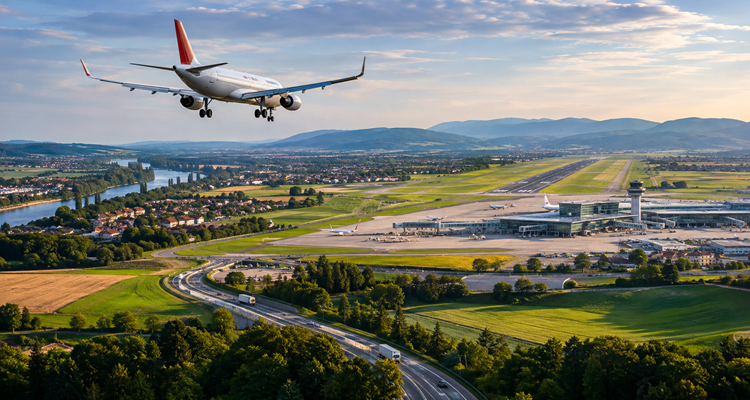
Some airports serve cities across international borders, others have exits into two countries, and a few can send travelers into an unexpected immigration situation. Here’s why the country on your itinerary may not tell the whole story.
Imagine booking a flight to Switzerland, watching the aircraft descend toward your destination, and discovering that the runway beneath you is actually in France.
At certain airports, that is perfectly normal.
International borders do not always fit neatly into the geography of air travel. Some airports are built in one country to serve a city in another. Others have unusual customs arrangements that allow passengers to leave the same terminal toward different countries.
Then there are genuine diversions, when bad weather or operational problems force an aircraft to land somewhere entirely different from its scheduled destination.
These situations have one important thing in common: the airport’s physical location, the city it serves, and the country where passengers complete immigration procedures are not always the same.
Understanding that distinction can prevent confusion over passports, visas, rental cars, ground transportation, and even which country you have technically entered.
1. EuroAirport Basel–Mulhouse–Freiburg: Flying to Switzerland, Landing in France
Its name connects three cities in three countries:
-
Basel, Switzerland
-
Mulhouse, France
-
Freiburg, Germany
Yet the entire airport is physically located in France, near the Swiss border.
EuroAirport is operated under a special French-Swiss arrangement established by an international agreement signed in 1949. Although it stands on French territory, the terminal has separate French and Swiss sectors.
How one airport serves two countries
Passengers arriving at EuroAirport can choose between exits marked for France and Switzerland after collecting their baggage.
This is not merely a matter of signage. The choice determines which side of the airport they enter and which ground transportation facilities they can access.
The airport’s official guidance confirms that passengers may use either exit and that the two sectors are connected inside the terminal.
For someone visiting Basel, leaving through the Swiss exit is generally the convenient option. A traveler heading toward Mulhouse may prefer the French side.
However, the airport’s third city, Freiburg, does not have its own German terminal sector. Germany is served through onward road connections.
Why this matters
A traveler who assumes a flight to Basel lands on Swiss soil could be surprised to discover that the airport is in France.
The distinction becomes especially important when collecting a rental car. French-side and Swiss-side rental arrangements may involve different prices, insurance terms, equipment requirements, and cross-border conditions.
The airport also warns that drivers cannot simply move between its French and Swiss parking areas without leaving the airport road system.
The unusual fact: You can book a flight to a Swiss city, land entirely in France, and leave the airport toward Switzerland without taking another flight.
2. Geneva Airport: A Swiss Airport With a French Exit
Geneva Airport offers a different kind of cross-border arrangement.
Unlike EuroAirport, Geneva Airport is located in Switzerland. But it has a dedicated French sector designed to make travel between the airport and neighboring France easier.
This arrangement is particularly useful for passengers visiting the French areas surrounding Geneva, including the Pays de Gex.
Can you arrive in Geneva and leave directly into France?
The answer depends on where your flight originated.
According to Geneva Airport’s official instructions, passengers arriving on flights from France can enter the French sector and choose how to exit.
Passengers arriving on other international flights must first follow the normal arrival process, collect their luggage, and pass through Swiss customs before accessing the French sector.
That is an important difference from the more flexible arrival exits at EuroAirport.
Geneva Airport also restricts movement between its French and international sectors to passengers with qualifying flight tickets. Other visitors, including some rental-car customers, must travel between the sectors by road via Ferney-Voltaire.
Why travelers should pay attention
The French sector can be convenient, but it does not mean every international passenger can bypass Swiss entry procedures.
Travelers should check their entry documentation, airline instructions, and rental-car pickup location before departure.
The unusual fact: One airport building can provide access to two countries, even though the runway itself remains in Switzerland.
3. Tijuana International Airport: Land in Mexico, Walk Into the United States
At Tijuana International Airport, the border-crossing experience becomes even more unusual.
The airport is in Mexico, but passengers can reach a terminal facility in San Diego, California, using a dedicated pedestrian bridge called Cross Border Xpress (CBX).
The bridge connects the Mexican airport directly with a passenger facility on the American side of the international border.
According to the airport operator, the enclosed crossing is approximately 390 feet (119 meters) long and is reserved for eligible airport passengers.
How it works
Imagine flying domestically from Mexico City to Tijuana.
Instead of leaving the airport into Tijuana, you can collect your baggage, follow the signs for CBX, complete the required border formalities, and walk into San Diego.
Your flight has remained entirely within Mexico, but your onward journey takes you into the United States.
The reverse arrangement is also possible. Travelers can begin at the CBX facility in San Diego, cross into Mexico, and board a flight from Tijuana Airport.
The important restriction
CBX is not an unrestricted international walkway.
Passengers need the required travel documents, an eligible boarding pass, and a CBX ticket. Arriving travelers using the bridge to enter the United States must also observe the operator’s time restrictions.
The unusual fact: A domestic Mexican flight can end with a passenger walking directly into an American terminal facility after completing an international border crossing.
4. Gibraltar International Airport: When a Flight to Gibraltar Lands in Spain
Gibraltar International Airport provides a particularly interesting example.
Gibraltar is a British Overseas Territory at the southern end of the Iberian Peninsula, bordered by Spain.
Its airport operates close to the Rock of Gibraltar, where local wind conditions can complicate approaches and landings.
When conditions prevent a safe arrival, airlines may divert to another airport, including Málaga–Costa del Sol Airport in Spain.
A documented example
In March 2023, a British Airways flight from London Heathrow could not land at Gibraltar because of crosswinds.
The aircraft diverted to Málaga, and passengers were subsequently transported to Gibraltar by coach, according to Gibraltar’s public broadcaster, GBC.
In June of the same year, two easyJet services were also diverted from Gibraltar to Málaga because of adverse weather conditions.
The choice of alternative airport is not guaranteed, however. In August 2021, poor visibility resulted in some Gibraltar-bound flights diverting to Faro in Portugal instead.
Why this is more than an inconvenience
Gibraltar and Spain have distinct border and immigration arrangements. A passenger who is eligible to enter Gibraltar should not automatically assume they satisfy every requirement for entering Spain.
During a diversion, an airline may arrange ground transportation, keep passengers aboard temporarily, or provide another onward travel solution. The outcome depends on the circumstances and the relevant authorities.
The unusual fact: A flight booked to a British Overseas Territory may unexpectedly land in Spain or Portugal, potentially creating immigration and ground-transport complications.
5. Copenhagen Airport: The Danish Airport That Also Serves Sweden
The reason is the Øresund connection between Copenhagen and the Swedish city of Malmö.
Passengers arriving in Copenhagen can take a direct train from the airport toward Malmö, crossing the international border during their onward journey.
Copenhagen Airport confirms that trains operate between its station and Malmö, while the regional tourism authority notes that border identity checks may apply.
Why travelers use this route
For some journeys to southern Sweden, Copenhagen Airport may offer more convenient flight options than a smaller airport closer to the final destination.
This does not mean that a flight to Copenhagen unexpectedly lands in Sweden. It means that travelers planning a Swedish trip may deliberately choose a Danish airport.
The difference matters when arranging onward transport, preparing identity documents, and checking entry requirements.
The unusual fact: An airport in Denmark can function as the international arrival point for a trip whose actual destination is in Sweden.
6. City of Derry Airport: A Gateway to Ireland Located in the United Kingdom
Located in Northern Ireland, which is part of the United Kingdom, the airport also serves nearby County Donegal in the Republic of Ireland.
The airport’s own published information identifies Donegal as part of its natural passenger catchment area.
For travelers exploring northwestern Ireland, this can make City of Derry Airport a practical arrival option.
However, a flight landing here arrives in the United Kingdom, not the Republic of Ireland.
That distinction can affect visa eligibility, immigration requirements, and onward travel arrangements.
The unusual fact: You can fly into the United Kingdom to begin a holiday in the Republic of Ireland, even though the destination lies in a different country.
The Key Difference: Three Ways an Airport Can Lead You Into Another Country
Not all these airports operate under the same arrangement. Understanding the distinction is essential.
| Situation | Example | What actually happens |
|---|---|---|
| Airport located across a border | EuroAirport Basel–Mulhouse | A flight serving Switzerland lands on French territory |
| Cross-border passenger access | Geneva, Tijuana | Travelers can use special arrangements to reach another country |
| Unexpected flight diversion | Gibraltar to Málaga | An aircraft lands at an alternative airport in another jurisdiction |
| Airport serving a neighboring country | Copenhagen, City of Derry | Passengers deliberately cross a border after landing |
The first three situations can create genuine surprises. The fourth is generally a planned travel choice rather than an unexpected landing.
What Happens to Your Passport and Visa if Your Plane Lands in Another Country?
The most important point is that an unexpected landing does not automatically give a passenger permission to enter the country where the aircraft has arrived.
There is a difference between an aircraft landing at an airport and a passenger being admitted through that country’s immigration controls.
If your flight diverts internationally, several outcomes are possible.
The airline might keep passengers aboard until the aircraft can continue. It might arrange a transfer through a controlled transit process. Alternatively, passengers may need to clear immigration before taking ground transportation or staying overnight.
The applicable rules depend on the country, the passenger’s nationality and travel documents, and the specific arrangements made by the authorities.
For planned cross-border airports, travelers should check entry requirements for every country they intend to enter, not simply the country named in their hotel booking.
How to Avoid an Unexpected Border Problem
Cross-border airport checklist
0 of 6 checked
These precautions are particularly valuable when booking flights to border regions or using an airport that serves several neighboring countries.
Even when international travel is straightforward, a wrong exit or incorrectly booked rental car can turn a simple arrival into an expensive inconvenience.
Why Airports Don’t Always Follow National Borders
Airports are built around practical geography, available land, transport networks, and political agreements.
A major city may be located close to a national boundary, while the most suitable site for its airport lies across that boundary. Neighboring countries may also cooperate to improve regional transport access.
EuroAirport illustrates how international cooperation can create a shared aviation facility without relocating a national border.
Tijuana’s Cross Border Xpress shows a different approach: keeping the airport in one country while building a controlled passenger connection to another.
Meanwhile, Copenhagen and City of Derry demonstrate that an airport’s economic and tourism catchment area can extend beyond its own country.
In other words, the geography of air travel is often regional, even when immigration law remains national.
The Bigger Picture: Your Destination Is Not Always Your Landing Country
Air travel makes international boundaries feel almost invisible. A ticket displays an airport code, a destination city, and an arrival time. The complicated geography behind those details is easy to overlook.
Yet the examples of Basel, Geneva, Tijuana, Gibraltar, Copenhagen, and Derry reveal several very different ways aviation connects neighboring countries.
Some arrangements are designed to make border crossings easier. Others reflect the geography of the region. And occasionally, weather or operational disruptions create an unexpected international arrival.
The lesson is simple: when traveling near a border, check where the runway is, where the terminal exits lead, and which country’s entry rules apply.
Your flight may arrive exactly where the airline intended, even if the country beneath the aircraft is not the one you imagined.
This content is published for informational or entertainment purposes. Facts, opinions, or references may evolve over time, and readers are encouraged to verify details from reliable sources.
Related News
- The Towns That Become Tourist Attractions for Something That No Longer Exists
- The Places Tourists Photograph but Never Realise Are Slowly Disappearing
- Why Airports Are Becoming Part of the Travel Experience Again
- The Rise of Multi-Stop Living: Why Some Travelers Are Designing Trips Like Temporary Lives