









The Ocean Creatures That Build Homes From the Bodies of Animals They Never Met
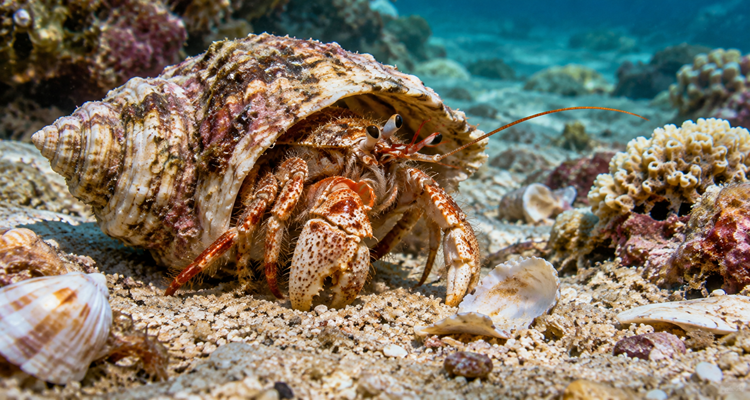
Beneath the waves, discarded shells, broken skeletons, and fragments of long-dead marine animals become the building materials for a remarkable second life.
On the ocean floor, a dead animal does not necessarily leave behind something useless. Its shell may become a shelter. Fragments of its skeleton may be incorporated into a protective tube. Even a piece of ancient-looking coral rubble can become part of another creature’s survival strategy.
Some of the most resourceful marine animals do not construct their homes entirely from materials their own bodies produce. Instead, they reuse structures created by other organisms—often animals they never encountered while alive.
Hermit crabs occupy empty snail shells. Sand mason worms assemble tubes from sand and shell fragments. Carrier snails attach discarded shells, coral pieces, and other objects to their own growing shells.
These animals are not deliberately honoring the dead, and they do not necessarily recognize where their materials came from. They are responding to the practical demands of life underwater.
Yet their behavior reveals something extraordinary about marine ecosystems: a structure built by one animal can continue serving other lives long after its original owner has disappeared.
Hermit Crabs: Living Inside Someone Else’s Shell
Unlike snails, hermit crabs do not manufacture the spiral shells they inhabit. Their abdomens are comparatively soft and vulnerable, making an external shelter particularly valuable.
For many species, that shelter is an empty gastropod shell—the hard structure originally produced by a marine snail.
When the snail dies and its soft tissues disappear, its shell can remain on the seabed. A hermit crab may eventually discover it, inspect the opening, and move inside.
The crab and the original shell-maker might have lived at entirely different times.
According to the Smithsonian Ocean, hermit crabs use these borrowed shells to protect their vulnerable abdomens and may exchange shells as they grow.
A home that must fit the body
Not every abandoned shell makes a suitable home.
A hermit crab needs enough internal space to accommodate its abdomen, but a shell that is unnecessarily large can be difficult to carry.
The opening also matters. A suitable shell allows the crab to withdraw its vulnerable body when threatened.
This makes shell selection more complicated than simply finding an empty object.
The crab must balance protection, mobility, and available space. As it grows, a previously comfortable shell may become restrictive.
Eventually, it must find another.
When one empty shell creates a chain of moves
Shell availability can influence interactions among hermit crabs.
In a behavior sometimes called a vacancy chain, several crabs can benefit from a single newly available shell.
Imagine a large empty shell appearing on the seabed. A smaller crab discovers it but cannot use it because the opening is too large. Another crab arrives and finds it suitable.
When that crab moves into the larger shell, its former home becomes available to a smaller individual. That move may free another shell.
One newly available shelter can therefore trigger a sequence of relocations.
Singapore’s National Parks Board describes vacancy-chain behavior among hermit crabs, illustrating how access to shells can become a shared ecological opportunity.
The striking part is that none of the crabs manufactured the original structure. They are redistributing a resource that another kind of animal created.
Sand Mason Worms: Architects of Broken Shells
The sand mason worm, Lanice conchilega, is a marine bristle worm found in coastal environments, including around the British Isles.
It builds a tube using grains of sand and fragments of shells.
Much of the structure remains buried beneath the seabed, while the upper section extends into the water.
The tube provides a protected place from which the worm can feed.
According to The Wildlife Trusts, the exposed portions can form elaborate branching arrangements of sand and shell fragments, associated with the worm’s feeding activity.
A house assembled from tiny remains
A shell fragment may appear insignificant when compared with a complete snail shell.
For a small marine worm, however, even tiny hard particles can be useful construction materials.
The worm incorporates selected particles into its tube, producing a structure that helps separate its soft body from the surrounding sediment.
Some of those fragments may have originated from mollusks that died long before the worm began building.
The result is a home assembled from material with many different biological origins.
Unlike the hermit crab’s borrowed shelter, the sand mason worm’s tube is not simply an intact structure left behind by one animal. It is a new construction that combines sediment with pieces of older structures.
That distinction matters.
The hermit crab is primarily a shell occupant. The sand mason worm is a builder using recycled materials.
Both demonstrate how marine organisms can turn biological remains into functional shelter.
Carrier Snails: Creatures That Build Other Shells Into Their Own
These animals produce their own shells, but they also attach foreign objects to the exterior.
Depending on the species and environment, those objects can include smaller mollusk shells, coral fragments, stones, sponge material, and other marine debris.
The finished shell can look like a miniature collection of objects gathered from the seabed.
Unlike a hermit crab, a carrier snail is not moving into a dead animal’s shell.
It is incorporating other objects into the shell it already owns.
How does a carrier snail attach the pieces?
Carrier snails use their mantle—the tissue responsible for producing shell material—to secure objects to their growing shells.
An object is positioned near the shell’s growing edge. The snail then secretes shell material that helps hold it in place.
Over time, additional objects can become incorporated into the expanding structure.
The University of Michigan’s Animal Diversity Web documents this behavior and describes the variety of biological and nonbiological materials that carrier shells can attach.
The precise benefits may differ between species and habitats.
Camouflage is one proposed function, particularly when attached materials help an animal resemble the surrounding seabed. Other potential benefits include changes in how the shell rests on the substrate.
Not every function is equally established for every carrier-snail species.
What is clear is the unusual construction method: an animal manufactures a shell while permanently incorporating objects made by other organisms.
The result is part biological growth, part environmental assembly.
Why Recycled Animal Remains Make Such Useful Homes
These three groups differ substantially in anatomy, behavior, and evolutionary history.
Yet they share an important feature: they take advantage of hard materials already present in their environment.
Reuse an intact empty shell as portable protection for a vulnerable abdomen.
Combine shell fragments and sand into a protective tube within the seabed.
Attach other objects to a shell that the snail continues to manufacture.
These are different solutions to the same broad environmental challenge: obtaining protection without having to produce every protective structure from scratch.
Hard structures can outlast their makers
A mollusk’s shell consists largely of calcium carbonate, a mineral material that can remain after the animal’s soft tissues have decomposed or been consumed.
Its persistence depends on environmental conditions. Shells may break, dissolve, become buried, or be transported by waves and currents.
But when they remain accessible, they can provide useful surfaces and shelters for other organisms.
A shell’s biological role therefore does not necessarily end when the mollusk dies.
It can become a resource for an entirely different species.
The ocean does not waste every useful structure
Marine ecosystems are often described through food webs: one organism eats another, transferring energy and nutrients.
But ecological relationships also involve physical structures.
A dead coral skeleton can contribute to habitat complexity. Empty mollusk shells can shelter small animals. Shell debris can become part of the sediment and the structures that organisms build within it.
These relationships demonstrate that organisms can influence their environments even after death.
In ecology, the creation or modification of habitats by living things is often discussed in terms of ecosystem engineering. Reusing the structures those organisms leave behind can extend their ecological influence.
This does not mean every shell fragment will become a home. Much of the material will eventually be buried, broken down, or chemically altered.
Nevertheless, some remains continue to perform useful ecological functions.
A Shell Can Be More Valuable Than It Looks
For a hermit crab, an empty shell is not merely an interesting object. It can determine whether the animal has adequate protection as it grows.
Scientific research has found that shell characteristics and availability can influence hermit crab growth, survival, and reproductive success.
A study published in the Journal of Experimental Marine Biology and Ecology examined how different hermit crab species exploit shells associated with dead gastropods. It found differences in how the crabs respond to the risks and opportunities involved in acquiring these resources.
The important lesson is that suitable shells are not interchangeable.
Their size, shape, condition, and accessibility can affect which animals can use them.
This also explains why a shell that seems empty and unimportant to a beach visitor may be valuable to a small marine animal.
Removing large numbers of shells from a habitat can potentially reduce the supply available to shell-dependent organisms, although the consequences depend on the location, species, and scale of removal.
Are These Animals Actually Using Tools?
The answer depends on what scientists mean by tool use.
Using an external object does not automatically qualify as tool use under every scientific definition.
Researchers often consider whether an animal deliberately manipulates an object to achieve a particular function, such as protection, food acquisition, or environmental modification.
A scientific review titled Tool Use by Aquatic Animals examined object manipulation among aquatic organisms, including crabs and marine snails.
The review emphasized that some behaviors involving carried or attached objects meet proposed criteria for tool use, while others require stronger behavioral evidence.
That distinction is particularly important for these marine builders.
A hermit crab inhabiting a shell, a worm constructing a tube, and a carrier snail attaching objects are all manipulating or exploiting environmental materials. But scientists do not necessarily classify all three behaviors identically.
Their resourcefulness is observable without assuming human-like planning, artistic intention, or an understanding of the objects’ histories.
The Hidden Afterlife of Marine Animals
Consider the journey of a single marine snail shell.
Its original owner produces it through biological growth. The snail eventually dies, and the shell becomes available to other organisms.
A hermit crab may occupy it for a period. Later, the shell may be abandoned again, damaged, or broken into smaller pieces.
Those fragments could become part of the surrounding sediment. Under suitable circumstances, some might eventually be incorporated into another animal’s construction.
This is an illustrative possibility, not a documented history of one particular shell.
It captures a larger ecological principle: the physical products of one organism’s life can remain useful across multiple generations and species.
A shell may begin as a living animal’s protection, become another animal’s home, and ultimately contribute to the structure of the seabed itself.
The ocean’s inhabitants are connected not only by what they eat or where they live, but also by the materials they leave behind.
What These Unusual Homes Teach Us About the Ocean
The strangest thing about these creatures may not be their building techniques.
It is how effectively they exploit the physical legacy of other organisms.
Hermit crabs demonstrate that a shelter can be inherited from an unrelated species. Sand mason worms show how scattered biological fragments can be assembled into new architecture. Carrier snails reveal that an animal’s own growing structure can incorporate materials created by others.
None of these animals needs to know the history of its building materials.
Natural selection favors behaviors that help organisms survive and reproduce, regardless of whether the materials involved were once part of another creature.
To us, an empty shell may look like a souvenir, a fragment of debris, or evidence of a life that has ended.
To a hermit crab, it may be the difference between exposure and protection.
To a marine worm, a broken piece may be part of a wall.
And to a carrier snail, it may become a permanent addition to a remarkable shell.
In the ocean, death does not always mark the end of a structure’s usefulness. Sometimes, it marks the beginning of someone else’s home.
This content is published for informational or entertainment purposes. Facts, opinions, or references may evolve over time, and readers are encouraged to verify details from reliable sources.