









Why the Last Spoonful of a Meal Can Taste Like a Different Dish
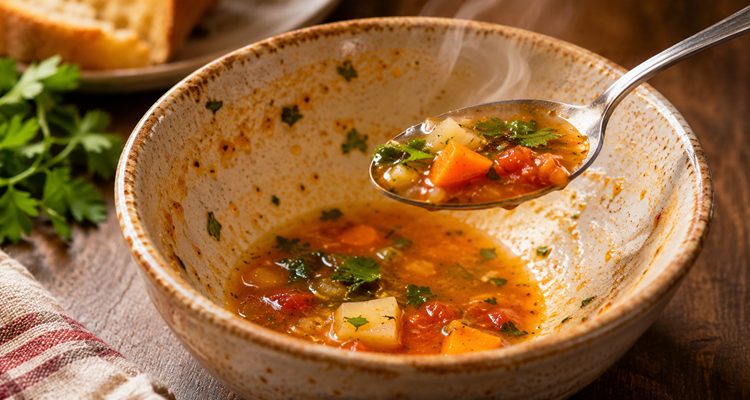
The food may be the same, but your senses, appetite, and expectations have changed. The science of taste explains why the final bite can feel surprisingly different from the first.
The first spoonful of a favorite meal can be extraordinary. The flavors seem vivid, the aroma is inviting, and every ingredient feels perfectly balanced. Yet by the time you reach the bottom of the bowl, something curious may have happened.
The final spoonful might taste richer, saltier, sweeter, duller, or unexpectedly more satisfying. Sometimes it seems almost like a different dish, even though you have been eating from the same bowl all along.
This experience has several possible explanations. Flavor is not a fixed property of food alone. It is an experience constructed by the brain using taste, smell, texture, temperature, hunger, and previous sensations.
As a meal progresses, some of those inputs change. The food itself may also change as sauces collect, ingredients settle, or the temperature drops.
Understanding the difference reveals something fascinating about everyday eating: we do not experience a meal as a series of identical bites. Each spoonful arrives in a sensory system that has already been influenced by everything that came before it.
Your Tongue Is Only Part of the Story
We often use the word taste to describe everything we experience while eating. Scientifically, however, taste is only one component of flavor.
Taste receptors help detect five widely recognized basic taste qualities: sweet, sour, salty, bitter, and umami, the savory quality associated with substances such as glutamate.
But the character of a meal depends on much more.
The aroma of roasted garlic, the warmth of spices, the creaminess of a sauce, and the crispness of a vegetable all contribute to the overall experience.
A particularly important process is retronasal olfaction. As you chew and swallow, volatile molecules from food travel from the mouth toward the smell receptors in the nasal cavity. The brain combines this smell information with signals from the tongue and mouth to create what we recognize as flavor.
This helps explain why food can seem unusually bland when your nose is congested. You may still detect sweetness or saltiness, but many of the aromas that give a dish its identity become harder to perceive.
It also means that the last spoonful can feel different even when its basic taste qualities remain similar.
Why Familiar Flavors Can Become Less Noticeable
Imagine walking into a kitchen where someone has been cooking with garlic and onions.
At first, the aroma may seem powerful. After spending some time in the room, however, you might barely notice it.
The smell has not necessarily disappeared. Your sensory response and attention have changed.
Related processes occur during eating.
With repeated exposure to a flavor, the nervous system may become less responsive to some of its familiar features. This is broadly associated with sensory adaptation and habituation, although these are distinct processes.
Sensory adaptation concerns changes in responsiveness during stimulation, while habituation involves a reduced response to repeated, familiar stimulation.
During a meal, these processes can make certain flavors seem less prominent.
For example, the first spoonful of a strongly seasoned soup might deliver an intense impression of garlic. Several spoonfuls later, that garlic may no longer dominate your attention.
Meanwhile, other elements—perhaps acidity, sweetness, or a subtle herbal note—may become more noticeable.
The recipe has not necessarily changed. The relative prominence of its sensory qualities has shifted.
Importantly, this does not mean every taste receptor simply becomes exhausted or that every flavor inevitably fades. Different sensory qualities behave differently, and changes in attention, appetite, and the food itself may be equally important.
Hunger Changes How Rewarding Food Feels
The first bite of a meal arrives under conditions that are often very different from those surrounding the last.
At the beginning, you may be hungry, anticipating the food, and especially motivated to eat.
By the end, some of that hunger has been satisfied.
This matters because eating is not merely a process of detecting flavors. It is also a process of evaluating how rewarding those flavors feel.
Researchers distinguish between sensory perception and the pleasure or motivation associated with food. A dish can remain recognizably sweet, salty, or savory while becoming less appealing as you eat.
One relevant phenomenon is called sensory-specific satiety.
It describes the tendency for the pleasantness of a food that has just been eaten to decline relative to foods with different sensory characteristics.
For instance, after finishing a large portion of a savory dish, another spoonful of that same dish may seem less appealing. Yet a small serving of fruit or a different dessert might still sound attractive.
This does not mean your stomach has a separate compartment for dessert. Rather, appetite and food reward depend partly on the sensory characteristics of what you have already consumed.
The final spoonful may therefore seem less exciting than the first, even if its chemical composition is nearly identical.
But the reverse can also happen. If you particularly enjoy the concentrated sauce at the bottom of a bowl, the last bite may be the most satisfying.
Sensory-specific satiety helps explain changing enjoyment, but it does not predict the experience of every individual bite.
Research supports this distinction. In a 1981 study published in Physiology & Behavior, researchers found that participants’ ratings of a food’s pleasantness decreased more after eating that food than their ratings of foods they had not eaten. The findings helped establish sensory-specific satiety as an important feature of human eating behavior.
Sometimes the Food Really Has Changed
Not every difference between the first and last spoonful originates in the brain.
A meal is a physical mixture, and its ingredients do not always remain evenly distributed.
Consider a bowl of vegetable soup. At the beginning, the spoon may collect mostly broth and a few floating vegetables. As the meal continues, heavier ingredients may become more concentrated near the bottom.
The final spoonful could contain more lentils, softened vegetables, herbs, or seasoning-rich liquid than earlier spoonfuls.
Other dishes show similar effects:
-
Rice and curry: Sauce can collect between grains or at the bottom of the plate, changing the sauce-to-rice ratio.
-
Pasta: The last few pieces may be coated in a different amount of sauce than the first serving.
-
Ice cream: Melting changes the balance between solid and liquid textures, altering how the dessert feels in the mouth.
-
Cereal and milk: The cereal gradually absorbs liquid, becoming softer and changing the experience of sweetness and texture.
These changes can be especially noticeable in dishes with several components.
A spoonful containing mostly rice and vegetables will not taste identical to one containing a concentrated mixture of sauce and spices.
In such cases, the difference is not a sensory illusion. The composition of the bite has genuinely changed.
Temperature Quietly Reshapes Flavor
A steaming bowl of soup does not deliver the same sensory experience after sitting on the table for fifteen minutes.
Temperature affects several characteristics of food, including aroma release, texture, and the perception of certain taste qualities.
As hot food cools, the release of volatile aroma compounds can change. This may make some aromas less prominent.
Temperature can also influence how intensely sweetness, bitterness, and other taste qualities are perceived, although the effects depend on the substance, temperature range, and testing conditions.
Texture changes can be just as important.
Melted cheese becomes firmer as it cools. Fat-rich sauces may feel thicker. A warm dessert can lose some of the soft, flowing texture that contributed to its initial appeal.
Consequently, the final spoonful of a dish may provide a different combination of aroma, taste, and mouthfeel.
This is one reason a meal that tastes excellent when freshly prepared can seem noticeably different after cooling, even without any additional seasoning.
Your Brain Is Comparing Each Bite With the Previous One
Flavor perception is influenced by context.
The brain does not interpret every spoonful in isolation. It processes incoming sensations alongside recent experiences and expectations.
Suppose you eat several bites of a mildly sweet dessert, followed by one containing a concentrated piece of fruit.
That fruit may seem especially tart because of the contrast with the sweetness you have just experienced.
Likewise, a bite containing an unusually strong spice or acidic ingredient can change how the following bite is perceived.
This is related to sensory contrast and the influence of preceding stimulation on perception.
However, contrast is not a universal explanation for the final bite. Its importance depends on the food, the sequence of flavors, and the individual eating it.
The broader point is that the order in which we experience flavors can matter, not just the ingredients themselves.
Two people eating identical meals in different sequences may therefore have somewhat different sensory experiences.
Why the Final Bite Can Sometimes Be the Best
The last spoonful is not always disappointing.
Sometimes it seems unusually delicious.
One explanation is physical: the most flavorful ingredients may have accumulated near the bottom.
Another involves attention.
At the beginning of a meal, you might be distracted by conversation, your phone, or the simple urgency of hunger. Later, you may become more aware of subtle details in the food.
A final bite may also carry emotional significance.
Knowing that a pleasurable experience is about to end can influence how much attention we give it and how we evaluate it.
For example, someone eating a favorite dessert may deliberately slow down to appreciate the last spoonful.
That final moment can feel special because of anticipation and meaning, not necessarily because the dessert has become objectively more flavorful.
This distinction matters. A bite can feel more satisfying without having a higher concentration of flavor compounds.
The Difference Between Taste Intensity and Enjoyment
One of the most useful ways to understand the phenomenon is to separate three questions:
| Question | What it measures |
|---|---|
| How strong is the flavor? | Perceived sensory intensity |
| What does the flavor resemble? | Recognition of its sensory qualities |
| How much do I enjoy it? | Pleasantness and reward |
These dimensions are related, but they are not interchangeable.
A spicy dish may remain intensely hot even after you stop enjoying it.
A familiar dessert may become less exciting without losing its sweetness.
Conversely, a subtle flavor may become more enjoyable as you begin noticing its complexity.
Research on sensory-specific satiety primarily demonstrates changes in pleasantness and food preference. It does not establish that the chemical taste of every successive bite changes.
That is an important scientific distinction when explaining why a meal seems different near the end.
A Simple Experiment to Try at Your Next Meal
You can explore these effects with an ordinary bowl of soup, yogurt, or another relatively uniform food.
The experiment will not provide laboratory-grade measurements, but it can help you notice how sensory experience changes.
-
Observe the first spoonful. Notice its sweetness, saltiness, aroma, temperature, texture, and how enjoyable it feels.
-
Eat at your normal pace. Avoid deliberately changing the food between bites.
-
Check again halfway through. Ask whether the flavor seems less intense, whether certain ingredients stand out, or whether your enjoyment has changed.
-
Examine the final spoonful. Look for differences in thickness, ingredient distribution, or temperature before tasting it.
-
Compare the experiences. Decide whether the change seems to involve the food, your perception, your appetite, or a combination.
For a more controlled comparison, divide a well-mixed portion into two small covered containers before eating. Keep them at similar temperatures, taste one near the beginning, and compare the other near the end.
Even then, you cannot completely isolate the effects of hunger, repeated exposure, and expectation. But you can reduce some of the physical differences between samples.
The goal is not to prove that the last spoonful always changes. It is to discover which aspects of flavor you notice as a meal unfolds.
What the Last Spoonful Reveals About Human Perception
The changing experience of a meal illustrates a larger principle: perception is an active process.
Our brains continuously combine information from the senses with internal conditions such as hunger, attention, and previous experience.
Food provides the sensory signals, but those signals do not produce exactly the same experience under every circumstance.
The last spoonful may taste different because its ingredients have shifted, its temperature has fallen, or its texture has changed. It may also seem different because familiar flavors have become less noticeable or the pleasure associated with eating has declined.
Often, several of these factors operate together.
And sometimes, the final bite really is the most delicious part.
The next time the bottom of your bowl seems to contain an entirely different dish, remember that the explanation may lie both in what is on your spoon and in the changing sensory experience of the person holding it.
The meal has been unfolding from the first bite to the last—and your perception has been changing along with it.
This content is published for informational or entertainment purposes. Facts, opinions, or references may evolve over time, and readers are encouraged to verify details from reliable sources.