






Why Shiva Wears the Moon but Never Tries to Stop Time
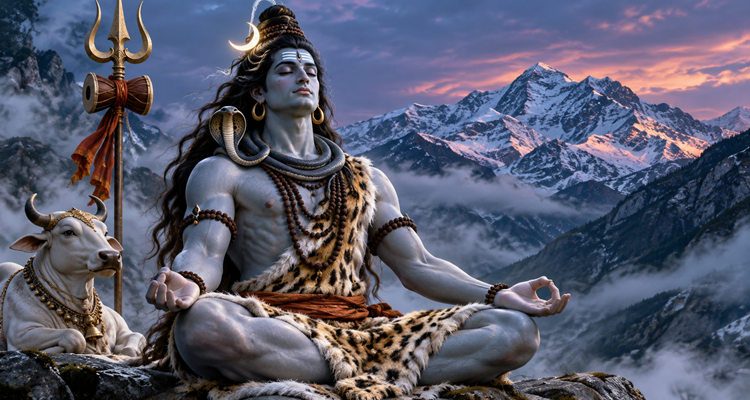
The crescent moon resting in Lord Shiva’s hair carries a profound message about change, impermanence, compassion, and the wisdom of living without trying to control everything.
The moon above Lord Shiva’s forehead is one of the most recognizable symbols in Hindu religious art. It appears small beside his matted hair, the flowing Ganga, and the powerful third eye. Yet this delicate crescent expresses an idea that reaches far beyond its appearance.
The moon represents the passing of time, while Shiva represents a divine reality that is not confined by time.
The moon grows brighter, becomes full, and gradually disappears from view before returning. Shiva, in many Hindu theological interpretations, remains beyond these changing cycles.
This creates a fascinating contrast. Shiva is associated with the power to dissolve creation, yet the moon resting upon his head continues its familiar journey through growth and decline.
Why does Shiva allow this cycle to continue?
The answer emerges from Hindu mythology, the symbolism of Shiva as Chandrashekhara, and a deeper philosophical distinction between being beyond time and trying to prevent change.
The Story Behind the Crescent Moon on Shiva’s Head
One widely told Hindu tradition connects Shiva’s crescent moon to Chandra, the moon deity, and a curse pronounced by Daksha.
According to this account, Chandra married the 27 daughters of Daksha, who are associated with the 27 nakshatras, or lunar mansions, used in traditional Indian astronomy and calendrical systems.
Although Chandra was married to all 27, he showed particular affection toward Rohini.
His preference caused resentment among the other wives, who complained to their father. Daksha warned Chandra against treating his daughters unequally, but Chandra continued favoring Rohini.
Angered by this behavior, Daksha cursed Chandra to lose his brilliance.
The moon began to fade.
As his radiance diminished, Chandra became frightened. In the traditional narrative, his decline also disturbed the natural and cosmic order.
Seeking relief, Chandra eventually turned to Lord Shiva.
Shiva responded with compassion and offered him protection. He placed the weakened moon upon his matted hair, allowing Chandra to regain his brightness periodically.
But the moon did not remain permanently full.
Instead, Chandra continued to wane and wax, losing and recovering his radiance in a recurring cycle.
This account is preserved in Shaiva storytelling, including the tradition presented by Shaivam.org in its discussion of Chandrashekharar.
The story explains why Shiva is known as Chandrashekhara, meaning the one who bears the moon upon his head.
It also introduces an important distinction: Shiva protects Chandra without eliminating the cycle through which Chandra changes.
Why Shiva Does Not Simply Remove the Curse
The story can be read as more than an explanation of the moon’s changing appearance.
Daksha’s curse represents a consequence. Shiva’s intervention represents grace.
Rather than presenting compassion and consequence as mutually exclusive, the narrative allows both to remain meaningful.
Chandra receives protection, but his experience of change continues.
In one philosophical reading, this suggests that divine grace does not always mean the removal of every difficulty. It may instead mean receiving the strength, protection, or opportunity needed to continue through difficulty.
This is an interpretation of the religious narrative, not a universal teaching shared identically by every Hindu tradition.
It is nevertheless a useful way to understand why the moon remains a crescent rather than becoming a permanently shining disc.
The Moon as a Symbol of Time
The moon has served as a natural marker of time across civilizations.
Its changing phases provide a visible rhythm through which people have organized calendars, festivals, rituals, and agricultural activities.
In Hindu calendrical traditions, the lunar month is commonly divided into two phases:
-
Shukla Paksha: The bright fortnight, during which the visible illuminated portion of the moon increases.
-
Krishna Paksha: The dark fortnight, during which the visible illuminated portion decreases.
These changes are not caused by the moon physically growing or shrinking. Astronomically, lunar phases result from the changing geometry of the sun, Earth, and moon as the moon orbits Earth.
The mythological explanation operates on a different level. It gives the visible cycle a religious and moral meaning.
The moon’s changing appearance becomes a reminder that the world is characterized by movement.
Light gives way to darkness. Darkness gives way to light.
Beginnings lead to endings, and endings make room for new beginnings.
In Hindu iconography, this connection between the moon and cyclical time is well established.
The Detroit Institute of Arts describes an 11th-century sculpture, Shiva with the Moon in his Crown, explaining that the crescent signifies the passage of time while Shiva’s eternal nature transcends temporal limitations.
This distinction is central to understanding the image.
The moon changes, but Shiva is not defined by those changes.
Shiva as Mahakala: Beyond the Limits of Time
In important Shaiva traditions, Shiva is revered as Mahakala, a divine form associated with time, mortality, and the power that transcends ordinary existence.
The Sanskrit word kala can refer to time, while Mahakala is commonly understood as Great Time or the Great Lord of Time, depending on theological context.
Shiva’s association with time does not simply mean that he possesses a supernatural clock or controls the movement of celestial bodies.
It expresses something more fundamental.
Everything within ordinary existence is subject to change. Living beings are born, grow, age, and die. Civilizations rise and fall. Even mountains and stars undergo transformations over immense periods.
In Shaiva theology, Shiva can be understood as the ultimate reality that is not limited by these processes.
This is why the moon is such a fitting ornament.
The moon is a visible measure of recurring time. Shiva, as the divine reality beyond time, wears that measure without being confined by it.
To transcend time is not necessarily to stop time.
That distinction gives the article’s central question its meaning.
The claim that Shiva never tries to stop time is best understood as a philosophical interpretation of his symbolism, rather than as a literal rule stated in every Hindu scripture.
Why Shiva Allows Change Instead of Preventing It
Imagine a world in which nothing changed.
There would be no aging, but there would also be no growth. No seasons would pass. No new experiences would unfold. Nothing could develop into something different.
Change makes loss possible, but it also makes renewal possible.
In Hindu cosmological thought, creation is often understood through recurring processes of manifestation, preservation, and dissolution. Different schools explain these processes in different ways, but change is not generally treated as an accidental defect in existence.
Shiva’s role as a deity associated with dissolution must be understood within that wider framework.
Dissolution is not always portrayed as meaningless destruction. It can also signify the ending of one condition and the possibility of another.
The moon provides a small, accessible image of this principle.
Its disappearance from the night sky is not permanent. The cycle continues.
Likewise, the philosophical meaning of Shiva’s crescent can be understood as an invitation to recognize that not every ending is absolute and not every change needs to be resisted.
This does not mean suffering should be ignored or that people should avoid trying to improve difficult circumstances.
Rather, it suggests a distinction between taking meaningful action and demanding that reality remain unchanged.
Shiva’s stillness, contrasted with the moon’s movement, makes that distinction visible.
The Crescent Moon and the Restless Human Mind
The moon also carries associations with the mind in several Hindu philosophical, devotional, and astrological traditions.
Human thoughts and emotions rarely remain constant.
A person may feel confident in the morning and uncertain by evening. Happiness may be followed by disappointment. Anger can arise suddenly and disappear just as quickly.
Like the moon, the mind passes through changing conditions.
In a common spiritual interpretation, Shiva’s placement of the moon upon his head symbolizes mastery over mental fluctuations.
But mastery does not necessarily mean suppressing every thought or eliminating every emotion.
A more nuanced interpretation is that awareness need not be overwhelmed by whatever the mind is experiencing.
Consider someone facing an important disappointment.
Their initial response might include anger, sadness, or anxiety. Those feelings are real and may require attention.
Yet the person can gradually learn to recognize those emotions without allowing them to determine every action.
The emotions may continue to change, but the person’s capacity for thoughtful response can become steadier.
Shiva’s moon offers a visual metaphor for this relationship.
The changing mind is present. It is not rejected or destroyed. Yet it does not define the deeper stillness represented by Shiva.
This is a contemplative interpretation, not a scientific claim that the moon controls human emotions.
Why the Moon Is a Crescent Rather Than a Full Moon
The crescent is particularly meaningful because it represents an incomplete phase.
A full moon might suggest perfection, fullness, or completion. A crescent, by contrast, visibly belongs to a process that is still unfolding.
In the story of Chandra, the crescent recalls the moon’s weakened condition when Shiva offered refuge.
It therefore expresses compassion toward something vulnerable.
Shiva does not choose the moon only when it shines at its brightest.
He receives it when its brilliance has diminished.
That detail gives the symbol a second meaning alongside its association with time.
The crescent can represent the possibility of restoration without requiring immediate perfection.
This is consistent with devotional interpretations of Shiva as a compassionate protector who offers refuge to those in distress.
It also explains why the image can be meaningful to people facing uncertainty, failure, or personal change.
The crescent does not promise that weakness will disappear forever.
It suggests that a weakened condition need not be the final condition.
The Moon Is Only One Part of Shiva’s Larger Symbolism
Shiva’s iconography brings together symbols that may initially seem contradictory.
Represents cyclical time and, in some interpretations, the changing mind. Its position in Shiva’s hair suggests a divine reality beyond temporal limitation.
Shiva as Nataraja is associated with cosmic activity, including creation and dissolution. His dance places movement and transformation at the heart of a larger cosmic order.
Shiva’s yogic forms emphasize contemplation and transcendence. The Metropolitan Museum of Art preserves a 12th-century representation of Shiva as Mrityunjaya, shown in meditation with a crescent adorning his matted hair.
These symbols need not be understood as competing descriptions.
Together, they express different dimensions of Shiva’s religious significance.
He can be associated with movement and stillness, destruction and protection, mortality and transcendence.
The moon adds the dimension of time to this larger symbolic language.
Does Shiva’s Moon Mean That Time Has No Power Over Him?
Within Shaiva theology, Shiva’s transcendence of time is a religious and metaphysical claim.
It should not be confused with an astronomical or experimentally established statement about time.
The moon itself follows physical laws, and its phases can be explained and predicted scientifically.
The religious image addresses a different question: What might it mean for ultimate reality to exist beyond the limitations experienced by ordinary beings?
For devotees, Shiva’s crescent can express the belief that the divine is not subject to the same impermanence as the created world.
For readers approaching the subject philosophically, the image offers a way to reflect on the difference between change and the awareness of change.
Both approaches can appreciate the symbolism without treating mythology and astronomy as interchangeable explanations.
What Shiva’s Crescent Moon Can Teach Us Today
The modern desire to control time takes many forms.
People try to preserve youth, avoid uncertainty, recover lost opportunities, and plan every stage of the future.
Planning and preparation are useful. Medical advances, education, and thoughtful decisions can improve human lives.
But no amount of planning can remove every uncertainty.
The moon’s phases offer a simple reminder that life unfolds through changing conditions.
Shiva’s relationship with the moon can inspire three practical reflections.
First, change does not always mean failure. A difficult period may be part of a larger experience whose outcome is not yet visible.
Second, compassion does not require denying consequences. In Chandra’s story, Shiva provides refuge while the cycle of waxing and waning remains.
Third, inner steadiness is different from external control. People cannot determine every event around them, but they can develop greater awareness of how they respond.
These are contemporary reflections inspired by the symbolism, not instructions that every Hindu tradition derives from the crescent moon.
Their value lies in helping readers connect an ancient religious image with recognizable human experiences.
The Deeper Meaning: Shiva Wears Time Without Being Ruled by It
The crescent moon on Shiva’s head is a remarkably compact symbol.
It carries a mythological story about Chandra’s decline and restoration. It reflects the moon’s role in measuring cyclical time. It communicates Shiva’s theological transcendence and offers a contemplative image of steadiness amid change.
Most importantly, it presents power in a form that is not simply about preventing things from happening.
Shiva’s greatness, in this interpretation, does not depend on freezing the universe into an unchanging condition.
The moon continues to wax and wane.
Its light returns, fades, and returns again.
And Shiva remains, bearing the changing moon upon his head.
Perhaps that is the most enduring philosophical lesson of the image: wisdom is not always found in making change impossible. Sometimes it is found in understanding change without being consumed by it.
Shiva does not need to stop time to stand beyond it.
This content is published for informational or entertainment purposes. Facts, opinions, or references may evolve over time, and readers are encouraged to verify details from reliable sources.
Related News
- Why Shiva’s Silence May Be More Difficult to Understand Than His Destruction
- Why Shiva Remains Relevant Even Outside Traditional Religious Practice
- Shiva’s Cosmic Dance: Why Nataraja Represents Creation, Destruction and the Rhythm of Time
- What Shiva’s Meditation Reveals About the Hindu Idea of Inner Stillness