






Shiva’s Cosmic Dance: Why Nataraja Represents Creation, Destruction and the Rhythm of Time
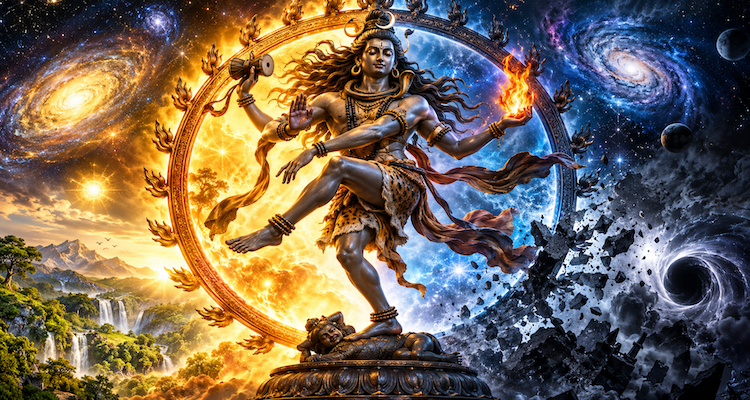
Shiva’s dancing form, known as Nataraja “Lord of Dance” is one of the most recognizable images in Indian religious art. A figure of Shiva dancing within a circle of flames, holding a small drum in one hand and fire in another, appears to capture two apparently opposite forces: the beginning of creation and the end of existence.
But the symbolism goes further than a simple “creation versus destruction” story. In the Nataraja image, movement and stillness, destruction and renewal, ignorance and liberation are presented as parts of a single cosmic process. Indian museum collections describe the image as representing Shiva’s role in creation, preservation and destruction, while Indian museum scholarship also identifies a broader set of five cosmic activities associated with the dance.
That is why Shiva’s dance is often described as the rhythm of creation and destruction: destruction is not treated simply as an ending, but as part of a continuing cosmic cycle.
Key Takeaways
- Nataraja represents Shiva as the cosmic dancer whose movement expresses an ongoing cycle rather than a single moment of destruction.
- The drum traditionally symbolizes creation, while the flame represents destruction or dissolution.
- The Nataraja image also incorporates preservation, concealment and grace within Shiva’s cosmic activity.
- The figure beneath Shiva’s foot, Apasmara, represents ignorance that obstructs spiritual understanding.
- The raised foot and protective gesture introduce liberation and reassurance into an image otherwise filled with movement and fire.
- Chola-period bronzes transformed this symbolism into one of the defining visual expressions of South Indian religious art.
The Meaning Behind Shiva as Nataraja
The word Nataraja combines nata, meaning dancer, with raja, meaning king or lord. The image presents Shiva not as a performer entertaining an audience, but as a divine force whose dance represents cosmic activity.
The Metropolitan Museum of Art describes Nataraja as an image that combines Shiva’s roles as creator, preserver and destroyer while expressing an Indian conception of time as an unending cycle.
This idea is important because the symbolism does not divide existence neatly into “creation” and “destruction.” Instead, one follows another.
A world comes into being, exists for a period, undergoes dissolution and is understood within a larger cycle of renewal. The Cleveland Museum of Art similarly explains the Nataraja image through a cyclical understanding of time, in which creation, maintenance and destruction recur.
The dance therefore becomes a visual representation of change itself.
The Drum: The Sound of Creation
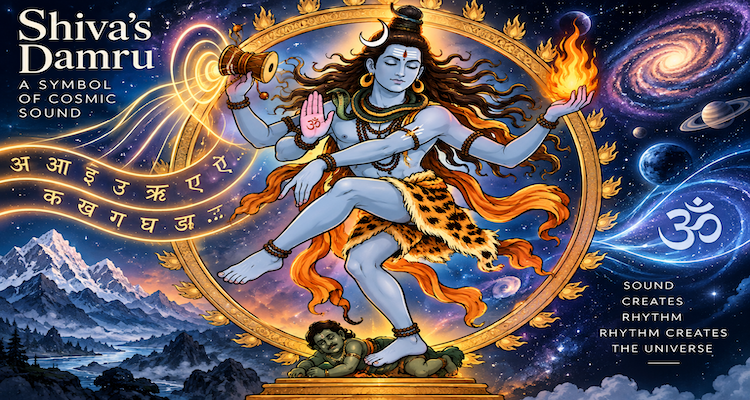
One of the most recognizable objects in the Nataraja image is the small hourglass-shaped damaru held in one of Shiva’s raised hands.
According to the traditional symbolism described by the Metropolitan Museum, the drum produces the primordial sound associated with creation.
The symbolism is striking because creation is represented not by a static object but by sound and rhythm.
A beat begins.
Another follows.
Together they establish rhythm.
In the religious imagination surrounding Nataraja, this rhythm becomes a metaphor for the ordering of the cosmos. The drum therefore represents more than a musical instrument. It symbolizes the generative impulse through which existence emerges.
The National Museum of India likewise identifies the damaru with Shiva’s creative power in its description of a Chola-period Nataraja bronze.
The Flame: Destruction as Transformation
In Shiva’s other raised hand is agni, the flame.
Fire traditionally represents destruction or dissolution. But within the Nataraja image, destruction does not stand alone. It exists within the same dance as creation.
This is one reason the image can appear paradoxical at first: Shiva holds the symbols of beginning and ending simultaneously.
The Metropolitan Museum identifies the drum with creation and the flame with destruction, while the British Museum describes Nataraja as representing Shiva dancing at the moment of cosmic dissolution and creation.
The broader message is therefore not simply that “everything dies.”
It is that forms change.
What exists does not remain permanently fixed. Dissolution creates the conditions for another phase of existence within the cyclical framework represented by the dance.
The Five Cosmic Actions Behind the Dance
The popular explanation of Nataraja often focuses on creation and destruction. But that leaves out an important part of the symbolism.
Indian museum sources describe Shiva’s dance through the concept of panchakritya, or five cosmic activities:
- Srishti — creation
- Sthiti — preservation
- Samhara — destruction or dissolution
- Tirobhava — concealment or veiling
- Anugraha — grace or liberation
The National Museum of India explicitly identifies these five activities in its description of Nataraja.
This broader framework changes how the sculpture can be understood.
Creation is only one movement.
Preservation is another.
Destruction is another.
The remaining actions concern the concealment of reality and the possibility of spiritual release.
The dance therefore becomes a representation of a complete cosmic process, rather than merely an image of destruction followed by rebirth.
Why Shiva Is Standing on Apasmara
Look beneath Shiva’s planted foot and another important part of the story appears.
The small figure is generally identified as Apasmara, a personification of ignorance.
The Metropolitan Museum describes the figure as representing illusion that leads humanity astray, while the National Museum identifies Apasmara as the figure beneath Shiva’s foot in its Nataraja descriptions.
This detail gives the dance an inward, human dimension.
The cosmic drama is not only about stars, worlds or cycles of existence. It also concerns the condition of the individual.
Ignorance can obscure understanding.
Shiva’s foot pressing down upon Apasmara therefore becomes a visual expression of overcoming that ignorance.
The symbolism is especially significant because Shiva’s face remains remarkably composed while the rest of the figure appears to be in intense motion. The Metropolitan Museum notes the contrast between the dynamic movement of the body and the calmness of Shiva’s face.
The result is an image of movement without inner disorder.
The Raised Foot: A Different Ending to the Story
The Nataraja image contains destruction, but it does not end there.
Shiva’s raised foot and the accompanying hand gesture are associated with refuge and liberation. The Metropolitan Museum describes the gesture toward the raised foot as offering refuge to the troubled soul, while Indian museum descriptions connect the raised foot with release or salvation.
That changes the emotional character of the sculpture.
Fire surrounds Shiva.
A demon representing ignorance lies beneath him.
The body is moving violently.
Yet one hand offers reassurance, and the raised foot points toward release.
The message is therefore not simply that destruction is inevitable. It also presents the possibility of moving beyond fear and ignorance.
The Ring of Fire and the Endless Cycle
The circular ring surrounding Shiva is another essential element.
The Metropolitan Museum describes the flaming halo as representing the boundaries of the Hindu cosmos.
Its circular form also reinforces the idea of cyclical time.
A straight line has a clear beginning and endpoint.
A circle continually returns to itself.
That visual distinction helps explain why Nataraja is so closely associated with cycles of creation and dissolution. The dance takes place within a circle rather than on a linear stage.
The Cleveland Museum similarly interprets the image through a cyclical conception of time, in which the world is created, maintained and destroyed repeatedly.
The circle consequently functions as more than decoration. It helps establish the philosophical structure of the entire composition.
Why the Chola Bronzes Made Nataraja Famous
Although representations of Shiva as a dancer existed earlier, the form most familiar today developed prominently during the Chola period in South India.
The Metropolitan Museum dates one celebrated Nataraja to the late 11th century and notes that the world-famous form evolved under Chola rule.
The Smithsonian’s National Museum of Asian Art notes that artists in the Tamil region began making the Nataraja form in the early tenth century, supported by royal patronage and traditions of metalworking.
These bronzes were not simply decorative objects.
The Smithsonian explains that Chola temple bronzes could be ritually enlivened and carried outside the temple during processions, allowing the deity to move among devotees.
That context matters.
Nataraja was designed to be understood not only as a sculpture but as a sacred presence participating in ritual life.
The movement depicted in the bronze consequently had a parallel in the movement of the image itself through temple streets and festivals.
Dance, Stillness and the Meaning of Balance
Perhaps the most sophisticated aspect of Nataraja is the tension between movement and stillness.
Shiva’s hair flies outward.
His limbs form complex patterns.
The flames around him appear to move.
Yet his face remains calm.
The Metropolitan Museum specifically highlights this contrast, describing the posture as dynamic while maintaining balance and serenity.
This gives the image another layer of meaning.
The universe may be understood as constantly changing, but the divine center of the dance remains composed.
Creation and destruction are movements.
The circle turns.
Fire burns.
The drum sounds.
But at the center there is stillness.
This is one reason Nataraja remains such a powerful image in Indian philosophy and art: it presents opposites not as mutually exclusive conditions, but as elements of one larger order.
More Than a Symbol of Destruction
Calling Shiva’s dance simply the “dance of destruction” misses much of what the Nataraja image communicates.
Destruction is certainly present. Shiva holds the fire associated with dissolution, and his mythology includes destructive aspects.
But the icon itself contains much more.
The drum represents creation.
The protective gesture represents reassurance.
The raised foot represents refuge or liberation.
Apasmara represents ignorance.
The ring of fire establishes the cosmic setting.
And the dance brings these elements together into a single composition.
Indian museum scholarship therefore treats Nataraja as an embodiment of multiple cosmic activities rather than destruction alone.
What the “Rhythm” Really Means
The phrase “rhythm of creation and destruction” is useful because rhythm requires both repetition and change.
A rhythm is not a single beat.
It is a relationship between beats.
Likewise, within the traditional interpretation of Nataraja, existence is not represented as one permanent state. Creation, preservation, dissolution, concealment and grace form a larger sequence of cosmic activity.
The drum and flame make that idea visible.
One initiates.
The other dissolves.
Between them is preservation.
Around them is the cosmic circle.
Under Shiva’s foot is ignorance.
Above it is the possibility of release.
Seen this way, Nataraja is less an image of destruction than an image of cosmic continuity through change.
Conclusion
Shiva’s dance is called the rhythm of creation and destruction because Nataraja presents existence as a dynamic cycle rather than a fixed state. The drum and fire place creation and dissolution within the same visual moment, while the protective hand, raised foot and defeated Apasmara expand the meaning toward preservation, spiritual understanding and liberation.
The greatest strength of the Nataraja image is therefore its ability to hold apparently opposite ideas together: movement and stillness, beginning and ending, destruction and renewal, ignorance and liberation.
For more than a thousand years, that visual language has remained recognizable because it does not depend on a single historical event. It expresses a recurring philosophical idea: change is not necessarily the opposite of order; change can itself be the rhythm through which order is experienced.
This content is published for informational or entertainment purposes. Facts, opinions, or references may evolve over time, and readers are encouraged to verify details from reliable sources.