






The Meaning of Ardhanarishvara: When Shiva and Shakti Become One Form
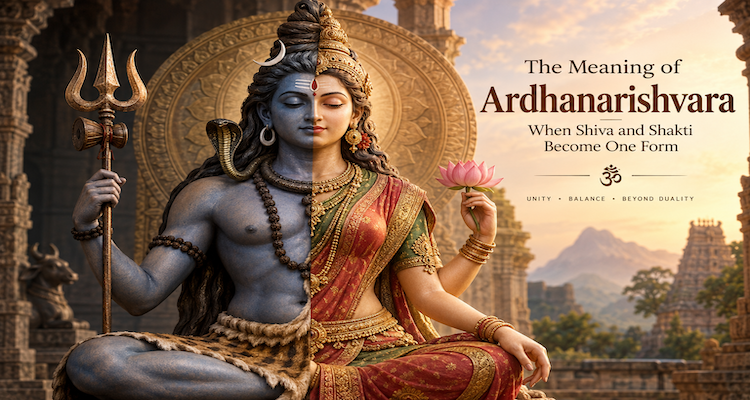
At first glance, Ardhanarishvara appears to present a paradox: one divine figure whose body is divided vertically into male and female forms. One side is Shiva; the other is Parvati, or Shakti. Yet within Hindu religious thought, the image is not primarily about division. It is about inseparability.
Ardhanarishvara literally understood as “the Lord who is half woman” is one of the most distinctive representations of Shiva in Indian sacred art. The image brings together Shiva’s ascetic and transcendent character with Shakti’s creative and dynamic power, presenting them not as competing forces but as complementary aspects of existence.
The idea has deep roots in Indian religious and philosophical traditions, while surviving sculptures and paintings show how the concept developed across centuries and regions. Scholars trace recognizable Ardhanarishvara images back to the Saka-Kushan period, roughly the first to third centuries CE.
Key Takeaways
- Ardhanarishvara represents Shiva and Shakti as two inseparable aspects of a single divine form.
- The image traditionally places Shiva on the right and Parvati or Shakti on the left.
- Its symbolism connects consciousness, creative energy, transcendence, and worldly activity.
- Ardhanarishvara has appeared in Indian sculpture, painting, temple art, and devotional traditions for centuries.
- The form is not simply a statement about gender; it also expresses ideas about cosmic unity and complementarity.
- Different Hindu traditions and artworks can emphasize different philosophical meanings of the combined form.
What Does Ardhanarishvara Mean?
The Sanskrit name Ardhanarishvara is generally translated as “the Lord who is half woman.” It refers to Shiva appearing with one half of his body represented as feminine.
The most familiar iconographic arrangement places Shiva on the right side and Parvati, identified with Shakti, on the left. The division is usually visible through differences in clothing, jewelry, hairstyle, body form, attributes, and posture. Oxford’s scholarly overview of the tradition notes that the vertical division between the masculine and feminine halves is one of the most consistent identifying features of Ardhanarishvara images.
This should not be understood simply as Shiva standing beside Parvati. The important feature is that the two are incorporated into one body.
That distinction gives the image its philosophical force.
Shiva and Shakti: Two Principles, One Reality
In Shaiva and Shakta traditions, Shiva and Shakti can be understood through different theological frameworks, but a recurring idea is that consciousness and power cannot function as completely separate realities.
Shiva is frequently associated with consciousness, stillness, transcendence, meditation, and the unchanging principle. Shakti represents divine power, energy, creativity, movement, and manifestation.
The Metropolitan Museum of Art’s discussion of South Asian religious art notes that Shakti may be understood as the female energy or counterpart of male deities and, at a higher philosophical level, as the universal energy necessary for divine power to become active.
Ardhanarishvara makes that relationship visible.
Instead of presenting Shiva and Shakti as two independent figures, the icon places them within a single form. The message can therefore be read as one of complementarity: stillness and movement, consciousness and energy, asceticism and worldly creativity.
It is important, however, not to reduce the concept to a modern slogan about “balance between men and women.” That interpretation can be useful as a contemporary reflection, but the traditional religious symbolism is considerably broader.
Why Is Shiva Shown as Half Female?
Several Hindu traditions preserve different accounts explaining how Shiva became Ardhanarishvara.
One well-known mythological explanation connects the form with creation. In one version, Brahma requires the union of Shiva and Shakti for creation to proceed, and Shiva manifests in a combined male-female form. Another tradition describes Shiva dividing his own form into male and female aspects.
The stories vary across texts and traditions, so they should be understood as religious narratives rather than a single historically verifiable event.
Scholarly research also places the idea within a much older Indian intellectual environment. Oxford’s reference work on Ardhanarishvara points to earlier ideas of composite or androgynous beings in Vedic and Upanishadic literature, including the concept of an original unified being dividing into male and female for the purpose of creation.
This gives the image a larger philosophical background: creation itself can be imagined as emerging through differentiation from an underlying unity.
Reading the Two Halves of the Image
Ardhanarishvara is particularly striking because the symbolism is communicated visually.
The Shiva half generally carries masculine markers associated with the god. Depending on the period and regional tradition, these can include matted hair, a trident, particular forms of clothing, and other attributes associated with Shiva.
The feminine half commonly has a more elaborate hairstyle, jewelry, a distinctly feminine torso and clothing, and attributes associated with Parvati or Shakti.
Oxford’s survey identifies recurring iconographic differences including Shiva’s matted hair and ascetic attributes on the right, while the female side may feature ornaments, a feminine hairstyle, a curving waist and hip, and a lotus or mirror. Regional and canonical variations exist.
The result is not intended to look like an ordinary human body divided into two anatomical halves. Indian sacred art traditionally used idealized visual conventions to communicate divine qualities rather than simply reproduce physical reality.
Ardhanarishvara at Elephanta
One of the most significant historical examples appears at the Elephanta Caves near Mumbai.
The rock-cut complex dates to approximately the sixth century CE and contains multiple representations of Shiva. Among them is a major relief of Ardhanarishvara, showing Shiva and Parvati joined as one form. Smarthistory notes that the sculpture forms part of a broader program exploring different aspects of Shiva’s character.
The presence of Ardhanarishvara at Elephanta demonstrates that the concept was not merely a literary or philosophical abstraction. It was incorporated into monumental sacred architecture and presented visually to worshippers and visitors.
The sculpture also illustrates an important characteristic of Hindu sacred art: a deity can have multiple manifestations, each emphasizing a different theological or symbolic dimension.
From Ancient Sculpture to Medieval and Later Art
Ardhanarishvara did not remain confined to one artistic period.
The Metropolitan Museum of Art holds an Ardhanarishvara bronze from Kerala dated to approximately the 13th century.
The form also appears beyond India. A Cambodian Ardhanarishvara sculpture in the Met’s collection dates to the 7th–8th century, demonstrating the wider circulation of Shaiva religious imagery across South and Southeast Asia.
Centuries later, the theme appeared in Indian painting as well. A 1694–95 folio attributed to Devidasa of Nurpur depicts Shiva and Parvati in relation to the Ardhanishvara concept, showing that the idea continued to inspire artists outside monumental temple sculpture.
This artistic continuity matters because it shows that Ardhanarishvara was not a static symbol. Artists repeatedly adapted the form to different materials, regions, aesthetic traditions, and devotional settings.
Is Ardhanarishvara About Gender?
This is one of the most interesting questions surrounding the image today.
Ardhanarishvara undeniably challenges a simple visual separation between male and female. Modern art historians and scholars of religion have therefore examined the figure in relation to gender, identity, complementarity, and the representation of the body.
Scholar Ellen Goldberg describes Ardhanarishvara as simultaneously an expression of male and female principles and emphasizes the image’s themes of symmetry, complementarity, and wholeness. At the same time, her scholarship cautions that the icon must be understood within the historical religious and social structures that produced it.
That distinction is important.
It would be misleading to claim that an ancient religious image straightforwardly expresses modern concepts of gender identity. Those are different intellectual contexts.
What can be said more securely is that Ardhanarishvara makes the masculine and feminine coexist within a single divine body. It therefore provides a powerful historical example of how Indian religious art could represent divine reality through the combination of qualities conventionally associated with both sexes.
More Than a Symbol of Balance
The most enduring meaning of Ardhanarishvara may lie beyond the question of gender itself.
The image asks what happens when apparent opposites are understood as mutually dependent.
Shiva without Shakti can be interpreted as consciousness without active manifestation. Shakti without Shiva can be interpreted as power without the transcendent consciousness traditionally associated with it. The combined image suggests that the universe cannot be reduced to one principle operating alone.
This interpretation also helps explain why the image has remained compelling across different artistic periods.
The sculpture is visually unusual, but its deeper idea is remarkably simple: what appears divided may belong to a larger unity.
Why Ardhanarishvara Still Matters
Ardhanarishvara survives not simply because it is an unusual image of Shiva, but because it compresses several layers of Hindu thought into a single visual form.
It can be approached as theology, mythology, philosophy, sacred art, or cultural history. Each perspective reveals something different.
For a devotee, it may express the inseparability of Shiva and Shakti. For an art historian, it provides an exceptionally rich example of Indian iconography. For a student of religion, it raises questions about creation, consciousness, energy, and divine embodiment. For a contemporary viewer, it can prompt reflection on complementarity and the limitations of rigid oppositions.
None of these perspectives needs to erase the others.
The power of Ardhanarishvara lies precisely in its ability to hold several meanings together.
Conclusion
Ardhanarishvara is not simply Shiva portrayed as half man and half woman. It is a sophisticated religious image in which difference and unity are deliberately placed within the same form.
Across ancient sculpture, temple reliefs, bronzes, paintings, and later devotional traditions, the figure has repeatedly expressed the relationship between Shiva and Shakti. Historical scholarship also shows that the concept belongs to a much older Indian conversation about creation, duality, embodiment, and the relationship between complementary principles.
Perhaps that is why the image remains so striking.
The dividing line through the body appears to separate two forms, yet the sculpture insists that they are one. The visual contradiction is the message: unity does not necessarily require sameness. Sometimes, it is represented through the complete presence of difference within a single whole.
Editorial classification: Established fact / Belief and tradition / Scholarly interpretation
This content is published for informational or entertainment purposes. Facts, opinions, or references may evolve over time, and readers are encouraged to verify details from reliable sources.