









What Happens When Wild Animals Stop Fearing Humans?
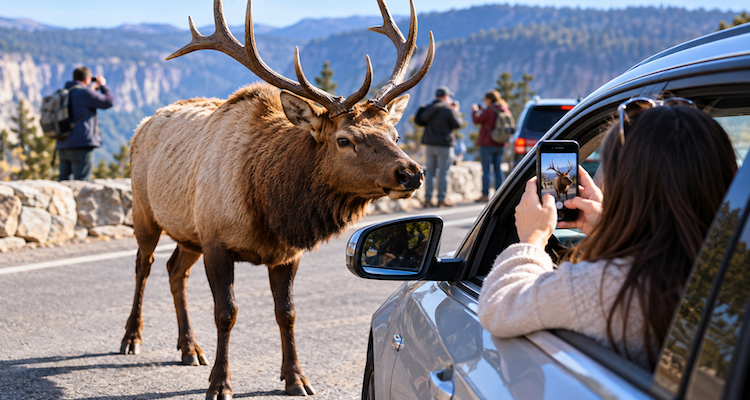
A wild animal does not need to become aggressive to create a dangerous human-wildlife encounter. Sometimes the more important change is quieter: it simply stops moving away.
That behavioral shift is known as habituation when an animal becomes less responsive to repeated human presence without an associated negative consequence. Scientists have documented this process in a range of wildlife, but they also emphasize that animals do not respond uniformly. Some become more tolerant of people, some continue to avoid them, and some can actually become more sensitive to human disturbance.
The distinction matters because a bear standing close to tourists, a deer remaining beside a busy trail or a bird continuing to forage near people may look comfortable. But tolerance of humans does not necessarily mean the animal has become safer, healthier or domesticated.
Recent research is making that picture more complicated. A 2026 study examining 37 bird and mammal species across the United States found that human presence affected more than 65% of the species studied, with responses varying substantially between species and landscapes.
The real question, therefore, is not simply whether wildlife stops fearing people. It is what animals gain or lose when human presence becomes part of their normal environment.
Key Takeaways
- Habituation can make wildlife tolerate people without making the animals tame or predictable.
- Food conditioning can create a more serious behavioral problem than simple tolerance of human presence.
- Some species avoid people less, while others remain fearful or become even more responsive to disturbance.
- Animals may alter their movement, activity and habitat use rather than simply approaching humans.
- Human tolerance can sometimes provide refuge from predators, but it can also increase exposure to roads, conflict and human food.
- Recent research shows that wildlife responses depend heavily on species, landscape and the type of human activity involved.
Habituation Is Not the Same as Tameness
When an animal repeatedly encounters people without experiencing harm, its response can diminish over time. This is one form of habituation.
For wildlife managers, that distinction is crucial.
A habituated animal may still be completely wild. It may retain its normal feeding, breeding and territorial behavior while simply reacting less strongly when people appear.
Research on brown bears, for example, has shown that habituation can influence how closely bears tolerate people, although other environmental and behavioral factors also affect bear-human tolerance.
The same principle does not apply equally to every species. A 2022 study of mesopredators found that bobcats and striped skunks continued to show strong responses to human presence across different levels of human development, while Virginia opossums showed a different pattern. The researchers concluded that some animals may retain their fear of humans rather than simply becoming habituated.
That variability is one reason broad statements such as “wild animals are becoming accustomed to humans” can be misleading.
What Changes When Fear Declines?
Fear is not simply an inconvenience for wildlife. It influences where animals travel, when they feed and how they use their surroundings.
If an animal becomes less responsive to people, it may begin using places it previously avoided.
That can include trails, roadsides, campgrounds, agricultural areas, suburban neighborhoods or other landscapes with frequent human activity.
A 2025 USGS analysis of wildlife in U.S. national parks illustrates how complicated this can be. Researchers examined GPS data from 229 individuals representing 10 mammal species across 14 parks. Animals differed considerably: some species consistently avoided human infrastructure, while others changed their use of developed areas when parks temporarily closed during the COVID-19 period.
The consequence is that reduced fear does not automatically mean a positive or negative outcome.
For some animals, greater tolerance may provide access to food or habitat.
For others, it can expose them to roads, buildings, people, pets and other hazards.
The Biggest Warning Sign: Food Conditioning
There is an important difference between an animal becoming accustomed to seeing people and an animal learning that people provide food.
The second situation can be considerably more problematic.
Food conditioning occurs when wildlife associates humans, buildings, vehicles or human activity with a food reward. Bears are a well-documented example.
The U.S. Fish and Wildlife Service warns that feeding bears, intentionally or accidentally, can habituate them to human development and create food-conditioned behavior. Garbage, pet food, bird seed and other accessible food sources can become attractants.
Once an animal repeatedly receives food around people, approaching humans can become a learned strategy rather than merely a reduction in fear.
That distinction helps explain why wildlife agencies emphasize never feeding wild animals, even when an encounter appears harmless.
When a Wild Animal Starts Approaching People
An approaching animal can create a misleading impression.
People may interpret proximity as friendliness. Wildlife biologists may see something very different: reduced wariness, food conditioning, defensive behavior, territorial behavior or an animal investigating a potential resource.
The U.S. Fish and Wildlife Service reported in July 2026 that managers at Alligator River National Wildlife Refuge in North Carolina had observed black bears approaching vehicles without apparent fear, including standing beside cars and climbing onto them. Officials temporarily closed parts of refuge roads to reduce human presence and the resulting habituation risk.
The episode demonstrates an important conservation principle: an animal can appear comfortable around humans while the situation is becoming less safe for both sides.
When wildlife repeatedly enters human spaces, managers may eventually need to intervene.
Depending on the species and circumstances, interventions can include removing attractants, restricting access, changing visitor behavior, hazing animals, relocating them or taking more serious measures when an individual becomes a persistent threat. U.S. wildlife authorities specifically note that management actions involving habituated bears can sometimes become necessary to protect human safety.
But Fear of Humans Is Not Always Beneficial
It would be too simple to conclude that wildlife should always fear people as strongly as possible.
Wildlife behavior is shaped by competing risks.
Humans can represent danger, but human-dominated areas can sometimes provide benefits. For example, predators may avoid places with substantial human activity, allowing some prey species to use those areas as temporary refuge.
USGS research on mule deer has described this as one possible form of “human shielding”: prey can sometimes tolerate human presence because predators avoid the same areas.
A 2025 USGS science synthesis similarly found that recreation can cause ungulates to increase vigilance, flee or avoid otherwise valuable habitat, but also noted that some ungulates may habituate to people and that human presence can occasionally provide refuge from predators.
This creates an ecological trade-off.
An animal may gain access to safer space from one threat while becoming exposed to another.
Human Presence Is More Complicated Than a Simple “Fear” Response
One of the most important findings emerging from recent research is that wildlife does not respond to humans along a single fear-to-friendliness scale.
The surrounding landscape matters.
A 2026 study published in Science examined 37 bird and mammal species across the United States and found that human presence and landscape modification interacted in complex ways. For roughly 60% of species that responded to human activities, the effect of human presence depended on the degree of landscape modification. Animals could respond more strongly to people in less-modified habitats.
This helps explain why the same species can behave differently in a national park, suburban neighborhood, agricultural landscape or heavily developed city.
It also means that counting animal encounters alone does not tell the whole story.
Researchers need to consider movement, habitat selection, activity patterns, vigilance, reproduction and other indicators to understand whether an apparent increase in tolerance is actually beneficial.
Wildlife Can Also Become More Sensitive to People
Habituation is only one possible response.
The opposite process, often called sensitization, can occur when repeated exposure makes animals more responsive to a stimulus.
A long-term study of yellow-bellied marmots examined changes in vigilance and flight-initiation distance and emphasized that continuous human exposure can lead to either habituation or sensitization.
Research involving recreation and ungulates also identifies sensitization as the counterpart of habituation. Animals exposed to threatening human activities can become more likely to flee rather than tolerate people.
This matters because a landscape crowded with people does not necessarily produce wildlife that becomes comfortable around humans.
Some animals may learn that people are a persistent threat.
Others may learn that people are predictable and relatively harmless.
Still others may change their activity patterns to avoid people altogether.
The Hidden Cost: Changing Where Animals Live
The most important effect may occur away from the moment of encounter.
If wildlife repeatedly avoids people, animals can lose access to otherwise valuable habitat. If wildlife instead becomes tolerant, animals may enter environments containing roads, vehicles, buildings, artificial food sources and other hazards.
USGS research on recreation notes that repeated disturbance can cause ungulates to spend more time vigilant or fleeing rather than feeding, and intensive recreation can lead some animals to avoid areas altogether. Such behavioral changes can have consequences for fitness.
Conversely, increased tolerance can bring animals closer to people.
The result is a complicated ecological balancing act rather than a simple question of whether wildlife should be afraid.
What People Should Do When Wildlife Seems Unafraid
For wildlife watchers, hikers, photographers and residents living near natural areas, the safest response is not to test how close an animal will tolerate.
A wild animal that does not immediately retreat should not be treated as tame.
Practical principles include:
- Do not feed wildlife or leave food accessible.
- Do not approach animals for photographs.
- Keep pets away from wild animals.
- Secure garbage and other attractants where appropriate.
- Follow local wildlife-viewing distances and regulations.
- Give animals a clear route to move away.
- Treat unusual boldness or repeated approaches as a reason to increase distance, not reduce it.
These precautions protect people, but they also protect wildlife from learning behaviors that can ultimately lead to conflict.
The Larger Lesson for Human-Wildlife Coexistence
The phrase “wild animals are losing their fear of humans” sounds like a single ecological trend. The evidence suggests something more nuanced.
Wildlife is responding to an increasingly human-shaped landscape in different ways.
Some animals become tolerant. Some remain wary. Some become more sensitive. Some alter their schedules. Some change where they move. Others exploit resources created by human activity.
The 2026 USGS research involving dozens of species reinforces that there is no universal wildlife response to human presence. Species, landscape and the type of human activity all matter.
That changes how encounters should be interpreted.
A fox that ignores a pedestrian, a deer feeding beside a trail or a bear approaching a vehicle may all appear to be examples of the same phenomenon. Ecologically, however, they can represent very different processes.
The safest assumption is not that wildlife has become friendly.
It is that the animal has learned something about its environment and humans are now part of that environment.
Conclusion
When wild animals stop reacting strongly to humans, the change can create opportunities as well as risks. Habituation may allow animals to use landscapes they once avoided, but it can also bring them closer to roads, homes, food sources and situations where conflict becomes more likely.
The critical distinction is between tolerance and safety.
An animal that no longer runs away is still a wild animal. Its behavior may reflect habituation, food conditioning, predator avoidance, changes in habitat or a completely different ecological response.
For people, the most responsible response is therefore not to reward that tolerance. Maintaining distance, preventing access to human food and allowing wildlife to retain its natural behavior are practical ways to reduce the chance that an apparently harmless encounter becomes a conservation or public-safety problem.
Wildlife does not need to fear every human it sees. But healthy coexistence depends on humans understanding that wild animals remaining wild is itself a form of protection for them and for us.
This content is published for informational or entertainment purposes. Facts, opinions, or references may evolve over time, and readers are encouraged to verify details from reliable sources.