






Why Wildlife Is Showing Up in Places Scientists Once Considered Unlikely
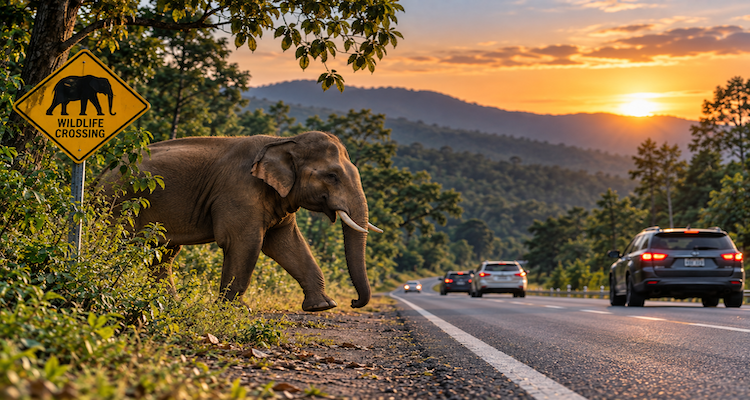
A bear appearing near a neighborhood, bats becoming surprisingly common around a city edge, or large mammals moving into abandoned farmland can look like isolated wildlife encounters. Taken together, however, such observations point to a broader ecological change: many animals are adjusting where they live as climate, land use, food availability and human settlement patterns change.
Scientists have documented widespread shifts in species ranges toward higher latitudes and elevations as the climate warms. At the same time, some animals are moving into landscapes shaped by people not simply because wildlife is being pushed out of nature, but because abandoned farmland, warmer winters, artificial food sources and fragmented green spaces can sometimes create new opportunities.
The important question is therefore not simply why wildlife is “invading” unusual places. It is why the ecological conditions that once made those places unsuitable are changing and what happens when animals and people begin sharing them more closely.
Key Takeaways
- Wildlife ranges are shifting as temperature, snowfall, vegetation and land-use patterns change.
- Japan provides a striking example of large mammals expanding toward human-dominated landscapes.
- Cities can support some adaptable species while becoming increasingly unsuitable for others.
- Abandoned farmland and fragmented green spaces can become unexpected wildlife corridors or habitat.
- Climate change and urbanization increasingly interact rather than acting as separate ecological pressures.
- A wildlife sighting in an unusual place can sometimes signal a larger landscape-level change.
The Map of Suitable Habitat Is Changing
A species does not live everywhere it physically can reach. Its distribution depends on temperature, food, water, shelter, predators, competition, disease and the availability of suitable habitat.
When several of those conditions change simultaneously, the boundaries of a species’ range can move.
The Intergovernmental Panel on Climate Change has found very high confidence that many terrestrial species have shifted their ranges poleward or toward higher elevations during the past century. A major global analysis cited by the IPCC estimated average shifts of roughly 17 kilometers per decade toward higher latitudes and about 11 meters per decade toward higher elevations across many groups of organisms.
That does not mean every species is moving north or uphill. Species respond differently depending on their biology and local environment. Some expand, some contract, some relocate, and some cannot move quickly enough to track changing conditions.
That distinction matters because a new wildlife sighting does not automatically mean a species is thriving.
An animal may be entering a new area because conditions there have improved or because conditions in its traditional habitat have deteriorated.
Japan Shows How Human Demography Can Change Wildlife Geography
One of the clearest recent examples comes from Japan.
A 2025 study in Communications Earth & Environment examined 40 years of distribution data for six large terrestrial mammals: sika deer, wild boar, Japanese serow, Japanese macaque, Asiatic black bear and brown bear. Researchers found that all six had expanded their geographical ranges since the 1970s, increasingly reaching landscapes closer to human settlements.
The explanation is more complicated than climate change alone.
The researchers identified increased agricultural abandonment and reduced snowfall as important factors. Japan’s rural population has declined and aged, leaving some agricultural land unused. As human activity decreases, formerly managed landscapes can gradually become more suitable for wildlife.
Reduced snow cover also removes a physical limitation for some species.
The result is an ecological feedback that is easy to overlook: human retreat from some landscapes can create opportunities for wildlife at the same time that human expansion elsewhere destroys habitat.
The Japanese study found that the expansion has already contributed to greater human-wildlife conflict. The researchers reported that crop damage from sika deer and wild boar has represented billions of yen annually over the past decade.
This is why simply describing such animals as “returning to nature” misses part of the story. They are often returning to landscapes that are no longer as heavily managed by people but those landscapes can still be farms, roads, villages and privately owned property.
Cities Are Not Biological Deserts
Urban areas can look hostile to wildlife, and for many species they are.
But cities are not ecologically uniform.
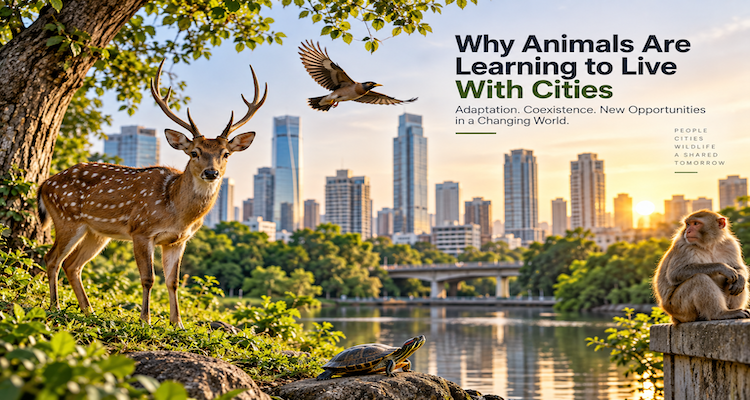
Parks, gardens, waterways, vacant land, railway corridors, cemeteries, suburban vegetation and peri-urban forests can form a patchwork of habitats. Some species learn to exploit these spaces, while others disappear as development intensifies.
A multi-city study of 725 sites across 20 North American cities examined 37 native terrestrial mammal species. It found that the relationship between urbanization and wildlife varied according to regional climate, vegetation and species characteristics. Larger-bodied mammals were generally more negatively affected by urbanization, while warmer and less vegetated cities tended to show stronger negative relationships between urbanization and mammal occupancy and diversity.
That means the phrase “wildlife is moving into cities” can be misleading.
Some wildlife is adapting to urban environments. Other wildlife is being squeezed out.
Both processes can happen within the same metropolitan area.
The City Edge May Be More Important Than the City Center
One of the most interesting places to look for these changes is not the downtown core but the boundary between urban and rural landscapes.
Research on bats in the Berlin-Brandenburg metropolitan region found an unexpectedly sharp increase in bat species richness and diversity near the transition between urban and peri-urban areas. The study also found that artificial light and anthropogenic noise could help explain variation in bat activity, although the researchers noted that their precise influence requires further investigation.
This illustrates an important ecological principle: the boundary between habitats can sometimes matter as much as either habitat itself.
A suburban green corridor may provide food and shelter while remaining close enough to urban structures to offer additional roosting opportunities. But crossing the wrong threshold too much light, traffic, noise, construction or habitat fragmentation can quickly reverse that advantage.
For wildlife, “city” is therefore not a simple category.
A leafy suburban neighborhood, a concrete downtown district and an undeveloped urban fringe can function like three very different ecosystems.
Climate Change and Urbanization Are Starting to Interact
Climate change and urbanization are often discussed separately, but wildlife experiences them simultaneously.
A warming climate can make a previously unsuitable region more tolerable for a species. Urban development can then determine whether the animal has somewhere to live, whether it can move through the landscape and whether it encounters people.
A 2024 review in Nature Climate Change specifically examined these interactions and concluded that climate change and urbanization need to be considered together when assessing future ecological change.
The interaction can work in opposite directions.
A warming climate might allow a species to expand into a new region, while roads and development prevent it from reaching suitable habitat. Conversely, abandoned agricultural land or connected green spaces may provide pathways that allow range expansion.
This is one reason wildlife distribution is becoming increasingly difficult to understand using old maps alone.
Some Unexpected Wildlife Encounters Are Warning Signs
Not every unusual wildlife sighting represents a conservation success.
An adaptable species can benefit from human environments while another species declines in the same landscape.
The distinction is especially important for disease and human-wildlife interactions.
Recent research in Nature Cities examined sarcoptic mange in coyotes across North American cities and found associations between disease occurrence, urban intensity, habitat connectivity and climate-related factors. The researchers also modelled potential increases under future urban growth and climate conditions.
Another 2026 study in Nature Microbiology examined virus records associated with seven urban-adapted mammal groups across 116 countries. The researchers identified substantial viral diversity and highlighted the importance of surveillance around wildlife species living close to people. The study did not establish that urban wildlife automatically causes human outbreaks; rather, it reinforces why closer wildlife-human contact deserves careful monitoring.
That distinction is essential.
Seeing a wild animal near a home is not evidence that it carries a dangerous disease. But increasing contact between people, domestic animals and wildlife changes the opportunities for pathogens to move between hosts.
The Mountains Are Changing Too
The shift is not confined to cities and farmland.
Mountain ecosystems are also experiencing changes in where species can live. The IPCC reports that warming is driving many species toward higher elevations, while species already restricted to mountaintops face a particularly difficult problem: there may simply be no suitable habitat above them.
At the same time, human activity is reaching higher terrain.
A 2025 Nature Cities study estimated that hillside urban areas expanded by 11.65 million hectares globally between 2000 and 2020. The researchers estimated that this expansion resulted in 6.73 million hectares of habitat loss and affected more than 6,600 species. About 35% of the hillside urban expansion occurred within biodiversity hotspots.
This creates a particularly difficult collision.
Wildlife may be moving uphill because of changing environmental conditions while people are also developing hillsides and mountain landscapes.
The direction of movement may therefore be the same, but the available space is becoming more contested.
What These Changes Really Tell Us
The most important shift may be conceptual.
Wildlife does not recognize the boundaries humans draw between “wild,” “rural,” “suburban” and “urban.” Animals respond to resources and risks.
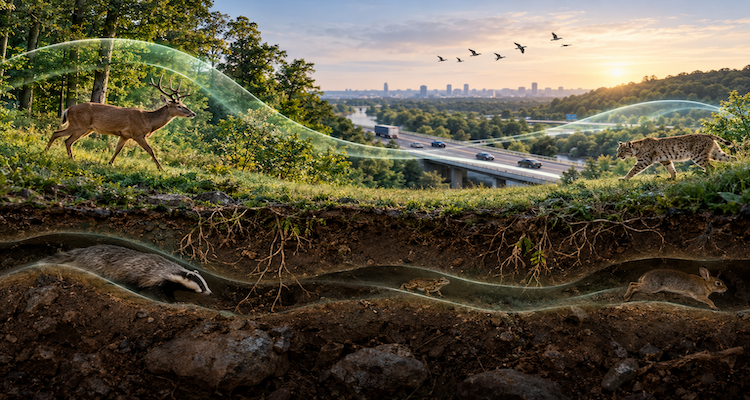
A disused field can become habitat. A drainage channel can become a movement route. A suburban garden can provide food. A warmer winter can make a previously marginal region more accessible. A highway can simultaneously divide a landscape that otherwise appears connected.
This also means that an unusual animal sighting can sometimes be useful scientific information.
When sightings are collected systematically through camera traps, GPS tracking, citizen-science observations and ecological surveys, they can reveal changes that may be difficult to see from satellite imagery or conventional land-use statistics alone.
But individual sightings should not be overinterpreted. A single animal in an unexpected location may simply be an individual dispersing beyond its normal range.
The meaningful signal emerges when repeated observations form a consistent pattern.
A New Wildlife Geography Is Emerging
The changing distribution of wildlife is not a single story of animals reclaiming human territory.
It is a story of redistribution.
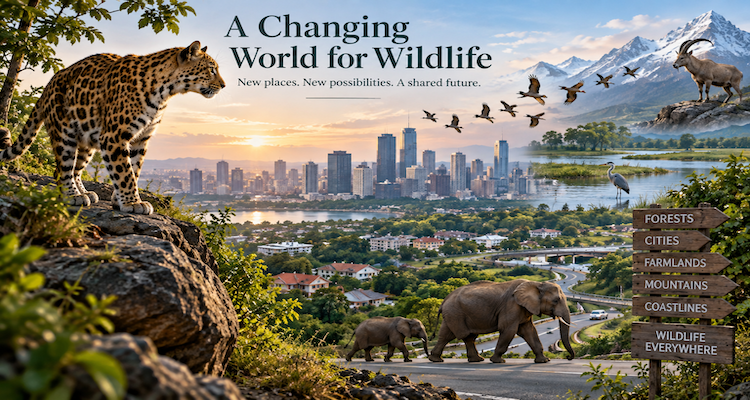
Some species are finding new opportunities because climates are changing. Others are benefiting from abandoned farmland or human-provided food. Some are adapting to urban landscapes, while species with narrower habitat requirements are disappearing from them. In mountains, species may move upward while development moves in the same direction.
The result is a more complicated map of coexistence.
For conservationists and city planners, that means protecting wildlife cannot depend only on preserving isolated reserves. Movement corridors, peri-urban habitats, agricultural landscapes, water systems and the spaces between developed areas can all influence whether animals can respond to environmental change.
For ordinary residents, it means an unexpected wildlife encounter may be more than an interesting photograph. Sometimes it is a small visible sign of a much larger ecological transition taking place across the landscape.
The animals have not necessarily changed their idea of where they belong.
The conditions defining that boundary have changed.
This content is published for informational or entertainment purposes. Facts, opinions, or references may evolve over time, and readers are encouraged to verify details from reliable sources.