





Why Shiva Is Called the Lord of Time and What That Symbolism Means
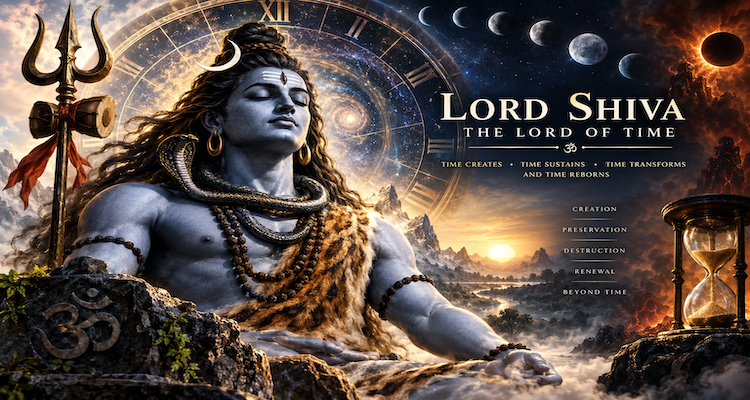
Shiva is often described as Mahakala, or “Great Time,” a name that captures one of the most profound ideas in Shaiva thought: everything that comes into existence is eventually changed, dissolved, or transformed. But calling Shiva the “Lord of Time” is more than saying that he controls a clock or measures the passage of years. It points to a deeper relationship between time, death, creation, destruction, and liberation.
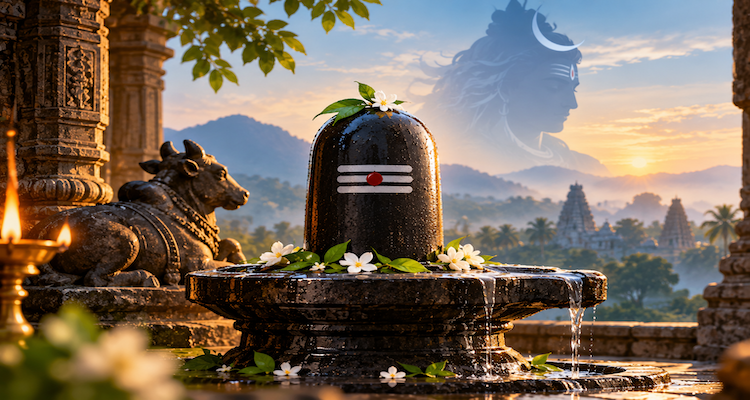
The connection is particularly visible at the Mahakaleshwar Jyotirlinga in Ujjain, where the deity is explicitly associated with time. The Government of Madhya Pradesh describes Mahakala as the presiding deity of time in Ujjain, while the temple tradition identifies Mahakaleshwar as a form of Shiva.
The symbolism becomes even clearer when Shiva is seen as Nataraja, the cosmic dancer. His dance brings creation and destruction into one continuous cycle, suggesting that time is not simply a straight line moving from past to future. It is also a process of transformation.
Key Takeaways
- Mahakala means “Great Time” and is a well-established epithet associated with Shiva.
- Shiva’s association with time is closely connected with death, dissolution, renewal, and transcendence.
- The Mahakaleshwar shrine in Ujjain gives the idea of Shiva as the presiding deity of time a particularly strong religious expression.
- The Nataraja image presents creation and destruction as parts of an endless cosmic cycle, rather than isolated events.
- Shiva’s symbolism distinguishes between being subject to time and transcending time a central theme in interpretations of Mahakala.
- The idea should not be confused with the Bhagavad Gita’s famous declaration that Krishna is “Time”; the two traditions use related ideas but involve different theological contexts.
What Does Mahakala Mean?
The Sanskrit name Mahakala is generally understood as a combination of maha, meaning “great,” and kala, a word associated with “time” and, in many contexts, death or destruction.
A Hindu encyclopedia entry by Swami Harshananda describes Mahakala as “Great Time” and “Great Destroyer,” identifying Mahakala as one of Shiva’s epithets and connecting the name with the destruction of the universe at the end of a cosmic cycle.
That meaning is important because time in this theological framework is not merely something that passes.
Time is the force through which forms arise, mature, decline and disappear.
A human life provides the simplest illustration. Birth begins a sequence that inevitably moves toward death. Civilizations rise and decline. Natural forms change. Even cosmic existence is understood through cycles of creation and dissolution.
Mahakala therefore represents a reality from which nothing conditioned can permanently escape.
But there is a second layer to the symbolism: Shiva is not simply destroyed by time; Shiva is also portrayed as standing beyond it.
That apparent contradiction is one reason the image of Mahakala is so powerful.
Shiva, Time and the Reality of Death
The relationship between time and death becomes particularly visible in the meaning of kala.
What time does to an individual is ultimately inseparable from mortality. Every passing moment removes one moment from a person’s finite life. In that sense, time is both a measure of existence and the process through which existence moves toward death.
Mahakala represents this unavoidable dimension of reality.
The symbolism is not necessarily intended to make time frightening. Instead, it can make mortality visible and meaningful.
At Mahakaleshwar in Ujjain, the association is embedded directly into the religious identity of the shrine. The official Ujjain district description calls Shiva the presiding deity of time and connects Mahakala with the city’s historic traditions of time calculation.
The official Mahakaleshwar Temple website likewise identifies the shrine as Shiva’s Mahakaleshwar form and emphasizes its long-standing worship in Ujjain.
This gives the abstract idea of “Time” a physical and ritual presence.
The Nataraja Connection: Time as a Cosmic Cycle
One of the clearest visual explanations of Shiva’s relationship with time comes through Nataraja, Shiva as Lord of the Dance.
The Metropolitan Museum of Art explains that the Nataraja image combines Shiva’s roles as creator, preserver and destroyer while conveying the Indian conception of an ongoing cycle of time.
Almost every element of the classical image contributes to that idea.
Shiva’s damaru, the small drum held in one hand, is associated with creation. His other raised hand carries fire, representing destruction. One hand offers reassurance, while another points toward the raised foot, associated with refuge and release.
Below Shiva’s foot is a small figure representing ignorance or illusion.
The symbolism is striking because destruction is not presented as the opposite of creation. The two occur within the same cosmic movement.
Creation leads to preservation.
Preservation leads to dissolution.
Dissolution makes renewal possible.
The cycle continues.
The Met describes this as a conception of time that differs from the familiar idea of time as a purely linear sequence of historical events.
Seen this way, Shiva’s dance is not simply a dance happening inside time.
It is an image of the cosmic process through which time itself becomes meaningful.
Why Shiva’s Destructive Aspect Matters
Shiva is sometimes reduced in popular explanations to the “destroyer” of the Hindu Trimurti. That description is useful as an introduction, but it can hide the deeper symbolism.
Destruction in Shaiva traditions does not necessarily mean meaningless annihilation.
It can mean dissolution of an existing form.
A leaf falls. A body ages. A building disappears. A civilization changes. A cosmic cycle ends.
What disappears may not simply be “lost”; it may become part of another stage of existence.
This is why Shiva’s destructive imagery can coexist with imagery of meditation, fertility, creation, compassion and liberation.
The Nataraja icon makes that paradox visible. The same Shiva who carries the destructive fire also offers reassurance and points toward release.
The message is therefore more nuanced than “everything dies.”
It is closer to:
Everything that exists in a changing form is subject to transformation.
Mahakala and the Idea of Transcending Time
This is where the symbolism becomes especially philosophical.
If Mahakala represents time that consumes all created things, what does it mean to worship Shiva as Mahakala?
One interpretation is that Shiva represents both time and that which lies beyond ordinary temporal limitation.
This distinction appears repeatedly in religious interpretations of Shiva: the changing world belongs to time, while the ultimate reality associated with Shiva is understood as enduring beyond those changes.
The Nataraja image expresses a related idea through an extraordinary visual contrast. Shiva’s hair and limbs are in energetic movement, yet his face remains calm and composed. The Metropolitan Museum notes that this contrast can be read as an image of stillness within movement the still point beyond the cycles represented by the dance.
That makes Nataraja a particularly useful image for understanding Mahakala.
Time moves. Shiva remains.
The symbolism does not require time to stop. Instead, it suggests that spiritual liberation involves recognizing something deeper than the constantly changing forms of ordinary existence.
Why Ujjain Became So Closely Associated With Time
The connection between Shiva and time is not only philosophical. It has a powerful geographical and religious expression in Ujjain, Madhya Pradesh.
The Mahakaleshwar Temple is one of India’s twelve celebrated Jyotirlingas. The Government of Madhya Pradesh identifies Mahakala as the distinctive presiding deity of Ujjain and notes the city’s historical importance in calculations of Indian time.
The temple also has a distinctive south-facing orientation. The official temple website identifies Mahakaleshwar as the only south-facing Jyotirlinga among the twelve.
Traditional interpretations associate the southern direction with death, giving the orientation additional significance in the Mahakala tradition. India’s official tourism portal similarly describes Mahakaleshwar as Shiva in his association with time and death.
The result is a remarkable convergence of place, ritual, mythology and philosophy.
Ujjain is not simply a location where a Shiva temple happens to stand. Within its religious tradition, the city itself became deeply connected with the measurement and meaning of time, while Mahakala represents the divine dimension of that idea.
Shiva and the Famous “I Am Time” Passage
There is another important distinction worth making.
The famous declaration, “I am Time, the world-destroyer,” comes from the Bhagavad Gita, Chapter 11, verse 32. But in that passage, the speaker is Krishna, not Shiva. The Sanskrit verse begins kālo’smi, “I am Time,” and the Gita Supersite hosted by IIT Kanpur provides multiple traditional translations of the verse.
The passage is nevertheless relevant because it illustrates a broader Hindu philosophical association between the divine and the destructive power of time.
It would be inaccurate, however, to use the Gita verse as if it were a direct statement that Shiva is speaking.
Instead, the two ideas can be understood as related theological expressions: divine reality can be associated with the force through which finite existence reaches its inevitable end.
That distinction matters when explaining Hindu traditions responsibly, because different scriptures and traditions do not always present divine functions in identical ways.
What the Symbolism Means for Human Life
The idea of Shiva as Mahakala can also be read at a deeply human level.
Time constantly asks people to confront change.
Youth becomes adulthood. Relationships evolve. Careers begin and end. Parents age. Children grow. Places that once seemed permanent disappear.
The Mahakala symbolism does not promise that these changes can be stopped.
Instead, it places impermanence within a larger spiritual framework.
The Nataraja image goes even further. The figure does not appear terrified by the movement surrounding him. Shiva dances inside the circle of flames while maintaining composure. The Met interprets this combination of movement and serenity as part of the image’s message about cosmic cycles and liberation.
That makes the symbolism surprisingly relevant beyond mythology.
It asks a difficult question:
If everything changes, what should remain steady within us?
Different schools of Hindu thought answer that question differently. But the image of Mahakala consistently brings attention back to mortality, impermanence and the possibility of seeing beyond them.
Why the Lord of Time Is Not Simply the God of Destruction
Calling Shiva the Lord of Time can therefore be misleading if it is understood only as another name for a destructive deity.
Mahakala represents something broader.
Time creates the conditions under which change occurs.
Change makes preservation possible for a while.
Eventually, forms dissolve.
And within the cyclical framework represented by Nataraja, dissolution is not necessarily the final word.
The symbolism turns destruction into part of a larger process.
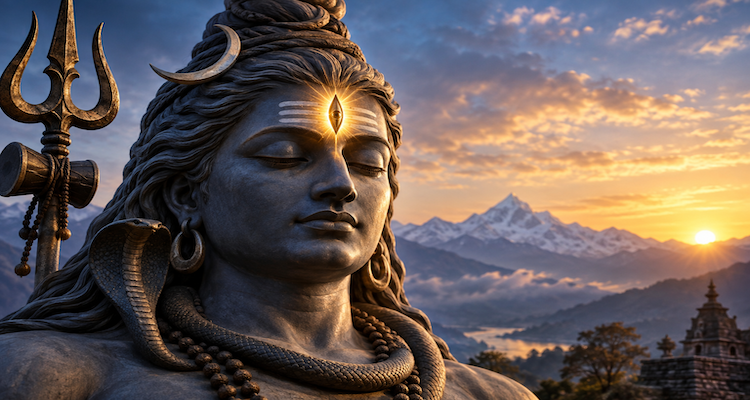
This is also why Shiva’s association with time can coexist with his image as a meditating yogi. The meditating Shiva represents stillness, while Nataraja represents movement. Mahakala represents the force that carries everything through change.
These are not necessarily contradictory images.
Together they describe different dimensions of the same theological idea.
Conclusion
Shiva is called Mahakala, the Great Time, because his symbolism reaches beyond the ordinary measurement of hours, days and years. Time is portrayed as the force through which created forms mature, change and eventually dissolve and Shiva’s Mahakala aspect embodies that ultimate process.
At Ujjain’s Mahakaleshwar, this idea becomes a living religious tradition. In the Nataraja image, it becomes a visual philosophy: creation and destruction move together inside an endless cosmic rhythm. And in the broader symbolism of Shiva, the deity associated with time can also represent the stillness that is understood to transcend the changing world.
Perhaps that is the deepest meaning of Shiva as Lord of Time.
It is not simply that time eventually destroys everything.
It is that everything we experience as permanent is subject to change and spiritual understanding begins when we learn to recognize that reality without being overwhelmed by it.
This content is published for informational or entertainment purposes. Facts, opinions, or references may evolve over time, and readers are encouraged to verify details from reliable sources.