







Why Shiva Remains Relevant Even Outside Traditional Religious Practice

Shiva is often approached first as a Hindu deity, but his cultural presence extends beyond the boundaries of formal worship. The image of Shiva as Nataraja the Lord of Dance appears in major museums, art history, education and even at CERN, while representations of Shiva as a meditating yogi continue to connect the figure with ideas of contemplation, discipline and transformation.
That does not mean these settings are equivalent to religious devotion. A museum visitor, artist, scientist or person interested in meditation may encounter Shiva as an artistic, philosophical or cultural symbol without adopting Hindu religious practice. The more interesting question, therefore, is not whether Shiva has become “secular,” but why a religious figure continues to generate meaning in contexts where worship is not the primary purpose.
Key Takeaways
- Shiva’s imagery communicates ideas about creation, destruction, transformation, balance and the limits of human understanding.
- Nataraja has become a major cultural and artistic symbol far beyond the temple environment in which its meaning developed.
- Shiva’s association with meditation and yoga connects ancient religious imagery with contemporary interest in contemplation and self-discipline.
- Museums preserve Shiva not merely as religious imagery, but as an important part of South Asian artistic and intellectual history.
- CERN’s Nataraja statue demonstrates how Shiva’s imagery can function as a cultural symbol without turning science into religion.
- Understanding Shiva outside worship requires distinguishing historical religious meaning from modern personal interpretation.
Shiva Is More Than a Single Religious Image
One reason Shiva continues to attract attention is that the tradition surrounding him contains several seemingly opposing dimensions.
He can appear as an ascetic absorbed in meditation, a family figure alongside Parvati, a destructive force, a teacher, and Nataraja, the cosmic dancer. The Metropolitan Museum of Art describes Shiva as both a great practitioner of yoga and Nataraja, while noting the distinctive visual symbols associated with him, including the third eye, matted hair and serpent.
This multiplicity makes Shiva difficult to reduce to a single modern concept.
The figure of the meditating Shiva, for example, represents a deeply established religious and artistic tradition rather than a modern invention. A 12th-century representation of Shiva as Mrityunjaya in the Metropolitan Museum’s collection depicts him in a yogic posture, with interlocked legs and resting hands.
For a religious practitioner, such imagery can carry devotional and theological meaning. For someone outside that tradition, the same image can raise questions about solitude, concentration, discipline and the relationship between stillness and action.
Those interpretations should not be confused with the original religious meaning. But they help explain why the imagery remains culturally legible.
Nataraja Turns Change Into an Image
Perhaps nowhere is Shiva’s continuing relevance more visible than in the image of Nataraja.
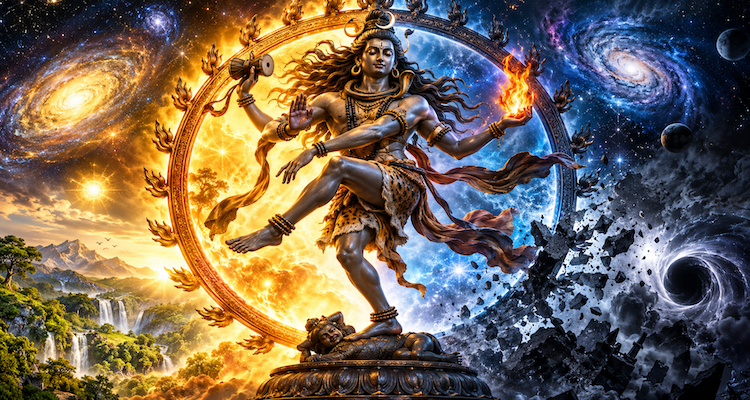
The Chola-period Nataraja represented in the Metropolitan Museum’s collection combines several ideas within a single composition: the drum associated with creation, the fire associated with destruction, a gesture offering reassurance and a figure representing ignorance beneath Shiva’s foot. The surrounding ring of flames evokes the cosmic setting of the dance.
The result is not simply an image of a dancing god.
It is a visual argument about change.
Creation and destruction are placed in the same composition. Movement exists alongside an extraordinarily calm face. The figure is dynamic without appearing uncontrolled.
That combination gives Nataraja a meaning that can be discussed in artistic and philosophical terms even when the viewer does not share the devotional framework.
The British Museum similarly documents Nataraja as a representation of Shiva’s cosmic dance, identifying the drum, flame and figure of ignorance as significant elements of the iconography.
This is one reason Shiva’s imagery continues to work as a subject of art history: the image itself contains multiple layers that can be studied independently of whether the observer participates in the associated religious practice.
A Symbol of Transformation, Not Simply Destruction
“Destruction” is one of the easiest aspects of Shiva to misunderstand when the figure is removed from its broader context.
Nataraja does not simply present destruction as an end. The traditional image places creation and destruction together within a continuing cosmic cycle. The Metropolitan Museum explicitly describes the image as combining Shiva’s roles as creator, preserver and destroyer and as conveying an Indian conception of cyclical time.
That distinction matters outside religious practice.
Modern life is full of situations in which something must end before something else can develop: institutions restructure, careers change, technologies replace older systems, artistic movements evolve and individuals abandon established habits.
None of these modern examples should be presented as proof of what Shiva “really means.” They are contemporary interpretations that resonate with themes already embedded in the iconography.
The enduring quality of the symbol lies partly in this capacity to provoke reflection on change without reducing change to either purely positive or purely negative terms.
Why Shiva Appears in Museums
The presence of Shiva in major museums also demonstrates that religious imagery can acquire several layers of cultural significance.
The Metropolitan Museum holds numerous representations of Shiva spanning centuries and regions, including works from India as well as historical representations from Southeast Asia. A seventh-century Shiva sculpture from Vietnam or southern Cambodia, for example, documents the presence and adaptation of Shiva imagery beyond the Indian subcontinent.
The museum’s collections therefore provide a useful reminder that Shiva’s history is not confined to contemporary India.
His image has travelled through artistic traditions, political cultures and geographic regions.
This matters because museum interpretation can introduce Shiva to people who encounter the figure primarily through art rather than religious observance. The context changes, but the historical object remains connected to the religious culture from which it emerged.
That distinction is important for respectful interpretation. Seeing Shiva as an artistic symbol does not erase the fact that the image remains sacred to many Hindus.
From Temple Icon to Global Cultural Reference
One of the clearest examples of Shiva’s movement into a non-religious institutional setting is CERN.
In 2004, CERN unveiled a statue of Nataraja presented by the Government of India. CERN described the statue as depicting Shiva’s cosmic dance and as a symbol of India’s relationship with the scientific organization.
The existence of the statue does not mean CERN considers Hindu cosmology a scientific explanation of particle physics.
Rather, the episode illustrates how a religious-cultural symbol can acquire an additional institutional meaning.
That distinction is particularly important because the Nataraja statue has sometimes been discussed online through claims that attempt to establish a direct scientific equivalence between Shiva’s cosmic dance and modern physics. The documented CERN material supports a cultural and symbolic connection; it does not establish Shiva’s dance as a scientific theory.
The difference between symbolism and scientific evidence is worth preserving.
A symbol can inspire reflection without becoming a scientific proposition.
Shiva and the Modern Idea of Stillness
Another dimension of Shiva’s continuing relevance comes from his association with meditation.
The image of Shiva in yogic contemplation has a long artistic history. The Metropolitan Museum’s collection includes representations that explicitly portray Shiva in deep meditation, while its broader discussion of Hindu art identifies Shiva with yoga and meditative imagery.
This provides a historical foundation for why modern audiences interested in meditation may find Shiva’s imagery meaningful.
But an important distinction remains.
Someone practicing meditation today does not automatically participate in Shaivism, and contemporary wellness culture should not be presented as a straightforward continuation of ancient Hindu practice. Yoga itself has a complex history, and modern forms can differ substantially in purpose, philosophy and religious context.
Shiva’s image can therefore function as a cultural reference point without implying that every modern meditation practice is a form of Shiva worship.
Artists Can Engage With Shiva Without Sharing the Belief
The relationship between Shiva and contemporary artistic interpretation offers another window into this question.
The Metropolitan Museum documented artist Izhar Patkin’s response to a Nataraja sculpture. Patkin described finding significance in the sculpture’s opposing ideas of destruction and rebirth and stillness and movement, even though his own relationship to the image was not based on Hindu belief.
That example is valuable because it demonstrates something often missed in discussions about religious art.
A work can retain its religious identity while generating artistic, philosophical or cultural interpretations among people outside the faith tradition.
The two meanings do not necessarily cancel each other out.
What Shiva’s Continuing Relevance Really Shows
The persistence of Shiva outside conventional religious practice does not prove that religion has become irrelevant. Nor does it mean that Shiva has simply been transformed into a secular lifestyle symbol.
Something more subtle is happening.
Shiva’s imagery carries a dense network of ideas developed within Hindu traditions meditation, dance, transformation, time, destruction, creation, ignorance and transcendence. Because these themes also intersect with questions that people encounter in art, philosophy, culture and ordinary life, the imagery remains capable of generating interpretation beyond devotional settings.
At the same time, removing the image entirely from its religious context can flatten its meaning.
A Nataraja sculpture is not merely a metaphor for “change.” A meditating Shiva is not merely an ancient wellness logo. These interpretations may be useful starting points, but they represent only part of a much larger religious and artistic tradition.
That tension may actually explain some of Shiva’s durability.
The symbol can travel without becoming empty but only when its original context is remembered.
Conclusion
Shiva remains relevant outside traditional religious practice because the figure operates simultaneously at several levels: deity, sacred icon, artistic subject, cultural symbol and vehicle for philosophical reflection.
Nataraja’s dance can be studied as one of the great achievements of Indian art. Shiva’s meditative form can open discussion about asceticism and contemplation. His presence at CERN illustrates how a religious image can acquire a broader cultural meaning without becoming scientific evidence. Museums demonstrate how Shiva’s representation travelled across centuries and regions.
The most useful way to approach this continuing relevance is therefore neither to secularize Shiva completely nor to assume that every modern encounter is devotional.
It is to recognize the layers.
A person does not have to worship Shiva to find questions in his imagery. But understanding why those questions exist requires taking the religious and historical tradition seriously.
This content is published for informational or entertainment purposes. Facts, opinions, or references may evolve over time, and readers are encouraged to verify details from reliable sources.