







The Quiet Decline of the “Everyone Knows Everyone” Community
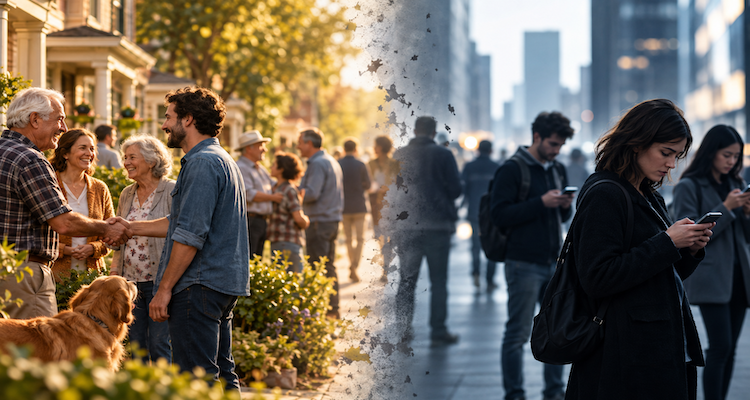
There was a time when a community could function almost like a living information network. A neighbor knew who had moved in, which family was struggling, whose child had graduated, who needed a ride, and which shopkeeper could be trusted. News travelled without an app. Reputation mattered because people repeatedly encountered the same people.
That kind of community has not disappeared, and it was never entirely idyllic. But the conditions that produced it are changing.
People move more frequently, live more independently, maintain relationships across greater distances and increasingly use digital platforms to communicate and find information. The result is not necessarily that people have fewer relationships. It is that relationships are becoming less geographically concentrated.
Recent research offers a useful picture of that transition. In a 2023 international survey reported by Pew Research Center, only 54% of U.S. adults said they felt very or somewhat close to people in their local community, compared with a median of 78% across the 24 countries surveyed. Among Americans under 30, the figure was 42%.
That does not prove that neighborhood life is collapsing. It does, however, suggest that the old assumption that living near people automatically produces social closeness is becoming less reliable.
When Familiarity Was Built Into Everyday Life
The “everyone knows everyone” model depends on repeated contact.
The same people attend the same schools, shop at the same stores, worship in the same places, work in the same local institutions and encounter one another in ordinary routines. Over time, familiarity creates overlapping networks: your neighbor may also know your employer, your child’s teacher may know your parents, and the person running the local store may know your family.
Social-network researchers describe this in terms of network density. A dense network contains many connections among the same people; everyone is connected to everyone else through multiple relationships.
But dense networks have a trade-off.
They can make cooperation and informal support easier because people know one another’s reputations. At the same time, they can reduce privacy and make it harder to escape established expectations. Recent research on rural communities, for example, has documented both sides of the “everyone knows everyone” environment: participants described community familiarity as a source of support but also as a source of social pressure and scrutiny.
The old village model therefore contained both security and constraint.
The important change today is that people increasingly have alternatives.
The Rise of the Selective Network
A person can now maintain close friendships with people who live hundreds or thousands of miles away while knowing very little about the person living next door.
That would have been unusual in a highly localized community.
Digital communication has made relationships less dependent on physical proximity. A former classmate can remain part of someone’s daily life after moving to another city. A professional community can exist entirely online. A person interested in a highly specialized hobby can find dozens of like-minded people without knowing anyone nearby who shares the interest.
This produces a paradox.
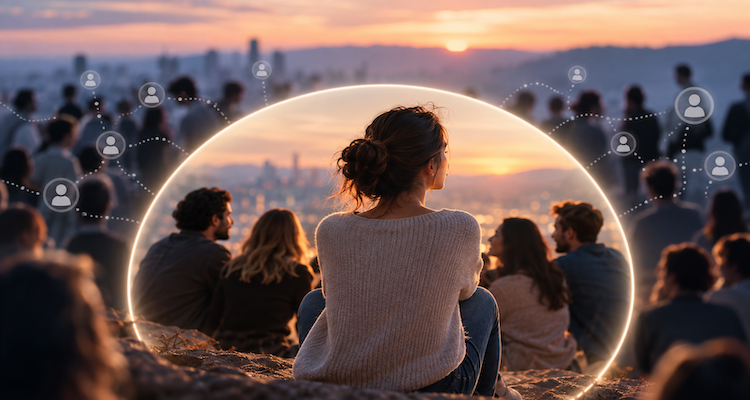
People can be socially connected while becoming less embedded in their immediate surroundings.
Research on social networks helps explain why this distinction matters. Weak ties acquaintances and connections outside one’s immediate circle can act as bridges between otherwise separate groups and provide access to new information and opportunities.
So the disappearance of a dense local network is not automatically a social loss.
Sometimes it represents greater freedom.
A tightly connected community can provide support, but it can also make privacy difficult. Research on migrant communities has documented this tension, with some participants describing small, interconnected communities as supportive while also worrying about the loss of personal privacy.
The modern network can therefore be more geographically scattered, but also more personally chosen.
What Gets Lost When Neighbors Become Strangers?
The problem begins when local relationships disappear without being replaced by meaningful alternatives.
A neighborhood does more than provide friendship. It can function as an informal information and support system.
That remains visible in the United States. Pew Research Center reported in 2024 that 73% of U.S. adults said they often or sometimes get local news from friends, family or neighbors. That figure was higher than the shares relying on television stations, radio stations or online forums in the survey.
Local relationships can therefore carry information that formal institutions do not always deliver effectively.
They can also provide practical assistance: noticing when something is wrong, helping during an emergency, recommending a reliable local service, or simply creating the expectation that someone will notice if a person disappears from ordinary routines.
When those connections weaken, the loss can be difficult to measure because there may be no formal institution replacing them.
A neighborhood can remain physically crowded while becoming socially thin.
The Loneliness Question Is More Complicated
It would be tempting to describe the decline of dense local communities as the direct cause of loneliness.
The evidence is more complicated.
Pew Research Center’s 2025 survey of 6,204 U.S. adults found that 16% said they felt lonely or isolated from people around them all or most of the time, while 38% said they sometimes felt lonely. Younger adults were more likely than adults aged 50 and older to report frequent loneliness.
But loneliness has multiple causes. Relationship status, income, education, age and other circumstances are associated with differences in reported loneliness. A simple explanation based entirely on neighborhood decline would therefore go beyond what the evidence supports.
What can be said more confidently is that social connection matters.
Research reviewed by Our World in Data links social relationships with well-being and notes that social connections also facilitate information sharing, learning and access to economic opportunities. At the same time, the organization emphasizes that more research is needed to understand the causal mechanisms and size of these effects.
The distinction matters: having fewer familiar neighbors is not synonymous with being lonely, and having a large online network is not synonymous with being socially fulfilled.
Community Is Becoming Something People Have to Build
One of the biggest changes may be that community is becoming less automatic.
Previous generations often inherited parts of their social network from geography. Today, people increasingly construct networks through work, education, interests, family, online communities and personal choice.
That gives individuals greater control over whom they interact with.
But it also transfers responsibility.
If everyday life no longer repeatedly places the same people in front of one another, relationships require deliberate maintenance. A neighborhood may have hundreds of residents without producing a shared social identity.
This is particularly visible in cities and highly mobile populations, where people can spend years living near others without developing meaningful relationships.
The physical neighborhood remains.
The social neighborhood becomes optional.
Digital Platforms Can Replace Some Functions But Not All
It would also be too simple to blame technology.
Digital platforms can weaken geographically based relationships, but they can also strengthen them.
Research in rural communities has found examples where digital initiatives helped residents participate in local civic life. In one study, streaming municipal meetings increased participation from people who were reluctant to attend meetings in person because of the visibility associated with a small community.
That example points toward a more useful way of thinking about technology.
The question is not whether online communication is good or bad for community.
The more important question is what kind of relationship it creates.
A neighborhood group that helps residents find a lost pet, organize assistance after a storm or share reliable local information can reinforce physical community. A platform that simply replaces every local interaction with distant digital engagement may do something very different.
Technology can provide infrastructure for community.
It cannot automatically create trust.
The Privacy Trade-Off
There is another reason the old community model has weakened: some people simply do not want it back.
Being known by everyone can mean being supported by everyone. It can also mean being watched, judged or discussed.
In tightly connected communities, reputation can become difficult to escape. Personal choices can become communal knowledge. Differences from local norms may attract attention.
Research among rural adolescents has illustrated this duality particularly clearly: participants described close community knowledge as supportive in some circumstances but associated it with social expectations and stigma in others.
Modern anonymity therefore has genuine value.
A person can move to a new city, change careers, reinvent parts of their identity and maintain relationships selectively.
The disappearance of automatic familiarity is not simply a story about social decline.
It is also a story about personal autonomy.
What the Future Community May Look Like
The emerging model is unlikely to be a return to the village where everyone knows everyone.
Instead, communities may become layered.
A person may have a few close local relationships, a wider professional network, a digital interest group, distant family connections and several loose networks that provide information or opportunities.
That structure can be more flexible than the traditional community, but it may also be less resilient when people need immediate local support.
The challenge is therefore not necessarily to restore an older form of community.
It is to preserve the useful functions of community trust, mutual assistance, shared information and belonging without requiring the loss of privacy and individual freedom that could accompany extremely dense social networks.
That distinction matters for cities, workplaces, schools, neighborhood organizations and technology platforms.
The most valuable community may not be the one in which everybody knows everybody.
It may be the one in which enough people know enough about one another to notice when help is needed while still leaving people room to live their own lives.
Conclusion
The “everyone knows everyone” community is not simply disappearing. It is being replaced, unevenly, by a more distributed form of social life.
People can now maintain meaningful relationships far beyond their neighborhoods while remaining relatively unknown to the people living next door. That creates freedom, diversity and access to new networks, but it can also weaken the informal systems of familiarity that once carried local information and support.
The evidence suggests that the real issue is not whether modern people have connections. They clearly do.
The harder question is where those connections live, what they provide, and whether someone will still notice when a neighbor needs help.
The future of community may depend less on making everyone know everyone and more on creating enough opportunities for people to know and trust some of the people around them.
This content is published for informational or entertainment purposes. Facts, opinions, or references may evolve over time, and readers are encouraged to verify details from reliable sources.