







The Secret Lives of Animals That Begin Only After the Forest Falls Silent
When daylight fades and familiar sounds disappear, forests reveal another world one shaped by extraordinary senses, hidden hunters, quiet communication, and the delicate balance of life after dark.
As the last sunlight slips through the trees, the forest begins to change.
Birdsong gradually fades. Shadows stretch across the undergrowth. The movements that filled the woodland during the day become harder to see, and for a brief moment, the entire forest may seem strangely still.
But the silence is misleading.
Beneath fallen leaves, small mammals begin searching for food. High in the branches, flying squirrels prepare to glide between trees. Owls listen for movements that human ears would struggle to detect. Farther away, bats emerge to hunt insects, while moths navigate a world illuminated by little more than moonlight and starlight.
The forest has not gone to sleep. Its activity has shifted.
For many animals, darkness is not an obstacle to overcome. It is the environment in which they are best equipped to survive.
Understanding what happens inside a forest after sunset reveals something remarkable about nature: the same habitat can support different communities of animals at different hours, each using its own adaptations to find food, avoid danger, communicate, and reproduce.
Why the Forest Changes After Sunset
A forest is never equally active at every hour.
Some species are diurnal, meaning they are primarily active during daylight. Others are nocturnal, with most of their activity occurring at night. A third group is crepuscular, becoming especially active around dawn and dusk.
These patterns are not simply preferences. They reflect the ecological pressures and opportunities that animals face.
Temperature, food availability, competition, predators, and the abilities of an animal’s sensory systems all influence when it is most advantageous to move.
For example, a small mammal that searches for seeds after sunset may avoid some daytime predators, although it could encounter nocturnal hunters instead. A bat that feeds on flying insects can exploit food resources during hours when many insect-eating birds are inactive.
In warmer environments, nighttime activity can also help animals avoid the heat of the day.
However, darkness does not automatically make the forest safer. It changes which dangers are most important.
An animal that escapes a daylight hunter may become vulnerable to an owl, snake, or other predator adapted to low-light conditions.
This constant exchange of risks and opportunities helps explain why forests contain such varied daily rhythms.
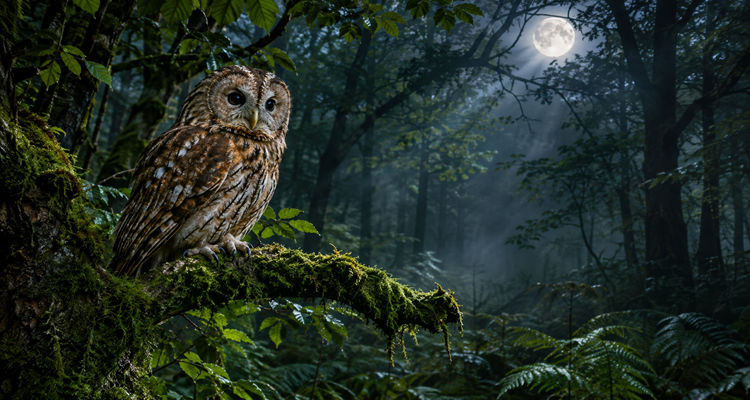
The Owl: A Hunter That Listens to the Darkness
Their success depends on a combination of adaptations rather than extraordinary eyesight alone.
Many owl species have eyes suited to gathering available light. Their forward-facing eyes also provide overlapping fields of vision that help them judge distance.
But hearing can be equally important.
The facial disc the arrangement of feathers around an owl’s face—helps direct sound toward its ears. In certain species, asymmetrically positioned ear openings improve the ability to locate sounds vertically as well as horizontally.
This allows some owls to identify prey even when it is partly hidden by vegetation or snow.
Their feathers provide another advantage. Specialized wing structures reduce some of the aerodynamic noise generated during flight, helping owls approach prey while also making it easier to hear faint sounds.
Not every owl is strictly nocturnal, and hunting strategies differ considerably among species. Nevertheless, many forest-dwelling owls demonstrate how evolution can favor quiet movement and precise hearing in low-light environments.
For a mouse moving through dry leaves, a barely audible rustle may reveal its position to a predator overhead.
Flying Squirrels: The Hidden Travelers Above the Forest Floor
While owls search for prey, another remarkable group of animals moves through the canopy.
Flying squirrels spend much of their active lives in trees, and many species are primarily nocturnal.
Despite their name, they do not fly by flapping wings.
Instead, they glide.
A flexible membrane of skin called the patagium stretches between their limbs. When a flying squirrel leaps from a branch and extends its legs, this membrane forms a surface that generates lift as the animal moves through the air.
By adjusting its body position and using its tail for stability and control, the squirrel can steer toward another tree.
Gliding allows these animals to travel between trees without repeatedly descending to the ground, where different predators and obstacles may await.
Their diet varies by species and habitat, but can include seeds, nuts, fungi, buds, and other plant material.
Some flying squirrels also play important ecological roles by consuming fungi and dispersing fungal spores. These fungi can form important relationships with tree roots, contributing to nutrient exchange within forest ecosystems.
A flying squirrel’s nighttime journey is therefore more than an impressive movement through the trees. Its feeding behavior can connect the animal to processes that help sustain the woodland itself.
Bats: Navigating a World Humans Cannot Hear
Many insect-eating bats use echolocation to navigate and locate prey. They emit sounds and interpret the echoes returning from objects in their surroundings.
In numerous species, these calls occur at ultrasonic frequencies above the normal range of human hearing.
The returning echoes provide information about the distance, direction, and characteristics of nearby objects.
This sensory ability allows bats to pursue insects in darkness, although their hunting performance depends on habitat structure, prey behavior, and species-specific adaptations.
Bats are not blind. Many have functional vision, and some use vision alongside echolocation.
Nor do all bats rely on echolocation in the same way. Fruit bats and other groups possess different combinations of sensory abilities and feeding strategies.
Forest bats can contribute to ecosystem functioning through insect consumption. In other environments, certain bat species are important pollinators and seed dispersers.
The significance of their nighttime activity extends beyond the individual insects they catch.
Bats are part of a wider network linking forest vegetation, insect populations, predators, and seasonal food availability.
Their movements also remind us that much of a forest’s ecological activity occurs beyond the limits of ordinary human perception.
Moths: The Night’s Overlooked Pollinators
Some of the forest’s most significant after-dark interactions involve insects and flowers.
Many moth species visit flowers to drink nectar. As they move between blossoms, they can transfer pollen, contributing to plant reproduction.
Their importance is easy to overlook because much of this activity occurs when people are not watching.
Different moth species use combinations of smell, vision, and other sensory information to locate flowers. Some plants have floral traits that are particularly suited to attracting nighttime visitors, including strong evening fragrances or pale flowers that are relatively conspicuous in low light.
However, moths are not universally nocturnal, and not every moth species is an effective pollinator.
Their ecological roles also extend beyond pollination. Moths and their caterpillars provide food for birds, bats, spiders, and other animals.
This creates an important connection between daytime and nighttime forest life.
A caterpillar feeding on leaves during one stage of its development may later become a moth that visits flowers after sunset. Along the way, it can support predators that operate at entirely different hours.
The forest’s food web does not reset when darkness arrives. It continues through changing forms of activity.
Small Mammals: The Quiet Search for Food
Much of the forest’s nighttime activity happens close to the ground.
Mice, voles, shrews, and other small mammals move through vegetation, leaf litter, fallen branches, and underground passages.
Their behavior differs widely by species. Some are mainly nocturnal, while others are active in repeated periods throughout the day and night.
For these animals, searching for food involves a delicate balance.
Seeds, fungi, insects, and other resources may be scattered across the forest floor. Finding enough food requires movement, but movement can increase exposure to predators.
Small mammals therefore often use protective cover, familiar routes, and sensory cues to reduce risk.
Their senses can be especially valuable in dim environments.
Whiskers help some mammals detect nearby surfaces and obstacles. Smell provides information about food, other animals, and territorial markings. Hearing can reveal approaching danger before it becomes visible.
These animals may seem insignificant compared with larger forest residents, yet their ecological roles are substantial.
Some disperse seeds and fungal spores. Others consume invertebrates, while many serve as prey for owls, snakes, foxes, and other predators.
Their nighttime movements help connect the forest floor to the wider ecosystem.
The Forest Has a Language That Becomes Easier to Notice at Night
A quiet forest is not necessarily a silent one.
As daytime sounds diminish, different signals become more noticeable.
Owls call across wooded territories. Frogs communicate near ponds and streams. Insects produce rhythmic sounds. Some mammals use vocalizations to maintain contact, warn others, or communicate during breeding.
The purposes of these sounds vary.
An owl’s call may help establish territorial boundaries or communicate with a mate. A frog’s breeding call may attract potential partners. Insect sounds can serve courtship and recognition functions.
Not all nighttime communication is audible to humans.
Some animals produce high-frequency signals, while others depend heavily on scent marking, body posture, or chemical cues.
Even silence can carry information.
An animal may become motionless when it detects a possible predator. Others may temporarily reduce vocal activity in response to disturbance.
It would be misleading, however, to assume that every pause in forest sound signals danger. Changes in calling can also reflect temperature, weather, seasonal conditions, or the natural timing of animal activity.
The nighttime forest is therefore better understood as a changing network of signals rather than a single mysterious chorus.
How Moonlight Changes the Rules of Survival
Darkness is not constant.
A forest beneath a bright full moon can present very different conditions from the same forest during a moonless night.
For animals that rely on vision, additional natural light may make navigation or food searching easier.
But brighter conditions can also increase visibility to predators.
Some small mammals reduce their activity in exposed areas when moonlight increases, a behavioral pattern often discussed in ecological research as lunar phobia.
Other species may respond differently, particularly when increased visibility helps them locate food or detect threats.
The relationship is complex. Cloud cover, vegetation density, predator abundance, and the animal’s own sensory abilities can all influence the response.
The same moonlit clearing may provide an advantage to one species while creating additional danger for another.
This helps explain why nocturnal behavior cannot be reduced to a simple preference for darkness.
Animals respond to changing levels of risk and opportunity throughout the night.
What Happens Beneath the Leaves After Dark?
The forest floor supports an extraordinary range of life, much of which remains hidden even during daylight.
Beetles, spiders, millipedes, springtails, worms, and countless other invertebrates inhabit the leaf litter and soil.
Some become more active at night, particularly when cooler temperatures and higher humidity reduce the risk of drying out.
Predatory arthropods may search for smaller animals, while detritivores consume decaying organic material.
Decomposition itself continues around the clock, driven by fungi, bacteria, and soil organisms. It is not exclusively a nighttime process.
Yet the animals involved in breaking down organic matter can have distinct activity patterns.
By fragmenting dead leaves and other material, soil invertebrates help make organic matter available for further decomposition. Microorganisms then participate in the release and transformation of nutrients.
Those nutrients can eventually support plant growth.
In this way, the forest’s apparently unremarkable layer of fallen leaves is part of a living recycling system.
What looks like a quiet carpet of debris is actually a habitat filled with feeding, movement, competition, and decomposition.
Why Artificial Light Threatens the Nighttime Forest
Streetlights, illuminated buildings, roads, recreational facilities, and other sources can introduce light into habitats that historically experienced natural cycles of darkness.
The effects extend beyond making nighttime brighter.
Animals use changes in light to regulate activity, feeding, reproduction, and biological rhythms.
A major scientific meta-analysis published in Nature Ecology & Evolution found that artificial nighttime lighting can produce substantial changes in animal physiology, daily activity, and life-history characteristics. The effects differ across species and circumstances.
Some insects are attracted to artificial lighting, while others avoid illuminated areas. Certain bats may exploit concentrations of insects around lights, whereas more light-sensitive species may avoid exposed locations.
Research reported by the U.S. Forest Service in 2023 found that introducing artificial lighting altered the composition of nighttime arthropod communities, including changes involving predators, scavengers, and parasites.
These findings matter because the consequences of artificial lighting are not limited to individual animals.
Changing where insects gather can affect their predators. Changing when mammals forage can alter their exposure to danger. Disrupting natural light cues may affect biological timing.
The result can be a broader shift in how an ecosystem functions.
The U.S. National Park Service has also documented the growing body of scientific research examining artificial light’s effects on wildlife and ecosystems.
How Scientists Discover Animals We Rarely See
Studying nocturnal animals presents an obvious challenge: many are most active when human observation becomes difficult.
Motion- or heat-triggered cameras can record animals moving through forests without requiring researchers to remain nearby. They help reveal activity patterns, habitat use, and species presence.
A camera trap may miss animals outside its detection area. Acoustic recordings do not always establish the exact number of individuals present. Tracking devices can be unsuitable for very small or sensitive species.
Researchers therefore often combine multiple methods to build a more reliable understanding of nocturnal wildlife.
The result is a gradually improving picture of ecosystems that humans have historically observed only in fragments.
Why Protecting the Night Matters as Much as Protecting the Forest
Forest conservation is often discussed in terms of trees, habitat loss, and endangered species.
Those concerns are essential, but they are not the entire picture.
A healthy forest also depends on ecological processes that unfold at different times of day.
Nocturnal pollinators visit flowers. Predators regulate prey populations. Small mammals move seeds and fungi. Invertebrates contribute to decomposition. Bats consume insects.
These activities overlap and influence one another.
When forests are fragmented by roads, disturbed by persistent noise, or exposed to excessive artificial lighting, the consequences can extend into the nighttime behavior of wildlife.
Practical conservation measures include protecting connected habitats, retaining appropriate tree cover and natural roosting sites, reducing unnecessary outdoor lighting, and limiting disturbance in sensitive areas.
Lighting should be used where genuinely needed, directed toward the intended area, and controlled to avoid unnecessary illumination of surrounding habitats. Its ecological effects depend on factors such as intensity, timing, wavelength, and location.
A scientific review of artificial nighttime lighting emphasizes that effective mitigation must consider these differences rather than assuming one lighting design is harmless to every species.
Staying on designated trails, avoiding disturbance to roosts and nests, keeping a respectful distance from wildlife, and following local access rules can reduce unnecessary impacts.
Observing nature should never require forcing an animal into view.
The Forest Never Truly Falls Silent
The most fascinating thing about a nighttime forest may be how much happens without attracting human attention.
An owl detects movement beneath the trees. A flying squirrel crosses a gap in the canopy. A bat follows echoes through the darkness. A moth visits a flower, while small creatures move through fallen leaves below.
These are not separate performances staged for the night.
They are interconnected parts of an ecosystem that continues functioning whether people are watching or not.
Daylight reveals only one version of the forest.
Darkness reveals another—not because nature suddenly becomes mysterious, but because different animals possess the abilities, behaviors, and ecological opportunities needed to thrive when the sun disappears.
The forest does not stop living when its familiar sounds fade.
It simply continues its work in ways that are easier for us to miss.
And perhaps that is the most important lesson of the nocturnal world: what we cannot easily see may still be essential to everything we can.
This content is published for informational or entertainment purposes. Facts, opinions, or references may evolve over time, and readers are encouraged to verify details from reliable sources.
Related News
- Mary the Elephant: The Animal They Executed for a Crime She Could Never Understand
- The Animals That Change Their Daily Routine When Humans Stop Watching
- The Forest Has a Warning System That Works Before Most Animals Ever See the Predator
- The Animals That Change Their Behavior When Nobody Is Watching