








Mary the Elephant: The Animal They Executed for a Crime She Could Never Understand
In September 1916, a circus elephant killed her handler in Tennessee. The following day, she was hanged from a railroad crane before a crowd of spectators. More than a century later, her story raises a disturbing question: When an animal causes a human tragedy, who is responsible for what happens next?
HISTORY · ANIMAL WELFARE · HISTORICAL FEATURE
On September 13, 1916, a five-ton elephant named Mary stood in a railroad yard in Erwin, Tennessee. A heavy chain was placed around her neck, and a powerful industrial crane began lifting her off the ground.
People had gathered to watch her die.
Mary was not suffering from an incurable illness. She had not been condemned by a court. She was a performing elephant whose handler had been killed the previous day.
To the people demanding her death, she had committed an unforgivable act. Newspapers would associate her with a chilling nickname: Murderous Mary.
But murder is a human legal and moral concept. Mary could not have understood an execution as punishment for a crime.
Her death was real, documented in local history and preserved through photographs, newspaper accounts, and witness recollections. Yet the circumstances surrounding it reveal something more complicated than a simple story of a dangerous animal.
They reveal how fear, entertainment, public pressure, and human decisions combined to turn an animal’s death into a spectacle.
Before the Tragedy, Mary Was a Circus Star
Long before Mary became infamous, she was one of the main attractions of Sparks World Famous Shows, a traveling American circus.
At a time when television did not exist and many communities had limited access to exotic wildlife, traveling circuses offered audiences the opportunity to see animals they might otherwise encounter only in books or illustrations.
Elephants were especially valuable attractions.
Their enormous size, unusual appearance, and ability to perform trained routines made them popular with spectators. Circus advertisements frequently presented them as extraordinary creatures capable of almost human accomplishments.
Mary was particularly important to the Sparks circus.
Historical accounts describe her as an Asian elephant weighing approximately five tons. She reportedly performed tricks, participated in musical routines, and appeared in comedy acts involving baseball.
She was also part of the circus’s public identity. Her presence helped attract audiences and distinguish the show from competitors.
But the performances that impressed spectators depended on an entirely different reality behind the scenes.
Mary lived under human control.
Her movements, routines, transportation, and interactions were managed by handlers. Like other performing elephants of the period, she was expected to obey commands in unfamiliar, crowded, and frequently noisy environments.
The public saw an impressive entertainer. The circus saw a valuable attraction.
What Mary experienced is much harder to reconstruct.
The historical record contains descriptions of her performances and eventual death, but it offers little reliable information about her daily physical condition, stress, or treatment over the years.
That absence matters. The people who controlled her life also shaped much of the surviving account of it.
September 12, 1916: The Day Everything Changed
The incident that sealed Mary’s fate occurred in Kingsport, Tennessee, on September 12, 1916.
Her handler was Walter Eldridge, commonly known as Red Eldridge.
Accounts describe Eldridge as a relatively inexperienced circus employee who had only recently begun working with the elephants.
During an outing involving Mary, something went terribly wrong.
Mary attacked Eldridge, and he died from his injuries.
That central event is well established. The exact sequence of events, however, is disputed.
One widely repeated version claims Mary stopped to pick up a discarded watermelon rind. Eldridge allegedly tried to redirect her with an elephant-handling hook, provoking a violent reaction.
Other accounts describe different circumstances, including an encounter near the circus tent.
Contemporary newspaper reports were sometimes highly dramatic, attributing human emotions and intentions to Mary while describing the attack.
Later historians found that eyewitness recollections and published descriptions differed substantially.
Joan Vannorsdall Schroeder’s historical investigation, drawing on oral histories preserved at East Tennessee State University, highlights these contradictions.
The distinction is essential: Mary killed Eldridge, but the surviving evidence does not establish exactly why she attacked him.
Was Mary reacting to pain?
One explanation that continues to circulate suggests Mary suffered from an infected or abscessed tooth.
According to this version, pressure from a handler’s hook near the painful area may have triggered her reaction.
It is a plausible explanation in the general sense that pain can influence animal behavior. But plausibility is not proof.
The toothache story appears in later retellings, and the available historical evidence does not conclusively establish the diagnosis or demonstrate that it caused the attack.
Other explanations, including stress, fear, improper handling, or an unpredictable response to a specific stimulus, also cannot be confirmed from the surviving record.
What can be said is that Mary was a powerful wild animal living in a highly controlled environment, and her handler died during an interaction with her.
Eldridge’s death was a genuine human tragedy.
Recognizing that tragedy does not require assuming Mary possessed a human intention to murder.
How an Elephant Became a Public Enemy
After Eldridge’s death, public anger intensified.
People feared that Mary might kill again. Accounts describe demands for the elephant to be destroyed, while attempts to shoot her were reportedly unsuccessful.
The circus now faced an immediate problem.
Mary was an enormous animal capable of causing fatal injuries, and the public had witnessed or heard about a frightening incident.
The circus also depended on public confidence.
An attraction that audiences once admired had become associated with danger.
The decision to kill Mary was made within this atmosphere of fear and commercial pressure.
But there was an additional, troubling element.
Instead of quietly arranging her death, the circus chose a method that would make the event highly visible.
Mary would be hanged using a railroad crane in nearby Erwin, Tennessee.
Historical interpretations differ on the relative importance of public safety, pressure from residents, and the circus’s business interests. What is clear is that the method transformed the killing of an animal into a public event.
The Hanging of Mary the Elephant
On September 13, 1916, Mary was brought to the Clinchfield Railroad yard in Erwin.
The railway facilities contained heavy industrial equipment, including a crane powerful enough to lift an animal of her size.
A crowd gathered to witness what was about to happen.
Estimates of attendance vary, with some historical accounts placing the number at approximately 2,000 or more.
The precise size of the crowd is less important than what its presence demonstrates: Mary’s death had become a public spectacle.
According to the account published by the Tennessee Encyclopedia, workers secured one of Mary’s legs to a rail and placed a heavy chain around her neck.
The crane began lifting her.
The first attempt failed.
The chain broke, and Mary fell to the ground. The Tennessee Encyclopedia reports that the fall broke her hip.
Workers then attached a heavier chain and attempted the hanging again.
This time, Mary was lifted and died from strangulation.
The account states that the second attempt took approximately five minutes.
Other historical narratives differ in some mechanical details, but they agree on the essential event: Mary was killed by hanging from a railroad crane after an initial failed attempt.
The machinery had been designed for industrial work.
On that September afternoon, it was used to kill an elephant.
What happened to Mary’s body?
Accounts indicate that Mary’s remains were buried near the railroad tracks.
The precise burial location has remained uncertain in later historical discussions.
The story survived not because her grave became a major landmark, but because the circumstances of her death were so unusual that they entered local memory.
Over time, the event became associated with Erwin itself, sometimes overshadowing the community’s broader history.
A town that happened to possess the necessary railway equipment became permanently linked to one of America’s most disturbing circus stories.
Was Mary Really Executed for Murder?
Calling Mary’s death an execution reflects how the event was presented and remembered.
But it is important to distinguish a public killing framed as punishment from a formal criminal proceeding.
Mary was not a human defendant. She did not stand trial, understand a criminal charge, or receive a judicial sentence.
The decision to kill her was made by people responding to a dangerous incident and the public reaction that followed.
This distinction changes how the story should be understood.
Human criminal responsibility generally involves concepts such as intention, knowledge, accountability, and the ability to understand prohibited behavior.
Those concepts cannot simply be transferred to an elephant.
Elephants can learn, remember, respond to training, and adjust their behavior through experience. But there is no basis for claiming Mary understood that she had violated a human law or that the hanging was retribution for Eldridge’s death.
To Mary, the chain, the crane, and the people surrounding her would have been experiences imposed upon her.
We cannot reconstruct what she thought or felt in those final moments.
We can, however, examine the human choices that brought her there.
The people involved possessed the ability to debate alternatives, consider consequences, and decide how to respond.
Mary did not possess that kind of control over the situation.
That imbalance is central to the ethical questions her death continues to raise.
The Dangerous Confusion Between Animal Behavior and Human Evil
Descriptions of dangerous animals often rely on human moral language.
An elephant becomes murderous. A predator becomes vicious. An animal that injures a person is described as seeking revenge.
Such language may express human fear, but it can also obscure the causes of animal behavior.
Animals can inflict devastating injuries without understanding the moral meaning humans attach to those injuries.
An elephant’s size and strength make this distinction particularly important.
A single defensive movement, stress response, or aggressive interaction can have consequences far beyond those of a smaller animal.
That does not make the resulting danger imaginary.
It means that responding responsibly requires understanding the animal’s behavior rather than simply assigning it a human moral identity.
Mary’s case illustrates the consequences of failing to maintain that distinction.
Once she became known as a killer, her individual circumstances mattered less than the frightening public image surrounding her.
The story became easier to tell as a punishment narrative: an animal killed a man, and the animal paid with her life.
But that narrative leaves out the people responsible for her captivity, training, handling, and eventual death.
It also leaves unanswered whether the fatal incident could have been prevented.
What the Famous Photograph Can and Cannot Tell Us
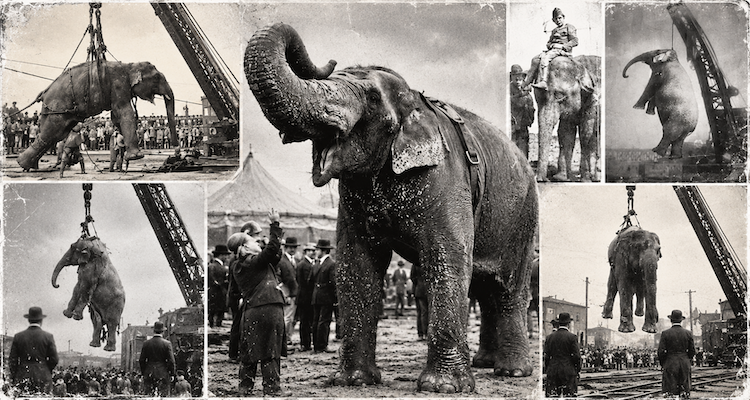
One of the most enduring elements of Mary’s story is a historical image associated with her hanging.
The photograph has circulated for decades as visual evidence of the event.
The City of Kingsport Archives maintains a photograph identified as Mary the elephant, while historical writers have examined the authenticity and circumstances of images associated with her death.
Some accounts have raised questions about the well-known hanging photograph, including inconsistencies involving the elephant’s appearance.
These questions do not invalidate the historical fact that Mary was hanged.
They do, however, illustrate why photographs should be evaluated alongside written records, provenance, and contemporary testimony.
A disturbing image can become so familiar that viewers stop asking how it was produced, whether it was altered, or what context may be missing.
The historical event is documented independently of any single photograph.
How Much of Mary’s Story Is History and How Much Is Legend?
Mary’s death occurred more than a century ago, and the story has been repeatedly retold.
Some details are firmly established. Others remain uncertain.
| Historical claim | Evidence assessment |
|---|---|
| Mary killed Walter Eldridge on September 12, 1916 | Well documented |
| Mary was hanged in Erwin on September 13, 1916 | Well documented |
| A railroad crane was used | Well documented |
| The first hanging attempt failed | Supported by multiple historical accounts |
| Mary attacked because of a watermelon rind | Disputed account |
| An infected tooth caused the attack | Unconfirmed explanation |
| The crowd contained exactly 2,500 people | Estimates vary |
| Mary understood she was being punished | Unsupported |
| The exact location of her remains is known | Not reliably established |
Historical uncertainty is not a weakness to conceal.
It is part of understanding the past responsibly.
Charles Edwin Price’s book The Day They Hung the Elephant specifically addresses the ways oral tradition and repeated storytelling complicated the historical record.
The challenge is to preserve the established tragedy without treating every memorable detail as fact.
A Century Later, Erwin Confronted Its Unusual History
Mary’s death did not disappear from local memory.
For generations, Erwin remained associated with the elephant hanging, often through an uncomfortable mixture of curiosity, embarrassment, and historical fascination.
But attitudes toward the story have changed.
In 2019, Colorado Public Radio reported on a project involving Tennessee high school students who interviewed residents, archivists, and public officials about Mary and Erwin’s relationship with the event.
The project explored how a community remembered a disturbing episode and how the story might encourage a different understanding of elephants.
Rather than treating the hanging simply as an unusual historical curiosity, the students examined its significance for animal welfare and the town’s identity.
That change in emphasis is important.
Remembering Mary need not mean reducing Erwin to a single act committed more than a century ago.
It can mean recognizing the event, understanding the historical circumstances, and asking what can be learned from it.
What Mary’s Death Reveals About Human Responsibility
The story of Mary the Elephant is sometimes presented as an example of how cruel people were in the past.
That interpretation is understandable, but it is incomplete.
Mary’s death was not the result of a single person’s decision in isolation.
It emerged from a larger system in which wild animals were transported, trained, exhibited, and controlled for commercial entertainment.
Within that system, people determined where animals lived, what they performed, how they were handled, and what happened when something went wrong.
When Mary killed Eldridge, the consequences were catastrophic.
Yet the decisions surrounding her response, confinement, and eventual killing belonged to human beings.
This does not mean dangerous animals should never be restrained or, in extreme circumstances, killed to protect people.
Public safety and animal welfare can present genuinely difficult decisions.
The ethical issue in Mary’s case is not simply that a dangerous elephant was killed.
It is that her death was staged as a public hanging, using a method that historical accounts describe as prolonged and unsuccessful on the first attempt.
That spectacle is difficult to separate from the era’s appetite for extraordinary entertainment.
Mary had spent years attracting crowds while alive.
In the end, she attracted another crowd because people had decided she should die.
Why Mary the Elephant Still Matters
More than a century after her death, Mary’s story remains unsettling because it resists an easy division between innocence and guilt.
Walter Eldridge lost his life. His death deserves acknowledgment, not dismissal.
Mary killed him, but the evidence does not establish why.
The circus faced a dangerous situation, yet the response transformed that danger into a public spectacle.
And the community of Erwin inherited a history that later generations would struggle to interpret.
The lesson is not that elephants are harmless or that human safety should be ignored.
It is that animal behavior and human moral responsibility are not interchangeable.
When people place powerful wild animals in artificial environments, those people also assume responsibility for the risks and consequences of that arrangement.
Mary could not choose the circus, the handler assigned to her, the journey to Erwin, or the method of her death.
Others made those choices.
That is why the most important question in Mary’s story is not whether she deserved punishment.
It is why human beings decided that punishment should look like a public execution.
And perhaps that is the most enduring tragedy of Mary the Elephant: she became famous for a crime she could never have understood, while the people who controlled her life were the only ones capable of understanding the moral consequences of what happened.
Sources & Further Reading
The following sources were consulted for the historical narrative, including its disputed details.
1. Tennessee Encyclopedia — Charles Edwin Price, “Murderous Mary.” Published by the Tennessee Historical Society. A concise historical account of Mary’s death and the hanging procedure. Read source.
2. Kingsport Public Library and Archives — “Mary the Elephant.” Archival photographic record and identification of the incident. View archival record.
3. Blue Ridge Country — “From the Archive: The Day They Hanged an Elephant in East Tennessee.” Historical reporting drawing on eyewitness recollections and regional archival material. Read investigation.
4. Knox County Public Library — “The Hanging of Mary, a Circus Elephant.” An abridged reading of Thomas Burton’s 1971 historical article. Explore historical account.
5. Charles Edwin Price — The Day They Hung the Elephant (1992). Historical study addressing inconsistencies and oral traditions surrounding the incident. View book record.
6. Colorado Public Radio — “The Town That Hanged an Elephant Is Now Working to Save Them.” Reporting on the event’s continuing legacy and a student-led historical project. Read feature.
This content is published for informational or entertainment purposes. Facts, opinions, or references may evolve over time, and readers are encouraged to verify details from reliable sources.