









The Forest Has a Warning System That Works Before Most Animals Ever See the Predator
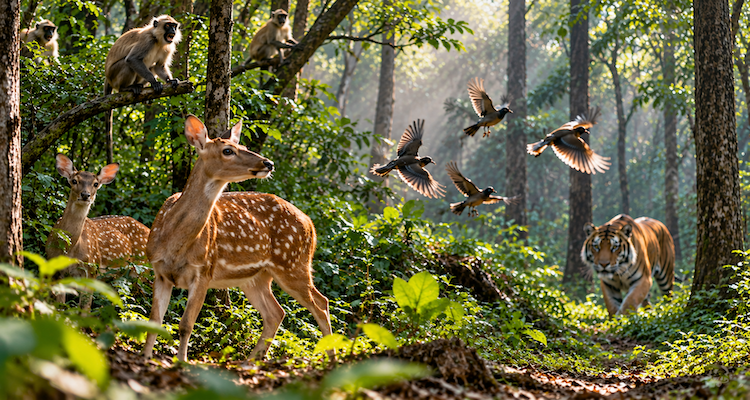
A forest may appear peaceful long before danger becomes visible. Birds continue moving through the canopy, insects hum beneath the leaves, and small mammals search the ground for food. Yet somewhere among these ordinary activities, a change may already be taking place. One bird gives a sharp call. Another suddenly stops feeding. A squirrel freezes on a branch. Within moments, animals that have never seen the approaching predator may begin behaving as if something is wrong.
This is one of the most fascinating features of forest life: animals can sometimes detect danger indirectly, using information produced by other living creatures. The forest does not need a central alarm or a single watchful guardian. Instead, countless individual responses can create a loose, constantly changing network of warnings.
The system is imperfect, but it can give animals something precious in the wild: a little more time to escape.
The First Warning May Come From an Animal You Would Never Suspect

Birds are particularly important in many woodland environments because they can spot movement from elevated perches and communicate through sound. When a bird notices a predator, it may produce an alarm call or change its behaviour. Other animals can respond to these signals without knowing exactly what the first bird saw.
Research on mixed-species bird flocks has shown that different species can respond to one another’s alarm calls. In some circumstances, birds also recognise distinctions between calls associated with different types of threats. This means a warning can travel beyond the species that first detected the danger.
However, not every bird call is an alarm. Calls can signal food, contact, territory or other information. Animals must interpret what they hear in context, and their responses can vary with the species, the threat and the surrounding environment.
The important point is that the animal that first detects a predator does not have to be the animal that benefits from the discovery.
The Forest Communicates Through More Than Sound

Many mammals have a powerful sense of smell. Deer, for example, may detect the scent of a predator or notice unfamiliar odours carried by the wind. Rodents can respond to chemical cues associated with predators, while some insects detect chemical signals released by other members of their species when danger threatens.
These signals do not work in the same way. An alarm call may identify an immediate threat, while a scent can indicate that a predator has passed through an area. Neither necessarily reveals the predator’s exact location or whether an attack is imminent.
Animals combine these clues with experience and their surroundings. A rabbit that hears sudden movement in nearby vegetation may become alert. If it also detects a predator’s scent, its response may become stronger.
Movement itself can become information. When several animals stop feeding, turn their heads in the same direction or suddenly retreat, their behaviour may attract the attention of others. An animal that cannot see the original threat can still recognise that its neighbours have detected something unusual.
Scientists study these responses as part of animal communication, collective behaviour and predator–prey ecology. Together, they help explain how information about danger can spread through a habitat without every animal independently detecting the predator.
Why One Animal’s Fear Can Save Another’s Life

Imagine a predator moving through dense woodland. A bird notices it first and gives an alarm call. A nearby squirrel reacts by climbing higher, while a deer lifts its head and watches the surrounding vegetation. Other animals may then become alert because they notice these changes.
The chain does not need to be deliberate. The bird does not have to warn the deer specifically, and the squirrel does not have to understand the bird’s message. Their reactions can still provide useful information to animals nearby.
This is sometimes described as eavesdropping on alarm signals: an animal uses communication produced by another species to assess its own risk.
The benefits can be considerable, particularly when visibility is poor. Forests contain dense vegetation, uneven terrain and many obstacles that make direct observation difficult. A network of sounds and behavioural cues can provide information from beyond an animal’s immediate field of vision.
There is a trade-off, however. Responding to every unusual noise wastes energy and time. Animals that flee too often may abandon food, lose access to shelter or expose themselves to other dangers.
They must therefore balance caution with the need to continue feeding, resting and reproducing. Some calls are more reliable than others, and familiar species may provide more useful information than unfamiliar ones.
A warning is valuable not simply because it exists, but because an animal can interpret it well enough to make a better decision.
Can the Forest’s Warning System Fail?

False alarms create another problem. A harmless movement may resemble a threat, causing animals to flee unnecessarily. If warnings repeatedly prove unreliable, animals may become less responsive to them.
Human activity can interfere with these systems as well. Traffic noise may mask animal calls, habitat fragmentation can separate populations, and changes in species abundance may alter the communication networks on which some animals depend.
Research into animal communication and ecological change suggests that these effects deserve attention, although their consequences vary by habitat and species. It would be misleading to assume that every forest has one coordinated warning system or that all animals interpret the same signals in the same way.
Instead, each ecosystem contains overlapping relationships shaped by evolution, experience and local conditions. Some animals listen for alarm calls. Others rely more heavily on scent, sight or their own ability to detect movement.
The forest’s apparent silence, therefore, does not necessarily mean that nothing is happening. Equally, a sudden burst of activity does not always mean a predator is nearby. Understanding these signals requires attention to the animals, their environment and the circumstances in which their behaviour occurs.
What This Reveals About Life in the Wild
The forest’s warning network offers a revealing lesson about survival. Animals do not live by their own senses alone. Their decisions can also depend on information gathered by other species, sometimes without direct contact or any obvious relationship between them.
A bird’s alarm call may help a mammal. A neighbour’s sudden retreat may alert an animal that has not heard a sound. A scent left behind hours earlier may influence whether a small creature ventures into an exposed clearing.
These interactions turn an ecosystem into something more than a collection of separate organisms. The actions of one animal can change the choices available to many others.
But this is not a perfect early-warning machine. Some predators go undetected, some warnings are misunderstood, and some animals respond too late. What makes the system remarkable is not that it prevents every attack, but that information can travel through a forest faster than an individual animal might discover the danger alone.
The next time a woodland seems peaceful, consider what may be happening beyond your sight. A bird may have noticed movement behind a tree. A squirrel may have stopped feeding. A deer may be listening rather than grazing.
None of these behaviours proves that a predator is present. Yet each is a reminder that survival often depends on noticing not only the world around us, but also how others respond to it.
In the forest, the first animal to recognise danger may not be the only one to benefit. Sometimes, survival begins with a warning that someone else heard first.
This content is published for informational or entertainment purposes. Facts, opinions, or references may evolve over time, and readers are encouraged to verify details from reliable sources.