









The Invisible Weather Inside a City That Never Appears on a Forecast
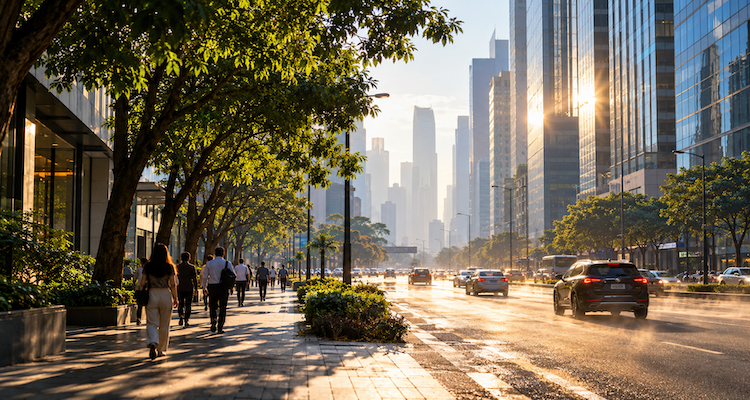
A weather forecast might tell you that the temperature in a city is 24°C, the wind is light, and the sky will remain clear throughout the afternoon. Yet, as you walk through that same city, the experience can change dramatically within a few minutes.
One street feels unbearably hot. Another offers surprising relief beneath a row of trees. A narrow passage seems to funnel the wind directly into your face, while a nearby courtyard remains almost completely still. The forecast has not changed, but the weather you experience has.
This difference is not simply a matter of perception. Cities create their own small-scale atmospheric conditions through buildings, roads, vegetation, traffic and human activity. Scientists study these variations through the concepts of urban microclimates and urban meteorology.
The result is a form of invisible weather that exists between buildings, above pavements and inside courtyards. It rarely appears in a standard citywide forecast, yet it can influence comfort, energy consumption, air quality and even how people choose to move through their surroundings.
Why Two Streets Can Feel Like Two Different Climates
Imagine walking along a broad road surrounded by glass-fronted offices. Sunlight reflects from windows, the pavement absorbs heat, and the surrounding buildings restrict the movement of air. A few minutes later, you turn onto a tree-lined residential street where shade protects the pavement and leaves release moisture into the atmosphere.
Both streets may share the same official temperature, but their immediate environments can feel remarkably different.
The reason begins with how urban surfaces absorb, reflect and release energy. Dark asphalt and many building materials absorb substantial amounts of solar radiation during the day. They gradually release some of that stored heat into the surrounding air, particularly after sunset.
Trees influence the process differently. Their canopies block some direct sunlight, while water released through their leaves can help cool the surrounding environment. The amount of cooling depends on factors such as available water, tree species, canopy coverage and local conditions.
Building geometry matters, too. Tall structures can cast extensive shadows, redirect sunlight and restrict airflow. A street surrounded by closely spaced buildings may remain shaded for much of the day, while an exposed plaza nearby receives intense solar radiation.
These differences create urban microclimates: small areas with atmospheric conditions that differ from those of their surroundings.
A city therefore does not have one uniform outdoor climate. It contains countless overlapping environments, each shaped by its materials, layout and vegetation.
The Hidden Movement of Wind Between Buildings
Wind does not travel through a city in the same way it moves across an open field.
When moving air encounters a tall building, it may be diverted around the structure, pushed upward or channelled towards street level. Depending on the building’s shape and the direction of the wind, pedestrians may experience sudden gusts around corners or along narrow passages.
This helps explain why a relatively calm day can still produce unexpectedly strong winds at certain street corners. The effect is not necessarily evidence that the broader weather forecast is wrong. It may simply reflect how the local architecture interacts with the prevailing airflow.
The opposite can also happen. Buildings can shelter courtyards and narrow streets, reducing the amount of wind reaching them. While this may make an outdoor space feel more comfortable in cool weather, limited air movement can contribute to uncomfortable heat during warmer periods.
Urban airflow is also influenced by street orientation, building height, gaps between structures and nearby open spaces. These factors can produce complicated patterns that change as the wind direction shifts.
Architects and urban planners increasingly consider these effects when designing public squares, pedestrian routes and new developments. A visually attractive space may not be comfortable if its design traps heat or exposes people to persistent gusts.
The invisible weather of a city is therefore partly an architectural creation. The shape of a street can influence how the atmosphere behaves at ground level.
Why Cities Can Stay Warm After Sunset
One of the most familiar examples of urban weather is the urban heat island effect.
Cities often remain warmer than nearby rural areas, particularly during the evening and night. Buildings, roads and other artificial surfaces absorb heat during the day and release it gradually. The relative lack of vegetation in some neighbourhoods can also reduce shade and evaporative cooling.
Human activities contribute additional heat. Vehicles, industrial processes, air-conditioning systems and buildings releasing waste heat can all influence local temperatures, although their relative importance varies between locations.
After sunset, the difference can become especially noticeable. Open countryside may cool relatively quickly, while densely built neighbourhoods retain warmth.
However, the effect is not identical everywhere. A leafy residential district, a paved shopping centre and an industrial estate can have substantially different thermal conditions even within the same city.
This matters because prolonged heat can affect sleep, concentration and physical comfort. People without access to effective cooling may face greater difficulties during heatwaves, particularly older adults, young children and people with certain health conditions.
Urban heat also creates challenges for public infrastructure. Higher temperatures can increase cooling demand, put pressure on electricity systems and make outdoor working conditions more difficult.
Planting trees, increasing vegetation, improving shade and using suitable reflective or heat-managing materials can help reduce some of these effects. Their effectiveness depends on local design, maintenance, water availability and the wider urban environment.
The important point is that the temperature announced in a forecast does not necessarily describe the heat experienced at every location within a city.
The Weather That Influences Air Quality
Invisible urban weather also affects what people breathe.
Air pollution levels depend on the amount of pollution being produced, how quickly it disperses, and how atmospheric conditions transport or transform it. Traffic emissions, industrial activity, construction dust and other sources can create local differences in air quality.
On some streets, buildings can restrict ventilation and allow pollutants to accumulate under particular wind and atmospheric conditions. On others, stronger air movement may help disperse emissions.
Temperature and sunlight also influence atmospheric chemistry. For example, ground-level ozone can form through chemical reactions involving nitrogen oxides and volatile organic compounds in sunlight. Its concentrations may vary across a city and throughout the day.
These patterns are complicated. A street that appears open and breezy is not automatically cleaner, and a shaded street is not necessarily more polluted. The sources of emissions, wind direction, background pollution and chemical reactions all matter.
Humidity and temperature can also influence how airborne particles behave and how comfortable breathing feels, but they do not provide a reliable substitute for actual air-quality measurements.
This is why a citywide air-quality reading cannot always describe the conditions beside a busy road or within a sheltered urban canyon.
The weather between buildings is not merely a question of whether people feel hot or cold. It can also affect the movement and concentration of substances in the air around them.
Can Cities Learn to Manage Their Invisible Weather?
Understanding urban microclimates offers practical opportunities for making cities more comfortable and resilient.
Urban planners can use temperature sensors, weather stations, satellite observations and computer simulations to identify neighbourhoods that experience excessive heat or poor ventilation. Measurements taken at different heights and locations can reveal patterns that a single monitoring station might miss.
Green infrastructure is one potential response. Trees provide shade, while parks and other planted areas can create cooler local environments under suitable conditions. Green roofs and vegetated walls may also help moderate building temperatures, although their benefits vary with design and climate.
Street layout can make a difference as well. Providing shade along walking routes, designing public spaces with local wind patterns in mind, and selecting appropriate surface materials can improve outdoor comfort.
Cities can also develop heat-response plans that identify vulnerable neighbourhoods and provide accessible cooling spaces during extreme temperatures.
However, no single intervention works everywhere. Dense tree planting, for instance, may improve shade and cooling but can also affect airflow in locations where ventilation is already limited. Reflective surfaces can reduce the amount of solar energy absorbed by some surfaces, yet their effects on nearby pedestrians depend on how sunlight is reflected.
Effective planning therefore requires local evidence rather than relying on a universal solution.
The goal is not to control every gust of wind or eliminate every temperature difference. It is to understand how the built environment shapes exposure to heat, wind and pollution, then design places that better support the people who live and work there.
The Forecast Is Only Part of the Story
The next time a weather app announces a comfortable afternoon, pay attention to what happens as you walk through your neighbourhood.
Notice where the pavement radiates heat, where trees provide relief, where the wind suddenly strengthens and where the air seems unusually still. These observations cannot replace scientific measurements, but they can reveal how dramatically the immediate environment changes from one location to another.
The city above the rooftops may share one broad weather system. At street level, however, countless smaller atmospheric patterns operate simultaneously.
Some are created by concrete and glass. Others emerge from vegetation, water, traffic and the movement of air around buildings. Together, they form a constantly changing environmental landscape that ordinary forecasts cannot fully capture.
Perhaps the most interesting part is that this invisible weather is not entirely beyond human influence. The streets we design, the trees we preserve and the materials we choose can change how heat and air move through urban spaces.
A city is more than a collection of buildings beneath the sky. It is also an environment that continuously reshapes the atmosphere around its inhabitants.
And sometimes, understanding the weather outside your door requires looking beyond the forecast on your phone.
This content is published for informational or entertainment purposes. Facts, opinions, or references may evolve over time, and readers are encouraged to verify details from reliable sources.