







Why Some Species Are Moving While Others Cannot
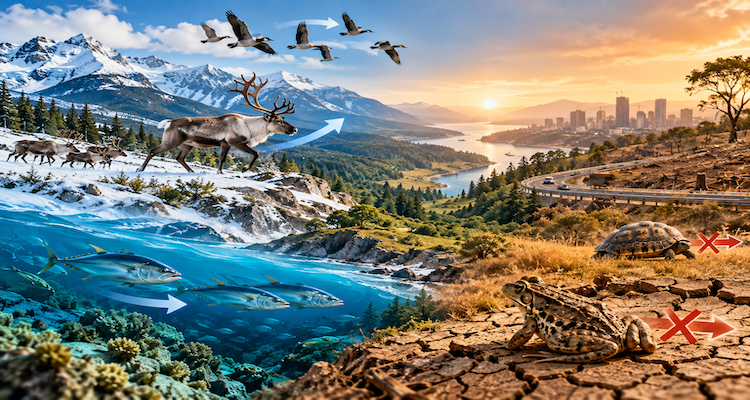
Climate change is redrawing the map of life, but species are not responding to a warming planet in the same way. Some animals and plants are appearing farther toward the poles or at higher elevations, following climates that were once found elsewhere. Others are barely moving at all.
That difference is more important than simply asking whether a species can tolerate heat.
For a species to track a changing climate, suitable conditions must exist somewhere else, and individuals must be able to reach them, survive the journey, reproduce there and compete with the species already present. Roads, cities, farms, fragmented forests, coastlines, mountains, rivers and unsuitable habitats can all interfere. Even when a destination appears climatically suitable on a map, it may be inaccessible in reality.
The result is a growing ecological mismatch: the climate a species needs can move faster or in a different direction than the species itself.
Key Takeaways
- Climate-driven range shifts are widespread, but their direction and speed vary substantially among species.
- Dispersal ability, habitat fragmentation and physical barriers can prevent populations from reaching newly suitable climates.
- Some species can survive warming through local microclimates without making large geographic movements.
- Marine species often track shifting temperature zones more effectively than terrestrial species.
- Climate connectivity is becoming an important conservation issue as warming alters the routes between suitable habitats.
- A species’ ability to move depends on more than climate; physiology, habitat, food, competitors and landscape structure also matter.
Climate Is Moving, but Species Do Not Move With It Automatically
The basic idea sounds straightforward: if a region becomes too warm, a species should move toward a cooler region.
Observations show that this is happening in many places. The IPCC reports very high confidence that species across terrestrial, freshwater and marine ecosystems have shifted their geographic ranges in response to climate change. Approximately half of assessed species have shifted toward higher latitudes or, on land, higher elevations.
But “moving” is not a single biological response.
A population can expand at its cooler edge while disappearing from its warmer edge. Another species may shift only a short distance into a shaded valley or cooler forest. A third may remain geographically stable while its population declines because the surrounding landscape provides nowhere suitable to go.
A 2024 review of documented species redistributions found that 59% of recorded range shifts were directionally consistent with climate change. That also means a substantial share were not, demonstrating that temperature alone cannot explain where species go. Habitat characteristics, other climate variables and interactions with other organisms can all influence the outcome.
The important question, therefore, is not simply whether a species can tolerate a changing climate.
It is whether the species can find and reach somewhere better.
The Missing Ingredient Is Often Dispersal
Dispersal is the ability of individuals to move from one location to another and establish populations.
It varies enormously between species.
A bird capable of flying tens or hundreds of kilometres faces a very different geographical problem from a plant whose seeds usually fall close to the parent. A fish is constrained by the structure and temperature of its river network. A small mammal may encounter a highway, city or agricultural landscape that effectively interrupts movement.
This creates a fundamental difference between climatic suitability and accessible suitability.
A climate model might identify a distant region as appropriate for a species in the future. But that does not mean the species can actually reach it.
Research on European bryophytes illustrates the problem. Even highly dispersive wind-borne plants were projected to experience substantially greater range losses when their actual dispersal limitations were incorporated into climate projections. The study found that simply mapping future climatic suitability could greatly overstate the amount of habitat that species would realistically colonize.
The same principle applies across ecosystems: a suitable destination that cannot be reached may be functionally irrelevant.
A Landscape Can Become a Barrier
Human land use has transformed the movement problem.
Natural habitats that once formed relatively continuous landscapes can now be separated by agricultural fields, roads, cities and other infrastructure. For a species already under climatic pressure, these interruptions can turn a gradual geographical shift into a series of isolated dead ends.
The IPCC identifies habitat fragmentation and limited dispersal capacity as important barriers to climate-driven range shifts.
Research involving 1,034 bird species worldwide provides another perspective. It found that sensitivity to forest fragmentation was strongly associated with dispersal limitation. In other words, species that are less capable of moving between habitat fragments are generally more vulnerable to fragmentation.
This matters because climate change and habitat fragmentation do not operate independently.
Warming can make a species’ current location less suitable at precisely the time when human-altered landscapes make relocation more difficult.
The species is not necessarily incapable of moving. It may simply lack a continuous route through which movement can occur.
Sometimes the Best Refuge Is Only a Few Hundred Metres Away
There is another complication: the climate experienced by an organism can be very different from the climate measured at a regional scale.
A forest, for example, can contain shaded areas, cooler slopes, moist ravines and other microhabitats that buffer organisms from surrounding temperature changes.
Recent research in tropical forests found that vegetation structure can substantially reduce and redirect estimated climate velocities. For organisms living beneath the canopy, dense vegetation can create local microclimatic refuges that reduce exposure to warming.
A related study of 244 plant taxa found that models using broad-scale climate data predicted a median range shift of about 14 kilometres, while models incorporating microclimate predicted localized shifts generally below 1 kilometre. The researchers concluded that macroclimate data can overestimate some plant range shifts because organisms experience fine-scale conditions rather than the regional average.
This changes the meaning of “movement.”
For some species, survival may depend less on travelling hundreds of kilometres and more on finding a cooler patch within an existing landscape.
For others, no such refuge may exist.
Oceans Offer More Room but Not Unlimited Freedom
Marine species can sometimes track changing temperature zones more effectively than terrestrial species.
A global analysis of more than 30,000 documented range shifts found that marine species moved toward the poles at roughly six times the rate of terrestrial species in the dataset examined. The researchers linked the difference partly to the relatively open nature of marine environments and the physical constraints affecting movement on land.
But even the ocean contains barriers.
Currents, temperature gradients, coastlines and habitat requirements can determine whether a species can reach a newly suitable region. A 2026 study of marine forests found that oceanographic connectivity could substantially restrict potential range expansion of seagrasses and brown macroalgae, leaving areas that appear suitable climatically potentially uncolonized.
Freshwater species face an even more constrained geography.
Rivers form branching networks rather than open landscapes. A fish cannot simply move in any direction to escape warming. It must remain within connected waterways that also provide appropriate temperature, oxygen, flow conditions, food and habitat.
A recent global assessment of freshwater fish projected increasing thermal fragmentation of river habitats under warming, with thermal barriers potentially restricting movement between suitable areas.
Moving Is Not Enough
Reaching a new location does not guarantee survival.
A species must be able to establish a viable population once it arrives. That requires suitable food, shelter, breeding conditions and interactions with other organisms.
A useful example comes from fish in the southern Appalachian Mountains. Researchers found that some tributaries could provide pathways with relatively slow climate velocities, potentially allowing certain fish to keep pace with warming. Yet some of those same tributaries lacked other habitat conditions required for successful establishment.
This distinction is easy to overlook.
A corridor can be physically connected without being biologically useful.
A road crossing, restored forest strip or river connection may enable movement, but the destination still needs to function as habitat.
That is why conservation planning increasingly has to consider climate connectivity rather than simply protecting isolated areas.
The Conservation Problem Is Becoming a Connectivity Problem
Traditional conservation has often focused on protecting important habitats in fixed locations.
Climate change complicates that strategy because the places suitable for a species today may not remain suitable indefinitely.
A protected area can therefore remain physically intact while becoming progressively less suitable for the species it was established to protect.
Research on 51 species of vascular plants, butterflies and grasshoppers in Central Europe found that strategies such as habitat corridors, landscape improvements and protected-area management could reduce some projected losses, but did not fully compensate for the effects of climate change in the scenarios examined.
This does not mean corridors are ineffective.
It means that connectivity is one part of a much larger problem.
A 2026 study examining terrestrial vertebrates projected that, under warming exceeding 4°C, approximately 77.9% of global land area could experience declining functional climate connectivity during 2061–2080. The study’s conclusion was that increasing warming could progressively weaken the networks through which species might track suitable climates.
The implication is significant: protecting biodiversity may increasingly require conservation networks designed around movement and changing environmental conditions rather than static boundaries alone.
Why Some Species Stay Put
The phrase “species cannot move” can therefore be misleading.
Some species may have limited dispersal ability. Others may encounter barriers. Some may depend on specific habitats that are not available along the route. Others may find small-scale refuges that allow them to persist without substantial movement.
There is also adaptation.
Species can respond to changing conditions through behavioural changes, physiological plasticity or genetic adaptation, although the speed and effectiveness of these responses vary greatly among organisms. Genomic research is increasingly being used to understand how populations respond through adaptation, range shifts and phenotypic plasticity.
And sometimes the apparent inability to move reflects a limitation in our models rather than the complete absence of movement.
The 2024 review of species redistributions emphasizes that range shifts are influenced by multiple interacting factors, including habitat, non-temperature climate variables and biological interactions.
That is why there is no universal migration rate that can be applied to all species.
A Moving Climate Creates Winners, Losers and New Ecological Relationships
Range shifts do more than relocate individual species.
When organisms move at different speeds, ecological relationships can change.
Predators may encounter prey in different places. Plants may arrive in areas where their pollinators are absent. Competitors may meet species they have never previously encountered. Diseases and parasites can also expand into new regions.
The IPCC notes that climate-driven range shifts are already altering community composition and can produce new interactions, including changes in competition, predator-prey relationships and host-parasite dynamics.
That means the ecological map being created by climate change is not simply a new version of the old map shifted northward.
It can be a different map altogether.
The Real Question Is Not “Can It Move?”
Climate change is often described as a test of whether species can move fast enough.
The evidence suggests a more complicated reality.
A species needs a suitable destination, a viable pathway, sufficient dispersal capacity, appropriate habitat along the route and the ecological conditions necessary to establish a population. In some landscapes, microclimates may reduce the need for long-distance movement. In others, barriers may make even relatively short shifts difficult.
The most vulnerable species may therefore not necessarily be the ones that move the least.
They may be the ones for which the places they need are disappearing faster than accessible alternatives can be reached.
That distinction has practical consequences for conservation. Protecting biodiversity in a warming world increasingly means protecting not only places where species live today, but also the connections, refuges and future habitats that could allow them to persist tomorrow.
The map of life is moving. The challenge is that the roads between its old and new locations are not moving with it.
This content is published for informational or entertainment purposes. Facts, opinions, or references may evolve over time, and readers are encouraged to verify details from reliable sources.