




The Hidden Climate Story Inside the World’s Changing Water Cycle
Climate change is often described through temperature records, melting glaciers, rising seas and extreme weather. But another signal is unfolding across the planet in a less visible system: the movement and storage of water itself.
The latest assessment from the World Meteorological Organization (WMO) shows that 2025 was one of the driest years for global river discharge in 35 years, while the past seven years have produced the fewest rivers with normal flows since 1991. At the same time, water stored on land has been declining over the past decade, and every major glacier region experienced ice loss for the fourth consecutive year.
The deeper story is therefore not simply that the world is becoming wetter or drier. It is that water is becoming less predictable, while some of the natural reserves that buffer societies against dry periods are being depleted.
That distinction matters for agriculture, energy, cities, ecosystems and economies.
Key Takeaways
- Climate change is altering the timing, intensity and geographic distribution of water, not simply reducing or increasing global water overall.
- WMO data show that 2025 was among the driest years for global river discharge in more than three decades.
- Land-based water storage, including groundwater, soil moisture, snow and ice, has shown a declining trend over roughly the past decade.
- Glacier loss is changing how some regions receive freshwater, creating different risks at different stages of glacier retreat.
- Heavier precipitation can increase flood risk while longer dry periods increase pressure on water supplies.
- Better hydrological monitoring is becoming as important to climate resilience as temperature and weather monitoring.
The water cycle is a climate system, not just a supply system
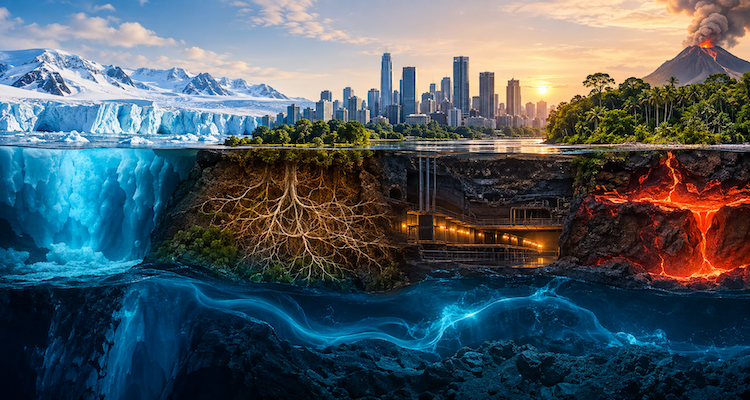
Earth’s water is constantly moving between oceans, atmosphere, land, rivers, groundwater, snow and ice.
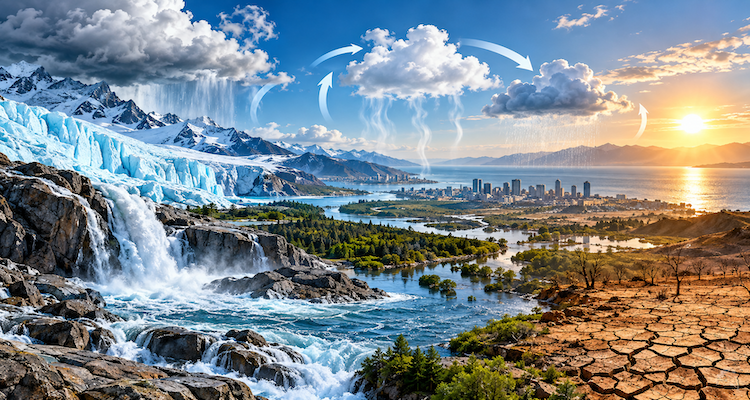
Solar energy drives evaporation. Water vapor moves through the atmosphere, condenses into clouds and returns as precipitation. On land, some water runs into rivers, some enters soil and groundwater, and some is stored as snow and ice before eventually returning to the wider cycle.
Climate change affects this system because temperature influences how much moisture the atmosphere can hold, how quickly water evaporates, whether precipitation falls as rain or snow, and how rapidly snow and ice melt.
The Intergovernmental Panel on Climate Change (IPCC) concludes that human-caused climate change has already produced detectable changes in the global water cycle. Observations show changes in precipitation patterns, heavier precipitation in many regions and shifts in dry spells and soil moisture.
This creates an important distinction.
A changing water cycle does not mean Earth is simply “running out of water.” Rather, the location, timing, form and storage of freshwater are changing.
That can be just as consequential.
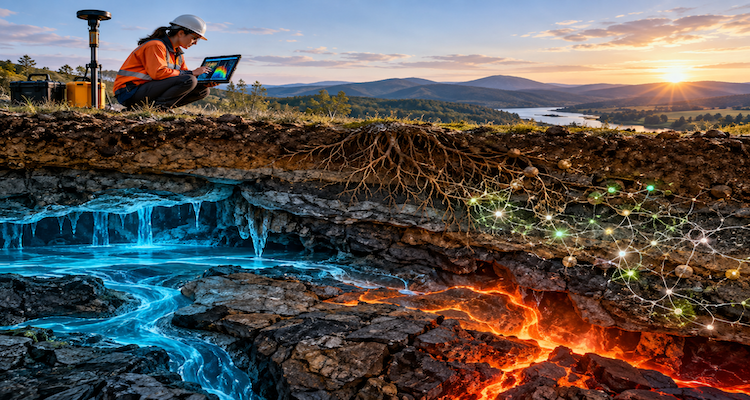
The hidden signal is water stored on land
Rainfall and river levels attract attention because they can change quickly. Groundwater, soil moisture, snow and glaciers operate on slower timescales.
Those slower reservoirs act as buffers.
A mountain snowpack can release water gradually into rivers. Groundwater can sustain wells when rainfall is low. Glaciers can provide meltwater downstream during warm and dry periods.
WMO’s 2026 assessment identifies a longer-term decline in terrestrial water storage and says global land water storage has decreased over the past decade. The organization describes the slow components of the water cycle as a kind of natural “savings account” that can buffer societies against short-term shocks.
When those reserves decline, a drought is no longer just a problem of insufficient rainfall during one season. The system has less stored water available to compensate.
This is one of the less visible dimensions of climate risk.
Rivers are showing the instability
The WMO’s latest data provide a particularly useful indicator because rivers integrate what happens across a landscape.
In 2025, global river discharge was among the lowest recorded in 35 years. WMO also reports that the previous seven years had the fewest rivers with normal flows since 1991.
That does not mean every river is declining.
Some regions experienced substantially above-normal water conditions while others suffered persistent deficits. WMO reported below-normal water conditions in parts of North and South America, Europe, the Middle East, Central Asia, India, China and North Africa in 2025, while some parts of Africa remained much wetter than normal.
This regional contrast is crucial.
A global average can conceal the problem because water crises happen locally. A community cannot compensate for a failing river simply because another continent has received excessive rainfall.
More intense rain does not necessarily mean more available water
One of the most important misunderstandings about climate change and water is the assumption that heavier rainfall automatically improves water security.
The physics are more complicated.
A warmer atmosphere can hold more moisture. The IPCC estimates that atmospheric water-holding capacity increases by about 7% for every 1°C of warming, which contributes to the intensification of heavy precipitation events. At the same time, warming increases evaporative demand and can worsen drought conditions over land.
NASA similarly explains that climate change can intensify the water cycle, producing heavier precipitation in some circumstances while contributing to drying in other regions.
The result can be an uncomfortable combination:
too much water when it is difficult to capture, followed by too little when it is needed.
Heavy rainfall can generate rapid runoff and flooding rather than slowly replenishing groundwater. A long dry interval can then follow.
This is why rainfall totals alone are becoming an inadequate way to describe water security.
Glaciers reveal the slower side of the transformation
Glaciers are among the clearest indicators of long-term changes in the water cycle.
WMO reports that 2025 was the fourth consecutive year in which all major glaciated regions experienced ice loss. The organization’s latest assessment also identifies continuing long-term declines in freshwater storage and glacier retreat.
The consequences are not identical everywhere.
During an early stage of glacier retreat, additional meltwater can temporarily increase downstream flows. But as glaciers shrink, that contribution eventually becomes smaller. WMO notes that several regions with smaller glaciers including the Caucasus, Western Canada and Central Europe show signs of having passed “peak water,” meaning the point at which glacier runoff reaches a maximum before declining.
This makes glacier loss more than a mountain environmental issue.
In glacier-dependent regions, it can affect water planning, agriculture, hydropower and ecosystems.
The United Nations’ 2025 World Water Development Report similarly emphasizes that mountain snow and glaciers function as critical “water towers” for billions of people and that their transformation has consequences for freshwater supply, food, energy and ecosystems.
Why businesses should care about the water cycle
The economic consequences of a changing water cycle extend far beyond drinking-water systems.
Agriculture depends on predictable rainfall, irrigation supplies, groundwater and river flows. Hydropower depends on water moving through river systems and reservoirs. Manufacturing requires water for processing and cooling. Cities need reliable supplies for households, sanitation and infrastructure.
When water becomes more variable, businesses face two different types of risk.
The first is physical risk: floods can damage facilities and supply chains, while drought can reduce production or increase water costs.
The second is planning risk: infrastructure designed around historical patterns may perform differently when those patterns become less reliable.
UN-Water describes water as a central link between climate change, food security, ecosystems, health and economic activity.
This makes hydrological information increasingly valuable to businesses.
Knowing only the expected temperature for a location may not be enough. Companies increasingly need to understand river conditions, groundwater availability, drought exposure, flood risk, reservoir levels and seasonal changes in water supply.
The data problem is becoming part of the climate problem
There is another hidden issue beneath all of this: we cannot manage water well if we cannot measure it well.
WMO’s global water assessments combine national observations with hydrological models and satellite observations. But major gaps remain in monitoring and data sharing.
The improvement is significant. At the launch of the 2025 assessment, WMO said the report had expanded to information from 68 countries and more than 3,000 stations, compared with seven countries and 14 river stations in its first edition.
That expansion matters because water systems cross borders.
A river basin can extend through several countries. Atmospheric moisture does not respect political boundaries. Glacier melt can influence downstream communities far from the ice itself.
Better observations therefore support not just scientific understanding but early-warning systems, infrastructure planning, agriculture and water governance.
The climate story may be moving from temperature to variability
Temperature remains one of the clearest indicators of global warming. But the changing water cycle shows why temperature alone does not capture the full experience of climate change.
Two communities can experience the same global warming trend and face radically different water consequences.
One may experience intense rainfall and flooding. Another may experience prolonged drought. A third may initially receive more meltwater from shrinking glaciers and later face declining flows as the ice reserve becomes smaller.
The common factor is not a uniform change in rainfall.
It is greater disruption of the relationships between precipitation, evaporation, storage, runoff and demand.
That is why the latest WMO findings deserve attention beyond the hydrology community.
What the changing water cycle means for the years ahead
The most useful way to think about the water-cycle problem is not “more water” versus “less water.”
It is less predictability and weaker natural buffers in some places, combined with increasing extremes in others.
That changes what resilience requires.
Cities need infrastructure capable of handling both intense rainfall and prolonged dry periods. Agriculture needs better information about soil moisture and water availability. Energy systems need to account for changing hydrological conditions. Governments need better cross-border data and basin-level planning.
And climate monitoring needs to treat water as a core indicator rather than a secondary consequence of warming.
The evidence does not suggest that every region will experience the same outcome. Nor does it justify treating every flood or drought as a direct consequence of climate change. Natural variability, land-use change, atmospheric circulation and events such as El Niño can all influence individual years and locations.
But the longer-term direction is increasingly clear: human-caused warming is changing the global water cycle, while recent observations show that many parts of the world’s freshwater system are operating farther from historical norms.
Conclusion
The hidden climate story is therefore not that the planet is simply becoming wetter or drier.
It is that the world’s water is moving differently, arriving differently and being stored differently.
The latest WMO assessment makes that story more tangible: river flows remain highly abnormal, terrestrial water storage has declined over the past decade, and glacier loss continues across the world’s major glaciated regions.
For people, governments and businesses, the implication is practical. Climate resilience cannot be built around temperature projections alone. It increasingly depends on understanding where water is, when it will arrive, how long it can be stored and whether natural reserves remain capable of absorbing the next drought or flood.
The climate signal may be visible in the thermometer. But increasingly, it is also written into the rivers, soil, groundwater and ice.
This content is published for informational or entertainment purposes. Facts, opinions, or references may evolve over time, and readers are encouraged to verify details from reliable sources.