







The Day an Entire Town Started Dancing and Nobody Could Explain Why They Couldn’t Stop
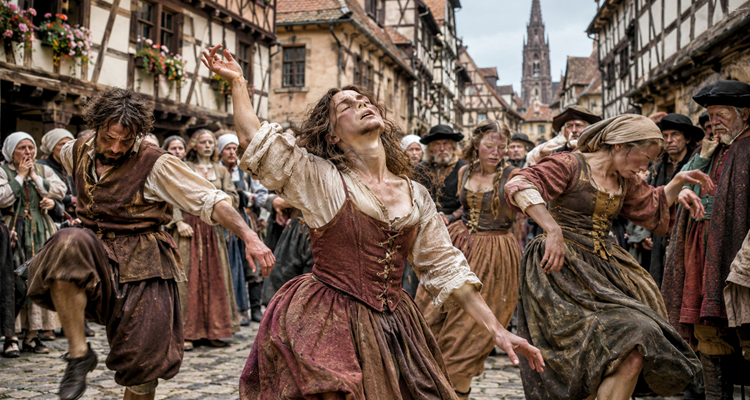
In the summer of 1518, residents of Strasbourg began dancing against their will. The strange outbreak lasted for weeks, baffled authorities, and became one of history’s most unsettling medical mysteries.
In July 1518, something extraordinary happened in Strasbourg, a city in what is now northeastern France.
People began dancing in the streets.
There was no festival to celebrate, no special occasion, and initially, no music. According to historical accounts, the movements appeared involuntary. Some participants continued until they were physically exhausted, only to resume after resting.
Within weeks, the outbreak had affected dozens of people. Later chronicles suggested that as many as 400 had participated.
City officials struggled to understand what was happening. Physicians offered explanations rooted in the medical beliefs of their time. Religious authorities considered supernatural causes. At one point, officials even encouraged the dancing, apparently believing that allowing the sufferers to continue would help them recover.
The episode became known as the Dancing Plague of 1518, one of the strangest recorded events in European history.
More than five centuries later, historians still debate its cause. But the surviving evidence reveals something more fascinating than a simple story about people dancing uncontrollably: a community confronting an illness it could neither understand nor reliably treat.
It Began With One Woman
The best-known account begins with a woman identified as Frau Troffea.
According to later historical narratives, she stepped into a Strasbourg street in mid-July 1518 and began moving in a way that resembled frantic dancing.
She reportedly continued for hours, despite obvious fatigue. When exhaustion finally forced her to stop, the relief was temporary.
The movements began again.
Her behavior was disturbing because it appeared to serve no ordinary purpose. She was not performing for an audience or participating in a celebration. Accounts portrayed her as someone caught in an activity she could not voluntarily control.
Soon, others reportedly began displaying similar behavior.
Within approximately a week, several dozen people were said to have joined the outbreak. Some accounts describe participants continuing despite painful feet, fatigue, and physical distress.
The name Frau Troffea, however, comes from the writings of physician Paracelsus, who discussed the event years afterward. Although contemporary documents confirm that Strasbourg experienced a dancing outbreak, not every dramatic detail in the familiar opening story can be independently verified.
That distinction matters. The outbreak itself is historical; some of its most memorable details belong to later retellings.
When Dancing Became a Public Emergency
Strasbourg in 1518 was not a quiet village. It was an important commercial city within the Holy Roman Empire, connected to regional trade and surrounded by communities facing serious economic and social pressures.
An unusual illness affecting a handful of residents was one problem. A growing group of people moving uncontrollably through public spaces was another.
Officials had to decide whether the behavior represented a disease, a religious crisis, or a threat to public order.
Contemporary administrative records demonstrate that authorities took the situation seriously.
A municipal document dated July 23, 1518, discusses arrangements involving affected people and their families. Other surviving records concern restrictions on public dancing and efforts to transport sufferers to a religious shrine.
These documents are particularly valuable because they were produced during the crisis rather than generations later.
They establish that the outbreak was not simply a legend invented by modern storytellers. Strasbourg’s government was responding to an unusual and disruptive event involving people described as suffering from a dancing condition.
The Authorities Tried an Astonishing Treatment: More Dancing
One of the most remarkable aspects of the Dancing Plague was the response of local officials.
Early medical thinking associated the condition with bodily imbalances and environmental influences. Some physicians believed the sufferers needed to work through the illness rather than suppress their movements.
According to historical reconstructions, the authorities arranged spaces where affected residents could dance. Musicians and professional dancers were reportedly employed to accompany them.
The apparent logic was that continued movement might eventually exhaust the condition itself.
Instead, the spectacle may have made matters worse.
If the outbreak involved psychological and social influences, gathering sufferers together and surrounding them with music could have reinforced the behavior. This is a plausible modern interpretation, not a proven explanation of what happened.
The city eventually moved away from encouraging public dancing. Authorities imposed restrictions and increasingly turned toward religious remedies.
The episode illustrates how medical decisions can become dangerous when an illness is misunderstood, even when the people making those decisions believe they are helping.
Did People Really Dance Themselves to Death?
This is the most disturbing and most frequently exaggerated part of the story.
Popular accounts sometimes claim that dancers died in large numbers from exhaustion, dehydration, or cardiovascular collapse. Some even repeat a figure of 15 deaths per day.
Historian John Waller’s 2008 study describes historical chronicles reporting deaths among the participants, and his reconstruction treats the outbreak as potentially fatal.
Yet the precise death toll is not securely established.
The surviving municipal evidence does not provide a reliable list of fatalities attributable to the dancing. Some dramatic descriptions come from chronicles written after the event, making it difficult to separate contemporary observation from later embellishment.
It is medically plausible that extreme exertion, particularly in hot weather and among people weakened by hunger or illness, could cause serious harm.
But plausibility is not proof that a particular number of people died.
The responsible historical conclusion is that the outbreak was real, but its reported death toll remains uncertain.
Similarly, the frequently repeated figure of 400 participants should be understood as an estimate from historical accounts, not a verified census.
What Could Make People Dance Against Their Will?
There is no universally accepted explanation for the Dancing Plague of 1518.
Several theories have been proposed, ranging from food poisoning to collective psychological distress. Each attempts to explain the same central puzzle: why did apparently unrelated people develop similar, unusual movements within a relatively short period?
Theory 1: A Fungus That Contaminated Their Food
One hypothesis involves ergot, a fungus that can infect rye and other cereal grains.
Ergot contains biologically active compounds capable of causing serious poisoning. Depending on the circumstances, ergotism can produce neurological symptoms, muscle contractions, and disturbances in perception.
This makes it superficially attractive as an explanation for bizarre physical behavior.
However, the theory has significant weaknesses.
Ergot poisoning does not neatly explain the prolonged, seemingly coordinated dancing described in historical accounts. Nor does it readily explain why similar outbreaks were concentrated in particular cultural and geographical settings.
The evidence also lacks the distinctive pattern of symptoms that would be expected from a substantial ergot poisoning outbreak.
For these reasons, historians such as Waller have argued that ergotism is an inadequate explanation for Strasbourg’s dancing epidemic.
The fungus remains an interesting hypothesis, but it has not been established as the cause.
Theory 2: Collective Psychological Distress
Another explanation focuses on what researchers call mass psychogenic illness.
This term describes situations in which groups of people develop genuine physical symptoms that spread through psychological and social processes, without a shared toxic or infectious cause being identified.
The symptoms are not necessarily deliberate or imaginary. People experiencing them may have little control over what their bodies are doing.
The theory becomes particularly relevant when examining Strasbourg’s circumstances.
The region had experienced periods of poor harvests, food insecurity, disease, and social hardship. Many residents lived with profound uncertainty about their survival.
Historian John Waller has argued that these conditions, combined with powerful religious beliefs, may have helped create the circumstances for an outbreak of involuntary dancing.
In this interpretation, psychological distress was not merely an individual experience. It could be shaped and intensified by the expectations of an entire community.
Still, no modern clinician examined the dancers, and the historical descriptions are incomplete. Mass psychogenic illness is a leading interpretation, not a confirmed retrospective diagnosis.
Theory 3: The Fear of a Saint’s Curse
To understand Strasbourg in 1518, it is necessary to understand how people interpreted illness at the time.
Many Europeans believed that saints could influence human health, sometimes through punishment and sometimes through healing.
One figure associated with involuntary dancing was St. Vitus.
Within certain religious traditions, unusual bodily movements could be interpreted as signs of divine displeasure or a saint’s curse.
Such beliefs may seem distant from modern medical thinking, but they influenced how communities recognized symptoms, understood suffering, and sought treatment.
If people already feared that a supernatural force could compel them to dance, that expectation might have shaped the form their distress took.
This does not establish a supernatural cause. Rather, it suggests that cultural beliefs may have influenced how a real physical and psychological crisis developed.
The relationship between belief, fear, and bodily symptoms remains an important part of historical interpretations of the outbreak.
The Outbreak Was Not Entirely Unique
Strasbourg’s experience was extraordinary, but it was not the first time European communities had reported episodes of compulsive dancing.
Historical accounts describe similar disturbances in parts of Europe during the Middle Ages.
One significant outbreak occurred in 1374, when reports of unusual group dancing emerged from communities around the Rhine and Meuse river regions.
Other accounts describe participants moving erratically, entering altered states, or appearing unable to control their bodies.
The reliability and details of these reports vary. Nevertheless, their geographical and cultural connections suggest that the Strasbourg episode belonged to a broader historical phenomenon sometimes called dancing mania or choreomania.
This creates an important question.
If contaminated food caused the Strasbourg outbreak, why did similar episodes appear in communities sharing particular religious beliefs and traditions?
Conversely, if psychological and cultural factors were responsible, why did the episodes occur at certain moments rather than continuously?
Neither question has a conclusive answer.
How Did the Dancing Finally Stop?
By the later stages of the outbreak, Strasbourg’s authorities had changed their approach.
Rather than simply allowing the dancing to continue, they attempted to restrict public dancing and directed affected individuals toward religious treatment.
Some sufferers were transported to a shrine associated with St. Vitus near Saverne, northwest of Strasbourg.
Religious ceremonies and devotional practices were believed capable of relieving the condition.
The outbreak eventually subsided, although its precise duration and the reasons for its disappearance remain uncertain.
Some popular accounts suggest that religious treatment cured the dancers. The surviving evidence does not establish that conclusion.
It is possible that the condition diminished naturally, that social circumstances changed, or that the interventions altered how the symptoms were experienced and expressed.
There is insufficient evidence to determine which explanation, if any, was decisive.
What is clear is that the extraordinary dancing episode did not become a permanent feature of life in Strasbourg.
The Most Important Clue May Be What We Don’t Know
Five hundred years later, the Dancing Plague raises a second mystery: how much of its familiar story can historians actually prove?
In 2018, Strasbourg’s Musée de l’Œuvre Notre-Dame organized an exhibition examining the event and its historical records.
The exhibition’s educational materials drew attention to the differences between contemporary documents and later narratives. They also challenged aspects of popular reconstructions, including assumptions about the outbreak’s social context and the identity of its first participant.
That research complicates the familiar tale.
We have evidence that people experienced an extraordinary dancing disturbance. We have records showing that authorities intervened. We have historical descriptions of medical and religious responses.
But we do not possess the equivalent of modern clinical observations, a reliable count of everyone affected, or definitive evidence identifying the cause.
Even the image of an entire town dancing simultaneously is misleading.
The outbreak affected a portion of Strasbourg’s population, not every resident.
The distinction may make the story less sensational, but it makes the history more meaningful.
Why the Dancing Plague Still Fascinates Us
The Dancing Plague of 1518 sits at an unusual intersection of medicine, psychology, religion, and history.
It challenges the assumption that physical symptoms must always have an immediately identifiable physical cause. It also demonstrates the danger of interpreting historical experiences exclusively through modern medical categories.
The people of Strasbourg did not possess today’s understanding of neurological disorders, toxicology, or psychological illness.
Their explanations reflected the world they knew.
For some, the dancing represented a disturbance of bodily health. For others, it carried religious meaning. For modern researchers, it raises questions about the relationship between distress, social expectations, and involuntary physical behavior.
Perhaps most importantly, the outbreak reminds us that a genuine historical event can become surrounded by details that are much harder to verify.
The temptation is to resolve every mystery with a single dramatic explanation.
History rarely offers that convenience.
A Mystery That Has Outlived Its Witnesses
The summer of 1518 ended. The dancers disappeared from Strasbourg’s streets. Ordinary life eventually resumed.
Yet the questions remained.
What caused people to move in ways they apparently could not control? Why did the behavior spread? Did shared fear and religious expectation play a role? And how many of the extraordinary details repeated today accurately reflect what happened?
We may never know every answer.
The strongest surviving evidence supports the existence of an unusual dancing outbreak, while its scale, consequences, and cause remain subjects of historical investigation.
And that is what makes the episode genuinely unsettling.
Not the exaggerated image of an entire city dancing itself to death, but the documented reality of people experiencing something their society could not adequately explain.
In 1518, Strasbourg’s residents confronted a mystery involving their own bodies. Five centuries later, the limits of the evidence mean that part of that mystery remains.
This content is published for informational or entertainment purposes. Facts, opinions, or references may evolve over time, and readers are encouraged to verify details from reliable sources.