








The Voice on the Recording That Nobody Remembers Hearing
Key Takeaways
-
Audio recordings can preserve voices, background conversations, and environmental sounds that listeners never consciously noticed when they were originally recorded.
-
Human memory is reconstructive, meaning people may remember the general experience without accurately recalling every detail.
-
An unfamiliar voice on a recording can have ordinary explanations, including a distant conversation, a television in another room, or a sound that was overlooked at the time.
-
When a voice seems impossible to explain, the mystery lies not only in what the recording contains but also in the limits of what people remember.
The Voice Nobody Could Place
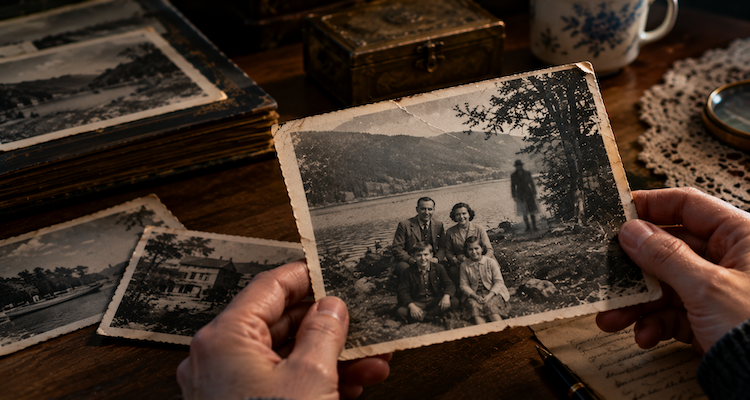
The recording was supposed to be an ordinary memory of an ordinary day.
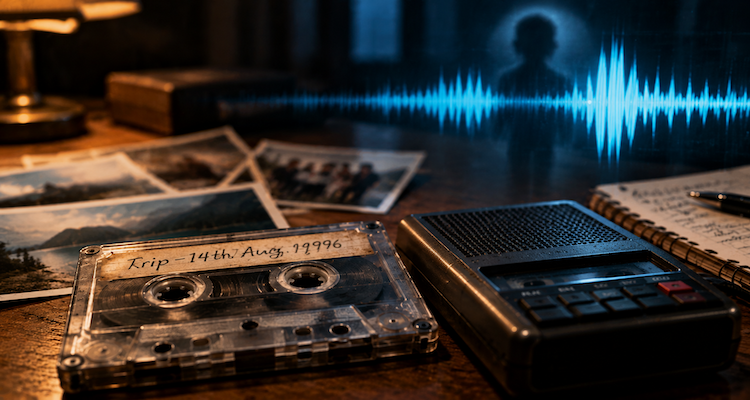
There was nothing unusual about it when it was made. A few people had gathered together, someone had switched on a recorder, and the device had captured a stretch of conversation mixed with the everyday noises of the surroundings. It was the kind of recording that people often make without expecting to listen to it again.
Years later, someone played it back.
At first, everything sounded familiar. The voices belonged to people they knew. The pauses, laughter, and occasional interruptions carried the unmistakable atmosphere of a moment that had once been lived rather than reconstructed.
Then, beneath the familiar conversation, another voice appeared.
It was brief. A few words, spoken quietly enough to be overlooked during an ordinary listen. The voice did not dominate the recording or interrupt the conversation dramatically. It simply seemed to belong there.
That was what made it unsettling.
Nobody listening could confidently identify the speaker. More strangely, nobody remembered hearing that person speak when the original recording was made.
The question immediately seemed simple: Who was talking?
But another question soon became more difficult to answer.
How could a voice be present in a memory of an event without being part of anyone’s recollection of it?
A Recording Can Remember What People Do Not
Human attention is selective. During a conversation, the brain prioritises information that seems relevant, meaningful, or important to the task at hand. Other sounds may enter the ears without becoming memorable experiences.
A person concentrating on a friend speaking nearby might not consciously register a conversation happening across the room. A passing vehicle, a television playing in the background, or someone speaking just outside an open window may become part of an audio recording without becoming part of anyone’s later recollection.
The recorder has no equivalent sense of importance.
It captures sound within the limits of its microphone, positioning, settings, and environment. It does not distinguish between the conversation everyone remembers and the quiet remark nobody noticed.
This difference between recording and remembering can create an unsettling effect. The playback seems to reveal a second version of the same moment: one preserved by a machine and another preserved imperfectly by the human mind.
Neither version necessarily contains the complete picture.
The recording may contain a sound that the listeners cannot identify. Their memories may omit an event that genuinely happened. And the absence of recollection does not establish that the event was impossible.
That is the first important clue in a mystery involving an unexplained voice: the recording and the memory are different kinds of evidence.
Why an Unfamiliar Voice Can Feel Impossible
Memory does not work like a video file stored inside the brain.
When people recall an event, they reconstruct it using fragments of experience, knowledge, context, and information encountered afterward. Some details remain vivid, while others fade. A person might remember exactly who attended a gathering while forgetting the background noise, the order of a conversation, or the presence of someone who spoke only briefly.
This is why a voice that appears during playback can produce such a strong sense of contradiction.
The listener may feel certain that only three people were present. Yet the recording appears to contain a fourth voice.
That certainty can be sincere without being complete.
Several explanations are possible. Someone may have spoken from another room. A person who was present but not actively participating may have been forgotten. A television or radio may have supplied the voice. Alternatively, the recording may have captured a sound that resembles speech without containing intelligible words.
There is another possibility worth considering: once someone points out a mysterious voice, other listeners may begin interpreting ambiguous sounds as words. Expectations can influence what people think they hear.
None of these possibilities automatically solves a particular recording. They simply demonstrate why an unfamiliar voice should be investigated before being assigned a more extraordinary explanation.
The unsettling part is that a person can be confident about a memory while still being mistaken about its details.
The Strange Power of Hearing Something Years Later
Time can change the way an old recording feels.
When a sound is first recorded, it belongs to a living environment. The people present are familiar with the surroundings, the day’s activities, and the ordinary noises that accompany them. A distant voice might be meaningless at the time because nobody needs to identify it.
Years later, much of that context has disappeared.
The room may have changed. The people involved may have moved away. Someone who once could have identified the speaker may no longer be available to ask. A background remark that would have been instantly recognisable on the original day may now sound like a message from an unknown person.
The recording has not necessarily changed. The listener’s relationship with it has.
This creates a peculiar form of unease: a familiar memory becomes unfamiliar because of evidence that was present all along.
A recording can also be replayed repeatedly, slowed down, amplified, or filtered. These techniques may reveal quiet details, but they can also make noise sound more structured than it originally was. The more a listener searches for a particular phrase, the easier it may become to hear the expected words in an ambiguous sound.
A responsible investigation therefore begins with an ordinary-speed playback, followed by careful listening to the original audio and its surrounding context.
The goal is not to make the voice sound mysterious. It is to determine what the recording actually supports.
What If Nobody Recognises the Speaker?
Imagine that several people listen to the same recording independently.
One hears a low voice near the end of a sentence. Another thinks the sound resembles a whisper. A third believes it may be coming from a television or radio. Nobody can identify the speaker.
At this stage, the voice remains unexplained, but it is not necessarily inexplicable.
A useful investigation would examine several details:
-
The location: Where was the recorder placed, and which rooms, doors, or windows were nearby?
-
The timing: Does the voice overlap with a known speaker, occur during a pause, or appear to come from another part of the environment?
-
The recording history: Has the original file been edited, transferred, compressed, or combined with another recording?
-
The sound itself: Does the voice contain clearly intelligible words, or does it merely resemble speech?
-
Independent identification: Can anyone recognise the speaker without being told what they are supposed to hear?
These questions help separate what is directly audible from what listeners infer.
For example, a voice that appears to answer a question may seem significant. But if the timing is examined carefully, the sound might come from a television playing in the background. A whisper that sounds like a name might turn out to be an indistinct fragment of conversation.
If no explanation emerges, the honest conclusion is that the voice remains unidentified.
Uncertainty is not evidence of a supernatural event. It is a description of what the investigation has not yet established.
The Mystery Beneath the Sound
Even when an unfamiliar voice has an ordinary explanation, the experience can leave a lasting impression.
People generally expect memories and recordings to agree. Photographs are expected to show who was present. Messages are expected to preserve what was written. Audio recordings are expected to reproduce what people heard.
Yet every form of evidence has limits.
A photograph excludes everything outside its frame. A written account reflects what its author noticed and chose to record. A sound recording preserves only what its equipment captured, while human memory selects and reconstructs details according to different processes.
The disagreement between these records does not automatically mean something impossible occurred.
Instead, it exposes a gap between experience and evidence.
That gap can become particularly uncomfortable when the missing detail is a human voice. Voices are closely associated with identity, presence, and intention. We instinctively try to connect a voice to a person and a sentence to a purpose.
When neither connection is available, the mind keeps searching.
Who spoke? What were they saying? Why does nobody remember them?
Sometimes the answers are recoverable. Sometimes the recording is too unclear, the context has been lost, or the people who could have explained it are no longer available.
The sound remains, but the story behind it does not.
When the Recording Becomes a Different Kind of Memory
The most interesting part of an unexplained recording may not be the voice itself. It may be what happens after someone hears it.
A person who once remembered a gathering as ordinary may now recall it as a gathering containing an unanswered question. The recording becomes attached to the event, changing how the event is understood.
This does not mean the original memory was false. It means new evidence can alter the meaning people assign to the past.
A previously unnoticed remark might reveal that a visitor was present. A distant conversation might explain an old misunderstanding. Even a sound that ultimately proves to be background noise can teach listeners something about how confidently they interpret incomplete information.
The recording becomes a second encounter with the same moment, but under different circumstances.
And that is where its eeriness comes from.
The voice does not need to belong to a ghost, a stranger from another time, or anything beyond ordinary explanation. It only needs to be something that was there without becoming part of anyone’s conscious memory.
The familiar past suddenly contains a detail nobody knew they had missed.
Conclusion: The Sound That Outlived Its Explanation
An unfamiliar voice on an old recording can feel like a message from a moment that nobody remembers correctly. It challenges the assumption that remembering an event means remembering everything that happened during it.
Science offers several reasons why such discrepancies occur: selective attention, imperfect recall, ambiguous sounds, and the ability of recording equipment to capture details people never consciously noticed.
But an individual recording must still be examined on its own evidence. Without the original audio, its context, and reliable information about the circumstances, nobody can responsibly claim to know who spoke or why the voice went unnoticed.
Perhaps the speaker was someone standing just outside the room. Perhaps the sound came from a forgotten television. Perhaps the recording contains a voice too indistinct to identify.
Or perhaps the available evidence will never provide a definitive answer.
The most unsettling possibility is not that the recording remembers something impossible.
It is that an ordinary moment may contain details we never noticed, never remembered, and may never be able to explain.
And somewhere in the background of a recording we thought we understood, a voice may still be waiting to be heard.
This content is published for informational or entertainment purposes. Facts, opinions, or references may evolve over time, and readers are encouraged to verify details from reliable sources.