







The Emergency Call That Came From a House Nobody Had Lived In for Years
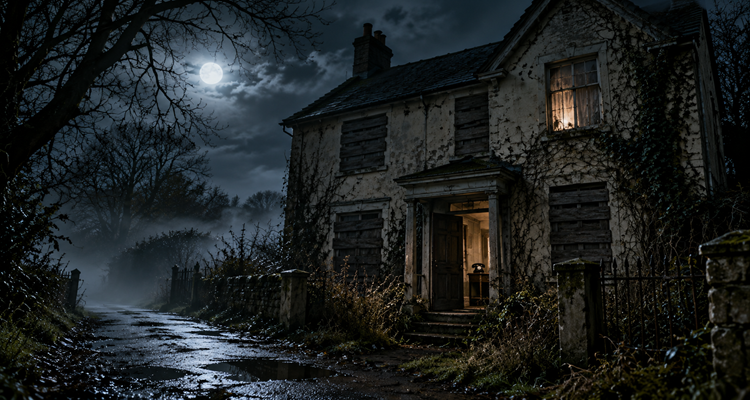
At 2:17 a.m., the emergency dispatcher received a call from a house that had been empty for eleven years.
The caller did not ask for an ambulance. There was no report of a fire, no mention of an intruder, and no frantic explanation of what had happened.
There was only a whisper.
“Please send someone. He’s back.”
The dispatcher asked for the caller’s name.
A long silence followed.
Then the voice answered, “You already know who I am.”
The line went dead.
When the dispatcher checked the address, she discovered that the property had been condemned years earlier. Its windows were boarded up, its electricity disconnected, and its former occupants had been gone since the night one of them mysteriously disappeared.
There should have been nobody inside.
Yet the emergency system had registered the call as originating from the house itself.
And when officers arrived, they found something that made the case considerably harder to explain: the front door was locked from the inside.
This is an original fictional mystery written for WIOBS. The characters, events, and investigation are imagined, not a report of a verified real-world incident.
The House at the End of Blackwood Lane
The house stood at the far end of Blackwood Lane, beyond a row of ageing trees and a narrow road that flooded whenever it rained.
It had once been an ordinary family home. A modest two-storey building with faded cream walls, a sloping roof, and a small porch where the previous owners had reportedly sat on summer evenings.
Then, eleven years earlier, something happened.
The details were never entirely clear to the people who lived nearby. Some remembered police cars arriving in the middle of the night. Others recalled an ambulance that left without its siren. A few insisted they had heard shouting coming from upstairs.
What everyone agreed on was that the family never returned.
The father, Daniel Mercer, had vanished. His wife, Helen, was later declared dead under circumstances that remained unclear within the story’s local rumours. Their young daughter, Emily, was never seen in the neighbourhood again.
The house was eventually sealed and condemned.
Over the years, weeds swallowed the front path. Rain stained the walls, and branches scraped against the upstairs windows whenever the wind picked up.
Children dared one another to approach the porch. Teenagers left graffiti on the boundary wall. Eventually, even the rumours faded.
The house became just another abandoned property that people passed without looking at.
Until the call.
A Voice That Should Not Have Been There
Mara Ellis had worked the overnight emergency desk for nearly six years. She knew the difference between a frightened caller, a prank, and someone struggling to explain a genuine emergency.
The voice from Blackwood Lane unsettled her because it sounded none of those things.
It was quiet. Controlled. Almost familiar.
After the call ended, Mara reviewed the system record. The emergency network had identified the source as a fixed line registered to the Mercer property.
That alone was strange. The telephone service had supposedly been disconnected years earlier.
She checked the number again, then searched the archived records.
The line had belonged to Helen Mercer.
Mara called the field supervisor and requested an immediate welfare check.
Two officers, Lewis Grant and Peter Shaw, were dispatched to the address.
At 2:41 a.m., Grant radioed back.
“Arrived at the property. No lights. No movement. Front entrance secured.”
Mara asked them to check the perimeter.
A few minutes passed.
Then Shaw’s voice came through the radio.
“Dispatch, we have a problem.”
Mara sat upright.
“What kind of problem?”
“The front door is locked. We’re hearing a telephone ringing inside.”
Neither officer had entered the house. Neither had touched the telephone system.
Yet the ringing continued, faintly audible through the door.
Grant tried the handle again.
It did not move.
Then the ringing stopped.
A moment later, someone knocked from inside.
Three slow knocks.
Mara heard the officers fall silent over the radio.
Then Grant spoke.
“Dispatch, we’re requesting additional units.”
“Why?”
His reply came after a pause.
“Because somebody just asked us to come in.”
The Room Upstairs
The officers forced the front door open at 2:53 a.m.
Inside, the house smelled of damp wood, dust, and something faintly metallic. Their flashlights moved across a narrow hallway, revealing peeling wallpaper and a staircase covered in debris.
There were no fresh footprints on the floor.
No signs of a break-in.
No evidence that anyone had been living there.
The living room was almost empty, except for a broken chair and a square patch on the wall where a family photograph had once hung. The kitchen contained a rusted sink, cracked tiles, and cupboards standing open.
But in the hallway, beside the staircase, sat a black telephone.
It was an old-fashioned landline with a rotary dial.
Grant stared at it.
The telephone cable had been cut cleanly at the wall.
“Tell me that’s not what I think it is,” Shaw said.
Grant crouched beside the instrument without touching it.
The receiver was resting on its cradle. Its cord was frayed, and dust covered the base. There was no visible power connection.
Mara, listening from the dispatch centre, asked them to describe the scene.
Grant explained what they had found.
Then the telephone rang.
Both officers stepped back.
The sound was sharp and mechanical, echoing through the empty hallway.
One ring.
Two.
Three.
Shaw drew his weapon, although he could not have explained what he expected to confront.
Grant reached toward the receiver.
“Don’t,” Shaw whispered.
But Grant had already lifted it.
For several seconds, he said nothing.
Then his face changed.
“What is it?” Shaw asked.
Grant slowly turned toward the staircase.
From the receiver came the sound of a little girl crying.
Not screaming. Not calling for help.
Just crying softly, as if she were trying not to be heard.
Then a child’s voice spoke.
“Is Daddy home?”
Grant dropped the receiver.
The line went silent.
The Missing Child
Back at the dispatch centre, Mara replayed the original call.
She listened through headphones, filtering out the background noise. Beneath the whisper, she heard a faint ticking sound and what might have been a second voice.
She slowed the recording.
The whisper became distorted, but one phrase emerged more clearly than before.
“Don’t let him upstairs.”
Mara froze.
She checked the archived case file associated with the Mercer family.
The records contained very little that could be independently established within the fictional investigation. Daniel Mercer had disappeared on the night of the original incident. Helen’s final known whereabouts were recorded as the house. Their daughter, Emily, had been seven years old.
The case had eventually gone cold.
There was, however, a note from the original responding officer. It described a locked upstairs bedroom and an unexplained discrepancy between the number of people believed to be inside the house and the number found when the property was searched.
The note ended with a handwritten sentence:
The child was heard after the house had been cleared.
Mara read it twice.
She called Grant.
“There’s something in the original case file,” she told him. “I need you to check the upstairs bedroom.”
Grant looked toward the staircase.
The officers had already searched the upper floor. Every room had been empty, its windows sealed and its doors hanging open.
Except one.
At the end of the corridor was a white door with a brass handle. Unlike the others, it had no visible dust on the handle.
Grant approached it slowly.
The door was locked.
“Dispatch,” he said, “we’ve found a locked room.”
Mara’s reply came immediately.
“Open it.”
He tried the handle once more.
From the other side came a quiet voice.
“Daddy?”
Grant stepped back.
Shaw moved beside him.
Neither officer spoke.
Then the voice came again, this time clearer.
“Daddy, why did you leave me here?”
The lock clicked.
The door opened by itself.
Beyond it was a child’s bedroom, perfectly preserved.
A small bed stood against the wall. A wooden rocking horse sat beside the wardrobe. Children’s drawings covered a pinboard, their colours faded but still visible in the flashlight beam.
On the bedside table was a glass of water.
It was full.
Grant approached the bed.
There was no child inside.
But on the pillow lay a folded piece of paper.
He opened it.
Four words had been written in a child’s handwriting:
He is in the walls.
What the Walls Were Hiding
The officers called for a structural inspection and additional support. They did not begin tearing the walls apart simply because of a note, but the discovery changed how they viewed the house.
The room was too well preserved for a property that had supposedly been abandoned for eleven years.
The water in the glass appeared clear. The bedspread showed no obvious signs of decay. Even the drawings had been arranged neatly, as though someone had recently returned to put them in order.
Shaw examined the wall behind the bed.
One section sounded different when he tapped it.
Hollow.
They moved the bed and discovered a narrow panel concealed behind the wallpaper. It opened into a cramped service cavity between the bedroom and the adjoining wall.
Inside lay a child’s red shoe, a small flashlight, and a cassette recorder.
The recorder had no batteries.
Grant carefully removed it from the cavity and examined the cassette. A label had been attached to its side.
For whoever finds Emily.
The officers contacted the investigation team responsible for reviewing the old disappearance. The recording was preserved as evidence within the story, and a specialist was asked to examine it.
When the tape was eventually played, it revealed a conversation between two adults.
A man’s voice spoke first.
“You said nobody would come back.”
A woman answered, barely audible.
“They won’t.”
Then came the sound of a door closing.
A child began to cry.
The man spoke again.
“If anyone asks, you never saw her.”
The recording ended with three knocks.
The same three knocks the officers had heard from inside the front door.
No explanation accompanied the tape. It did not establish who had recorded it, when it had been made, or what had happened to Emily. But it gave the fictional investigators a concrete reason to reopen the case rather than dismiss the emergency call as an elaborate prank.
The house was no longer merely the setting of an old rumour.
It was a place that might still contain evidence of a disappearance.
And then Mara received another call.
The Second Emergency
At 3:26 a.m., the emergency system registered a new incoming connection.
The source was Blackwood Lane.
Mara did not answer immediately. She checked the number, confirmed the address, and opened a fresh incident record.
Then she picked up the headset.
“Emergency services. What is your location?”
A man’s voice replied.
“I’m at home.”
Mara’s fingers tightened around the pen in her hand.
“Can you tell me your address?”
There was a short laugh.
“You know where I am.”
She looked at the screen. The call was still being associated with the Mercer property.
“Are you in immediate danger?”
“No,” the man said. “But they are.”
“Who is?”
“The people inside.”
Mara heard movement in the background, followed by a door creaking open.
Then the man whispered, “They found the room.”
The call ended.
Mara immediately contacted Grant.
The officers were still inside the house.
They had heard no telephone ring.
They had seen no one enter.
Grant checked the hallway. The black telephone remained exactly where they had found it, its receiver resting on the cradle.
Shaw was standing at the foot of the staircase when he noticed something on the wall.
A shadow had appeared beneath the peeling wallpaper.
It resembled a human figure, tall and narrow, standing on the other side of the wall.
Shaw raised his flashlight.
The shadow disappeared.
He moved closer and pressed his palm against the surface.
The wall was cold.
From somewhere behind it came a faint scraping sound.
Then a voice, low enough to be mistaken for the movement of air, spoke through the plaster.
“Please don’t let him out.”
Grant called for everyone to leave the building until the structure could be examined safely.
As they moved toward the front door, Mara remained on the line, asking questions and recording their observations.
Grant was the last to leave.
He turned once more toward the staircase.
At the top, a little girl stood in the corridor.
She wore a pale nightdress and held a red shoe in one hand.
For a moment, Grant could not move.
The girl looked directly at him.
“Did you find my daddy?” she asked.
The hallway lights, which had not worked in eleven years, flickered on.
Grant blinked.
The corridor was empty.
The lights went dark again.
The Call That Had No Answer
By sunrise, the house had been secured. Investigators began reviewing the original disappearance, the newly discovered recording, and the emergency system logs.
The old telephone was taken for examination. The call records were preserved. The property was searched again, this time with specialists who could assess the hidden spaces and the building’s structural condition.
The investigation did not establish a supernatural cause.
Nor did the fictional account offer a definitive explanation for how the emergency calls had been placed.
There were ordinary possibilities to investigate: an undocumented connection, a concealed device, a person with access to the property, or a technical error. The recording and the hidden cavity suggested that the house might have concealed physical evidence, but neither explained the calls on its own.
The most unsettling detail emerged when Mara reviewed the second call’s audio.
At the very end, beneath the man’s voice, another sound could be heard.
A telephone ringing.
Then three knocks.
And a child’s whisper.
“It’s not Daddy.”
The recording ended.
The case remained open.
Years of rumours had turned the Mercer house into a local legend, but the emergency call had forced the investigators to confront a more immediate question: what had actually happened there, and why had someone—or something—chosen that night to draw attention to it?
The house was empty again when the sun came up.
The doors were secured. The windows remained boarded. No one was permitted inside without authorization.
At 2:17 a.m. the following night, the emergency system registered one final incoming call from Blackwood Lane.
This time, the dispatcher did not hear a whisper.
She heard breathing.
Then a man’s voice said, very calmly:
“You can stop looking now.”
A pause followed.
“I’m right here.”
The line went dead.
And on the dispatcher’s screen, beneath the address of the abandoned house, a new field appeared.
Occupant status: One person inside.
Mara stared at it.
The system had not received another call.
Nobody had entered a name.
And the address had been marked unoccupied for eleven years.
She reached for the phone to report the anomaly.
Before she could dial, the black telephone from the Mercer house rang on her desk.
It had been disconnected from the system hours earlier.
Mara looked down at it.
Then, slowly, she lifted the receiver.
A little girl whispered from the other end.
“Now he knows you can hear him.”
The line clicked.
And somewhere, far away, a door opened.
This content is published for informational or entertainment purposes. Facts, opinions, or references may evolve over time, and readers are encouraged to verify details from reliable sources.