









The New Loneliness: Being Socially Connected but Personally Unknown
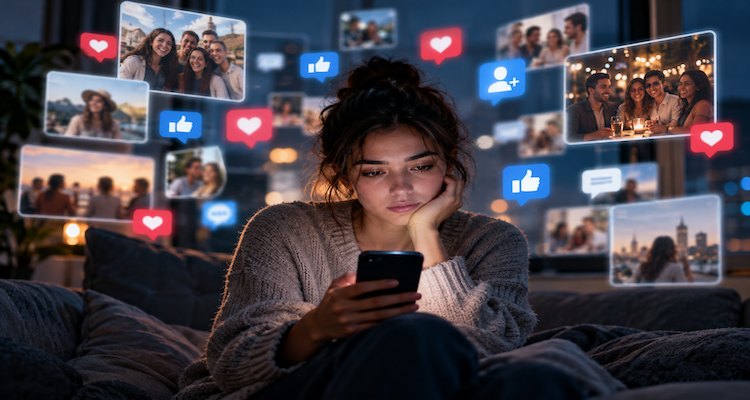
A person can have hundreds of contacts, exchange messages throughout the day, appear regularly in group chats and still feel that nobody truly knows them. That contradiction is becoming increasingly important as social life moves across platforms designed to keep people continuously connected.
Loneliness, however, is not simply the absence of people. The World Health Organization defines loneliness as the painful feeling that the relationships a person has do not match the relationships they want or need. Someone can therefore feel lonely while surrounded by friends, colleagues or family. Social isolation is different: it concerns the quantity and frequency of social relationships, while loneliness concerns the subjective experience of connection.
That distinction helps explain a newer form of disconnection: being socially visible without feeling personally known.
Key Takeaways
- Having many digital contacts does not necessarily provide the emotional quality of connection people need.
- Loneliness is about perceived disconnection, not simply the number of people around someone.
- Research does not support the idea that social media automatically causes loneliness.
- Problematic social media use shows a stronger association with loneliness than social media time alone.
- Meaningful connection depends on interaction quality, responsiveness, trust and a sense of belonging.
- Rebuilding connection often requires moving beyond visibility toward deeper, more reciprocal relationships.
When Connection Becomes a Performance
Modern communication makes it remarkably easy to signal that we are connected.
A birthday receives dozens of messages. A photograph generates reactions. A professional achievement attracts congratulations. A group chat remains active from morning until night. Someone can maintain conversations across several platforms without having a single conversation that feels deeply personal.
This creates an important distinction between social contact and social connection.
Contact tells us that communication is happening. Connection asks whether that communication creates understanding, belonging, support or mutual recognition.
The difference matters because loneliness is fundamentally subjective. A person may have a large social network but still feel that their important thoughts, fears, ambitions or difficulties have nowhere to go.
The WHO’s 2025 Commission on Social Connection report describes loneliness and social isolation as widespread problems with consequences for health, well-being and society. Its findings estimate that approximately one in six people worldwide experiences loneliness, with particularly high rates among adolescents and young adults.
The numbers describe the scale of the problem. They do not, however, fully capture its modern texture.
The uncomfortable question is no longer only, “How many people do you know?”
It is increasingly, “How many people actually know you?”
The Difference Between Being Seen and Being Known
Digital platforms are exceptionally good at visibility.
They allow people to display interests, achievements, opinions, photographs, locations and daily experiences. They can maintain weak ties across geographical distances and make it easier to reconnect with people who might otherwise disappear from our lives.
That is a genuine benefit.
Research does not support a simplistic conclusion that social media itself causes loneliness. A recent review found that social-media use was only weakly related to trait loneliness and explained relatively little variation compared with other factors. The researchers also concluded that there was no evidence that social media use itself causes loneliness.
The important question, therefore, is not simply whether someone uses social media.
It is what kind of social experience that use creates.
A message from a close friend asking how someone is coping with a difficult situation is fundamentally different from scrolling through hundreds of updates. A long conversation is different from a reaction. A trusted relationship is different from an audience.
This is where the idea of being “personally unknown” becomes useful as an editorial lens.
Someone may be highly visible while remaining emotionally private. They may share a great deal publicly while revealing very little of what actually matters to them.
And sometimes the problem is not that nobody cares. It is that the relationships surrounding a person have never developed the depth required for vulnerability.
Why More Digital Contact Does Not Automatically Mean More Belonging
The relationship between social media and loneliness is more complicated than the familiar argument that “more screen time equals more loneliness.”
A 2022 meta-analysis covering 82 articles, 90 independent samples and more than 48,000 participants found a weak positive association between social networking-site use and loneliness. The researchers also found that the type of use mattered: abnormal and passive use showed stronger positive associations, while general and active use did not show the same relationship.
More recent evidence points in a similar direction while adding important nuance.
A 2026 systematic review and meta-analysis of 59 studies involving more than 81,000 adolescents and young adults found substantial variation between studies. Problematic social media use had a moderate association with greater loneliness, while time spent on social media had a much smaller association. The authors emphasized that the relationship is complex and that the direction of causality cannot simply be assumed.
That distinction matters.
A lonely person may turn to digital platforms more frequently because they already feel disconnected. In that situation, loneliness can influence online behavior just as online behavior may influence loneliness.
The platform is therefore only part of the story.
The deeper issue is the quality and purpose of interaction.
The Hidden Cost of Constant Availability
There is another paradox in digitally mediated relationships: communication can become easier while attention becomes harder.
People can be technically available almost all the time, yet psychologically unavailable during important conversations.
A person may answer messages while watching television, check notifications during dinner, glance at social media while someone is talking or divide attention between multiple conversations.
Research on social media and close relationships describes this as a duality: digital behavior can facilitate connection while also contributing to relational disconnection.
This does not mean phones or social platforms are inherently harmful.
It means that connection requires more than transmission.
A message has to be received. A disclosure needs a response. A difficult experience needs attention. Friendship requires some degree of reciprocity.
Technology can provide the channel. It cannot guarantee the relationship.
That distinction becomes especially important when people confuse responsiveness with intimacy.
Someone may reply instantly to dozens of messages yet have nobody they would call at midnight.
The Health Dimension of Disconnection
Loneliness is sometimes treated as an emotional inconvenience, something that will disappear when a person becomes busier or meets more people.
The evidence suggests a more serious picture.
The WHO’s Commission on Social Connection reported in 2025 that loneliness and social isolation are associated with substantial effects on physical and mental health. The organization estimated that loneliness affects about one in six people globally and linked social disconnection with outcomes including depression, anxiety, cardiovascular disease and premature mortality.
The U.S. Surgeon General’s social connection advisory similarly describes social connection as important to individual, community and societal health.
These findings do not mean that feeling lonely occasionally is itself a medical disorder.
Loneliness is part of ordinary human experience. Moving to a new city, losing a relationship, changing jobs or going through a major life transition can temporarily disrupt a person’s sense of belonging.
The concern is persistent disconnection.
That is why treating loneliness simply by encouraging people to “socialize more” can miss the point. Someone can attend more events, collect more contacts and still lack relationships in which they feel understood.
The objective is not maximum social activity.
It is meaningful social connection.
What Being Known Actually Requires
Being known is not the same as being observed.
It usually develops through repeated interaction, trust, attention and reciprocal disclosure. It involves people remembering what matters to one another and creating enough psychological safety for honesty.
That can happen online, offline or through a combination of both.
A video call with a distant parent can be deeply meaningful. An online community can provide belonging to someone who struggles to find people with similar interests locally. A message can sometimes arrive at exactly the right moment.
Digital connection therefore should not be dismissed.
Indeed, research into digital interventions for loneliness suggests that some technology-supported approaches can help, particularly when they incorporate psychological or group-based components. At the same time, evidence remains mixed, with researchers noting heterogeneity and limitations in existing studies.
The practical lesson is straightforward: technology is most useful when it supports relationships rather than merely simulating social activity.
A platform can introduce two people.
A relationship develops afterward.
Moving From Social Visibility to Social Connection
The solution to modern loneliness is unlikely to be abandoning technology or attempting to recreate an entirely offline world.
A more realistic approach is to become more deliberate about the difference between communication and connection.
That can mean having fewer but deeper conversations, protecting uninterrupted time with important people, checking on someone without waiting for a public signal that they need help, joining communities based on genuine shared interests and creating opportunities for repeated interaction.
It can also mean recognizing when a digital relationship has become meaningful rather than dismissing online friendships simply because they began on a screen.
The WHO’s recommendations similarly emphasize solutions at multiple levels, from community infrastructure and public policy to individual and relationship strategies. Parks, libraries, community spaces and local groups can all contribute to the social infrastructure that makes connection easier.
The broader lesson is that loneliness cannot be solved by technology alone because it is not fundamentally a technology problem.
It is a relationship problem.
Conclusion
The defining contradiction of the new loneliness is not that people have stopped communicating.
It is that communication can continue without necessarily producing the feeling of being understood.
A person can be followed without being known, contacted without being supported, surrounded without feeling accompanied.
That does not make digital life a failure. Technology has created extraordinary ways to maintain relationships, discover communities and cross geographical boundaries. But it has also made it easier to mistake visibility for intimacy and activity for belonging.
The more useful question for an increasingly connected society may therefore be neither “How many people are in your network?” nor “How much time do you spend online?”
It is simpler:
Who could tell when something was wrong with you and would you feel safe telling them?
That is where social connection becomes more than communication. It becomes belonging.
This content is published for informational or entertainment purposes. Facts, opinions, or references may evolve over time, and readers are encouraged to verify details from reliable sources.