







Why Shiva’s Third Eye Opens Only When Ordinary Sight Is No Longer Enough
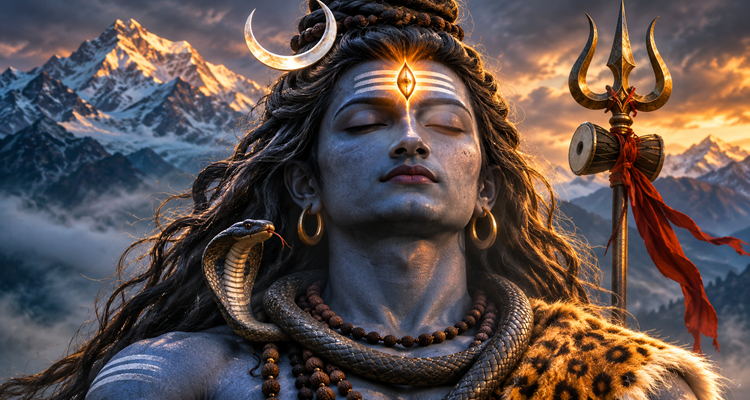
Shiva’s third eye is more than a symbol of destruction. In Hindu spiritual traditions, it represents a deeper form of awareness one that can see beyond appearances, recognize illusion, and transform what ordinary perception cannot resolve.
The two eyes can recognize a face, observe an action, and distinguish light from darkness. Yet they cannot always reveal the intention behind a smile, the attachment hidden within desire, or the truth concealed beneath a convincing appearance.
In Hindu iconography, Lord Shiva possesses a third eye, traditionally depicted at the center of his forehead. Unlike his two ordinary eyes, this eye is associated with spiritual knowledge, extraordinary perception, and the power to destroy.
When Shiva opens it in sacred narratives, the consequences can be immense. Desire is reduced to ashes in one celebrated story. In other traditions, the eye expresses divine energy that cannot be contained by ordinary perception.
But why does such an extraordinary eye remain closed?
One meaningful philosophical interpretation is that the third eye represents a level of awareness needed when ordinary ways of seeing are insufficient. This is not a universal scriptural rule about when Shiva opens his eye. Rather, it is a way of understanding the symbolism that connects Shiva’s insight, restraint, and transformative power.
To appreciate that meaning, we must distinguish what Hindu stories actually describe from the spiritual lessons later readers and teachers draw from them.
What Does Shiva’s Third Eye Represent?
Shiva’s third eye is commonly associated with jnana, or knowledge, and with the fiery power of transformation.
His ordinary eyes can be understood symbolically as representing perception of the manifest world. The third eye points toward a different capacity: recognizing realities that are not immediately apparent through the senses.
This distinction is important because seeing and understanding are not identical.
A person may witness an argument without understanding the fear behind it. Someone may recognize an attractive object without noticing how strongly the desire to possess it controls their thoughts. A person may observe constant change while continuing to behave as though everything they value will remain permanent.
Ordinary sight provides information. Wisdom requires interpretation, discernment, and sometimes the willingness to question what appears obvious.
Within Shaiva philosophical traditions, Shiva is associated with consciousness, transcendence, and liberation. The third eye can therefore be read as an emblem of insight that is not limited to surface appearances.
Yet the symbol has another dimension. Shiva’s third eye does not merely reveal. It burns.
That combination of knowledge and destructive power is central to its significance.
The Story of Kamadeva: When Desire Interrupts Meditation
One of the best-known narratives involving Shiva’s third eye concerns Kamadeva, the Hindu deity associated with love and desire.
The story appears in different forms across Sanskrit literature, including the Shiva Purana and Kalidasa’s Kumarasambhava. Their details and literary emphases are not identical, but they share an important narrative foundation.
Shiva is absorbed in profound meditation. Meanwhile, the gods face a threat connected with the powerful asura Tarakasura. In prominent versions of the tradition, the birth of a son of Shiva is necessary for Tarakasura’s defeat.
The gods therefore seek to bring Shiva and Parvati together.
Kamadeva is enlisted to awaken desire in Shiva. Armed with his flower-tipped arrows, he attempts to disturb the meditating deity.
The intervention has devastating consequences.
Shiva becomes aware of the disturbance, and the fire of his third eye burns Kamadeva to ashes.
The episode is often interpreted as a dramatic representation of the power of spiritual discipline over desire.
But its meaning becomes more interesting when we examine what happens afterward.
Does Shiva’s Third Eye Mean That All Desire Is Wrong?
Not necessarily.
Shiva ultimately unites with Parvati, and their relationship occupies a central place in Hindu sacred traditions. Kamadeva, too, is restored in different ways in later portions or versions of the narrative, including his continued existence without a physical body.
These developments complicate any interpretation that treats the story as a simple condemnation of love.
The issue is not necessarily desire itself, but desire’s ability to disturb awareness, overcome restraint, or turn attention away from a higher purpose.
In this reading, the third eye destroys the power of uncontrolled desire rather than declaring all affection, attraction, or worldly involvement spiritually worthless.
Shiva’s later marriage to Parvati reinforces an important distinction: spiritual mastery does not always require rejecting life. It may instead require engaging with life without becoming enslaved by its impulses.
This is an interpretation of the narrative, not a claim that every Hindu tradition explains Kamadeva’s burning in precisely the same way.
Why Is the Third Eye Associated With Fire?
Fire has multiple meanings in Hindu religious thought.
It can destroy, but it can also purify, illuminate, and transform. In Vedic ritual, Agni carries offerings and mediates between human and divine realms. In philosophical and devotional imagery, fire may represent the removal of ignorance or the dissolution of what cannot endure.
Shiva’s third eye brings these associations into a particularly powerful form.
Its fire can be understood on three levels.
First, it represents the destruction of illusion. A mistaken understanding may feel secure until knowledge reveals its weakness. In the same way that light makes darkness disappear, insight can make a false belief impossible to maintain.
Second, it represents the destruction of attachment. People often cling not only to possessions or relationships but also to expectations, identities, and ideas about how life should unfold. The third eye can symbolize the painful but necessary recognition that these attachments are not permanent foundations.
Third, it represents transformation rather than destruction for its own sake. Shiva is frequently associated with dissolution within the broader cycles of cosmic existence. Dissolution makes room for renewal, although different Hindu philosophical schools explain these processes differently.
The third eye’s fire is therefore not simply an expression of anger. Its symbolism can encompass the removal of obstacles to deeper understanding.
Still, the stories should not be reduced to metaphors alone. For many devotees, Shiva’s third eye is also a genuine expression of divine power within sacred reality.
Both devotional and philosophical readings deserve recognition.
Why Ordinary Sight Is Not Always Enough
The central difference between ordinary sight and the third eye is not that one sees fewer objects while the other sees more.
It is that perception can remain incomplete even when the visible details are clear.
Consider three situations.
A person receives praise and immediately feels superior. Their senses accurately register the praise, but they may fail to recognize the pride growing within them.
Another person experiences criticism and responds with anger. They hear the words clearly but may not recognize the insecurity shaping their reaction.
A third person achieves a long-desired goal, only to discover that satisfaction quickly fades. They can see the achievement, yet they have not understood the restless nature of their expectations.
In each case, the problem is not defective eyesight.
It is a limitation of self-awareness.
The third eye offers a spiritual image for the ability to observe these deeper processes.
This is why its symbolism can remain relevant beyond the specific mythological circumstances in which Shiva opens it. It raises a question that applies to ordinary human experience: What happens when the way we interpret the world becomes part of the problem?
The answer suggested by the symbol is that a different kind of understanding may be necessary.
The Third Eye and the Ajna Chakra: Are They the Same?
Shiva’s third eye is often connected in contemporary spiritual discussions with the Ajna chakra, commonly located in the region between the eyebrows.
The association is understandable, but the two concepts should not be treated as interchangeable in every historical or religious context.
In several yogic and Tantric systems, Ajna is part of a subtle-body framework involving chakras, channels, and spiritual practices. Its significance varies across texts and lineages.
Shiva’s third eye, meanwhile, belongs to a broader range of mythological, iconographic, devotional, and philosophical traditions.
Modern interpretations often bring these ideas together by describing the third-eye region as a center of intuition, insight, or heightened awareness.
That association can be spiritually meaningful to practitioners, but it does not establish that a physical organ exists in the forehead or that chakra-related experiences demonstrate supernatural perception scientifically.
The third eye is best understood within the particular religious or philosophical tradition being discussed, rather than assuming that every reference describes the same doctrine.
Why Shiva’s Restraint Matters as Much as His Power
Shiva’s third eye is extraordinary partly because it is not depicted as an ordinary instrument of everyday observation.
In the Kamadeva narrative, its opening marks a decisive intervention. The action has consequences that cannot be compared with simply looking at something.
This invites a deeper interpretation of Shiva’s character.
Shiva is simultaneously associated with intense asceticism and profound cosmic power. He can remain absorbed in meditation, yet he also possesses the capacity for overwhelming transformation.
The contrast suggests that power and restraint are not opposites.
Restraint can be what gives power its significance.
A person who reacts to every irritation may possess strength but lack mastery over its expression. Someone who can recognize anger without immediately acting upon it demonstrates a different kind of control.
The symbolism of Shiva’s closed third eye can be understood in a similar way. The existence of extraordinary power does not require its constant use.
However, Hindu narratives do not establish a single universal principle that Shiva opens his third eye only after all other possibilities have failed. The headline’s idea is a philosophical reading of the symbol, not a literal rule governing every sacred account.
That distinction makes the interpretation more responsible—and more interesting.
The Deeper Meaning: Seeing Beyond What the Mind Wants to Believe
Perhaps the most useful contemporary lesson of Shiva’s third eye concerns the relationship between perception and attachment.
Human beings rarely observe the world without interpretation. Memories, expectations, fears, and desires influence what receives our attention and how we understand it.
Sometimes these influences are helpful. Experience allows us to recognize danger, understand relationships, and make decisions.
At other times, they prevent us from seeing clearly.
We may interpret disagreement as disrespect because we are attached to being right. We may mistake familiarity for truth because questioning an established belief feels uncomfortable. We may continue pursuing something harmful because admitting a mistake would threaten our self-image.
In such moments, gathering more information does not necessarily solve the problem.
What may be needed is a change in the observer’s relationship with their own thoughts.
This is where the third eye becomes a particularly compelling symbol. It suggests that wisdom is not merely the accumulation of knowledge. It also involves recognizing the limitations of the mind that receives that knowledge.
The third eye, in this interpretation, does not provide a convenient escape from difficult realities. It represents the courage to confront them without the protection of comforting illusions.
Does Opening the Third Eye Mean Becoming Angry?
The association between Shiva’s third eye and anger deserves careful attention.
In Kalidasa’s Kumarasambhava, Canto 3, verses 71–72, Shiva’s anger at the disruption of his austerities is explicitly connected with the fire emerging from his third eye and consuming Kamadeva.
It would therefore be inaccurate to suggest that anger plays no role in the narrative.
Yet it would be equally limiting to conclude that the third eye symbolizes nothing beyond divine anger.
Religious symbols often carry meanings that extend beyond any single episode. Shiva’s third eye has become associated with knowledge, insight, and tremendous divine energy, as reflected in broader descriptions of his iconography.
The distinction matters when applying the symbolism to human life.
Anger can reveal that something feels wrong, but it does not automatically reveal what is true. A person may feel intensely certain while misunderstanding a situation.
Wisdom requires more than emotional intensity.
A constructive reading of Shiva’s third eye therefore emphasizes discernment rather than encouraging people to treat anger as proof of spiritual insight.
What Shiva’s Third Eye Can Teach Us About Everyday Life
The third eye need not be interpreted as a promise of supernatural abilities to offer a meaningful lesson.
Its symbolism can encourage several habits of reflection.
-
Question first impressions. What seems obvious may be influenced by incomplete information or personal assumptions.
-
Recognize attachment. Strong desire can sometimes make an outcome feel necessary even when it is harmful.
-
Practice restraint. Not every emotion requires immediate action, and not every conflict needs an immediate response.
-
Accept uncomfortable truths. Understanding may require abandoning a belief, expectation, or identity that once felt secure.
-
Distinguish knowledge from wisdom. Knowing what happened is different from understanding why it matters and how to respond.
These are contemporary applications of a religious symbol, not instructions directly prescribed by the Kamadeva narrative.
Their value lies in making an ancient image relevant without claiming that its sacred meaning can be reduced to modern psychology.
Why the Third Eye Remains a Powerful Symbol
Shiva’s third eye brings together two qualities that might initially seem contradictory: extraordinary awareness and extraordinary destruction.
The contradiction becomes less puzzling when we consider that gaining understanding sometimes involves losing something.
A false belief must be abandoned before a more accurate one can take its place. An unhealthy attachment may need to loosen before a person can act freely. A familiar interpretation may have to collapse before a deeper understanding becomes possible.
In this sense, the destructive dimension of the third eye is inseparable from its association with insight.
But the religious significance of Shiva extends beyond personal improvement. Within Hindu devotional traditions, Shiva’s power belongs to a divine reality whose meaning cannot be exhausted by psychological metaphors.
For devotees, the third eye may inspire reverence for the deity’s knowledge, authority, and cosmic power. For philosophical readers, it may encourage reflection on consciousness and illusion. For those encountering the symbol culturally, it offers an introduction to the richness of Hindu religious imagination.
These approaches are not identical, but each helps explain why the image has endured.
Conclusion: When Seeing More Is Not the Same as Understanding More
Shiva’s third eye does not simply represent a more powerful version of ordinary sight.
It points toward another dimension of seeing one associated with knowledge, transformation, and the capacity to confront what lies beyond surface appearances.
The story of Kamadeva shows the third eye as a formidable expression of divine power. Philosophical interpretations draw from that imagery a lesson about desire, restraint, and the limitations of ordinary perception.
The idea that Shiva opens his third eye when ordinary sight is no longer enough is therefore best understood as a symbolic insight rather than a fixed scriptural rule.
Its enduring message is that some forms of misunderstanding cannot be overcome merely by looking harder at the world.
Sometimes, the way we see must change.
And in the symbolism of Shiva’s third eye, that transformation can be as profound as the fire that makes it possible.
This content is published for informational or entertainment purposes. Facts, opinions, or references may evolve over time, and readers are encouraged to verify details from reliable sources.