








The Spiders That Build Fake Versions of Themselves to Fool Hungry Predators
Deep in tropical forests, tiny spiders construct oversized lookalikes from silk, insect remains, and debris. Scientists believe these remarkable decoys may help them survive encounters with predators.
Imagine being a spider just a few millimetres long, surrounded by animals that could eat you in an instant. You cannot outrun every predator, and your delicate web offers little protection against a determined attacker.
But what if you could make yourself appear much bigger without actually growing?
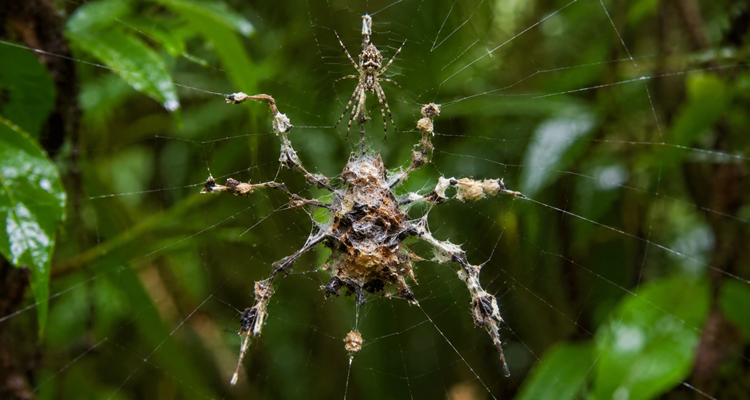
In the tropical forests of Peru and the Philippines, researchers have documented spiders that appear to do something remarkably close to that. These small orb-weavers assemble loose material into shapes resembling larger spiders, complete with body-like centres and projections that look like legs.
The structures are not living spiders. They are elaborate constructions made from silk, debris, and the remains of other creatures.
Scientists suspect these artificial lookalikes could discourage predators or draw attacks away from their builders. A study published in Ecology and Evolution in November 2025 provided the first detailed scientific documentation of this unusual behaviour in two geographically separated spider populations.
The discovery reveals something fascinating about animal survival: sometimes, the appearance of being dangerous may matter almost as much as actually being dangerous.
Meet the Spiders That Make Their Own Decoys
The spiders belong to the genus Cyclosa, a group of orb-weaving spiders known for incorporating unusual materials into their webs.
Unlike the familiar image of a spider sitting in the centre of a clean, symmetrical web, many Cyclosa species arrange prey remains, plant fragments, egg sacs, and other debris along their silk structures.
These arrangements are known as stabilimenta, a scientific term for conspicuous web decorations.
For some species, the decorations form relatively simple lines or clusters. But the spiders documented in Peru and the Philippines create something considerably more elaborate.
The real spider is much smaller than the object it creates.
This distinction is important. The spider is not changing its body or growing artificial limbs. Instead, it is modifying its surroundings to produce a potentially misleading visual signal.
Researchers have observed these constructions in separate tropical regions, suggesting that the behaviour is not limited to a single isolated location.
How Does a Spider Build a Fake Spider?
The process combines ordinary web-building abilities with an extraordinary arrangement of materials.
Rather than creating a replica with precise anatomical details, the spider produces a rough silhouette that may be convincing enough to influence an approaching predator.
The construction involves several elements.
-
Silk: Provides the structural framework and holds the decoration together.
-
Dead insects and prey remains: Contribute material to the central mass.
-
Plant debris and other fragments: Help form the overall shape.
-
Extended projections: Create the impression of spider-like appendages.
The finished structure is often substantially larger than the animal responsible for building it.
That difference in size may be central to the possible defensive advantage.
A predator that normally hunts small spiders could hesitate when confronted with what appears to be a larger one. Alternatively, it might attack the artificial structure instead of the real animal.
Either outcome could potentially benefit the builder.
The surprising order of construction
Researchers studying the Peruvian spiders also documented an intriguing sequence.
In their observations, the spiders began constructing the spider-shaped decoration during the night and completed other parts of the web closer to dawn.
The researchers proposed that building the decoy first might help ensure that a defensive structure is ready before daylight brings visually hunting predators.
That explanation remains a hypothesis, however. The observations establish the construction sequence, but they do not prove why the spiders follow it.
A Fake Spider That Appears to Move
The deception becomes even more interesting when the structure moves.
During observations in Peru in 2022, researchers encountered approximately 20 Cyclosa spiders in a floodplain habitat. Some had simple linear decorations, while others possessed more elaborate spider-shaped constructions.
When observers approached certain spiders with the complex decorations, the animals began shaking their abdomens against the structures.
The movement caused the artificial spider-like forms to vibrate.
As the observers moved closer, some spiders dropped from their webs toward the ground. The researchers reported that the spiders subsequently returned.
A moving decoy could potentially be more convincing than a stationary one, particularly to predators that use movement to locate prey.
But there is an important distinction between what scientists observed and what they have demonstrated experimentally.
The spiders were observed making their decorations vibrate. Researchers have not yet established that this movement reliably deceives predators or improves survival.
That unanswered question is one of the most interesting parts of the discovery.
Why Would a Predator Fall for the Trick?
The proposed defence exploits a basic challenge faced by visually hunting animals: they must make rapid decisions from incomplete information.
A predator approaching a spider web may need to determine whether an object is edible, dangerous, too large to handle, or simply irrelevant.
A convincing visual distraction could interfere with that decision.
Scientists have proposed two main defensive possibilities for the spider-shaped constructions.
1. Making the spider appear too large to attack
Some predators prefer prey within a particular size range.
In the Peruvian habitat, researchers documented the presence of helicopter damselflies, including Mecistogaster linearis and Microstigma rotundatum.
These insects belong to a group that includes specialised predators of web-building spiders.
Earlier research indicates that some helicopter damselflies target relatively small spiders while avoiding larger ones.
The 2025 researchers suggested that an oversized artificial spider might therefore discourage an attack.
The idea is plausible because the real spider falls within a size range that these predators may hunt, while the constructed silhouette can resemble a larger animal.
However, the study did not directly demonstrate that helicopter damselflies avoid these particular decoys.
2. Giving predators the wrong target
Another possibility is that the artificial spider serves as a distraction.
A predator might attack the more visible structure while overlooking the actual spider.
This would be especially useful if the spider could escape during the confusion.
The mechanism has some support from research on other members of the same genus.
In a 2009 study published in Animal Behaviour, researchers examined Cyclosa mulmeinensis, a spider that arranges prey remains and egg sacs into decorations resembling its own appearance.
The study found that decorated webs attracted more wasp attacks, but the decorations themselves became targets. The researchers concluded that the decoys could provide a survival advantage despite making the webs more conspicuous.
That is an important finding, although it does not prove that the larger, leg-shaped constructions documented in 2025 function identically.
Different spider species, predators, and decoration types may produce different outcomes.
The Same Trick, but Different Approaches
One particularly interesting finding is that the spiders in Peru and the Philippines do not use their artificial lookalikes in exactly the same way.
In Peru, the researchers identified the decoy-building species as Cyclosa longicauda. These spiders typically position themselves just above the central mass of their decorations.
From a distance, the real spider can look like a small part of the larger structure.
In the Philippines, however, the observed spiders rested within a shallow pocket formed by the central mass of the decoration.
That arrangement could help conceal the real animal rather than simply diverting an attack elsewhere.
The Philippine spiders have not yet been identified to species level because the researchers could not collect specimens for anatomical examination.
Two observed approaches
The real spider rests above the larger artificial silhouette.
The spider rests inside a pocket in the decoration’s central mass.
These differences suggest that similar-looking structures could potentially provide protection in more than one way.
They also illustrate why scientists need to study the spiders’ actual interactions with predators before settling on a single explanation.
How Large Are These Fake Spiders?
The structures are impressive relative to the animals that construct them.
In the 2025 study, researchers reported measurements from 48 Cyclosa spiders photographed in Peru during 2014.
Measurements from the Peruvian observations
2.54 mm
Mean spider abdomen length
8.15 mm
Mean central decoration width
3.3×
Reported average size ratio
Spider abdomen
2.54 mm
8.15 mm
The numbers show how an animal only a few millimetres long can create a visual structure several times its own size.
For a predator making a rapid visual assessment, that difference could matter.
Could the Decoys Be Disguised as Something Else?
A fake spider is not the only possible interpretation of these structures.
The researchers also considered whether some decorations might resemble bird droppings.
This possibility may sound less dramatic, but it has a biological precedent.
In 2014, scientists published research on Cyclosa ginnaga, a spider whose silvery body and white silk decoration can create the appearance of bird droppings.
The study provided evidence that this form of masquerade could help the spider avoid predators.
The irregular shape and downward-pointing projections of some Peruvian decorations raise the possibility that they could serve a similar function.
A predator might avoid the structure because it resembles an unsuitable food item rather than a larger spider.
Both explanations remain possible for the newly documented decoys.
The structures might even work differently against different predators.
A bird, a wasp, and a damselfly do not necessarily perceive the same web in the same way.
What Scientists Still Need to Discover
Although the spider-shaped constructions have now been formally documented, their precise defensive function remains unresolved.
The 2025 study was primarily observational. It described the spiders, their decorations, and their construction behaviour rather than experimentally measuring protection from predators.
Several questions remain open.
-
Do predators attack spider-shaped decorations more often than undecorated webs?
-
Are spiders with larger decoys more likely to survive?
-
Does vibrating the artificial spider change a predator’s response?
-
Are the structures more effective against birds, insects, or other hunters?
-
Why have some Cyclosa species developed elaborate spider-like decorations while others build simpler arrangements?
Researchers could investigate these questions by comparing decorated and undecorated webs, observing natural predation attempts, and testing how predators respond to different shapes and sizes.
Such experiments would help distinguish between camouflage, intimidation, and attack diversion.
They could also reveal whether the resemblance to a spider is essential or whether a similarly sized, irregular clump of debris would work just as well.
A Small Discovery With a Bigger Evolutionary Lesson
The most remarkable aspect of these spiders may not be their ability to produce a recognisable shape.
It is that they use materials outside their own bodies to potentially influence how another animal perceives them.
Animal camouflage often involves colours, patterns, or body shapes that have evolved over generations. These spiders add another possibility: modifying the environment itself to create a misleading appearance.
That does not mean they consciously understand deception or plan their constructions in the human sense.
Their behaviour may be guided by inherited instincts and responses to environmental cues. The evolutionary processes that produced these particular constructions remain a subject for investigation.
But the result is extraordinary.
A tiny spider can turn fragments of dead insects and silk into something that looks much larger than itself. It may even make that object move.
And in a rainforest where survival can depend on a predator’s split-second decision, such an illusion could make all the difference.
The spiders have already demonstrated that they can build remarkable artificial lookalikes. The next scientific challenge is discovering exactly how those constructions affect the animals that hunt them.
That is what makes this discovery more than a curious example of spider behaviour. It offers a window into how evolution can shape not only an animal’s body, but also the objects it builds around itself.
This content is published for informational or entertainment purposes. Facts, opinions, or references may evolve over time, and readers are encouraged to verify details from reliable sources.