






The Villages Where You Can Walk Into Another Country Without Realising You’ve Crossed a Border
In a handful of extraordinary European communities, international borders run through ordinary streets, public squares and even private homes. These places reveal what happens when political boundaries divide communities that continue to share everyday life.
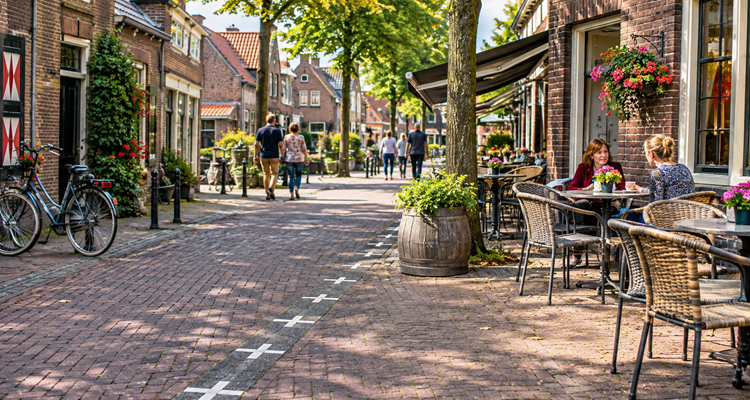
Imagine leaving a café, walking a few metres down the pavement and discovering that you are standing in another country. No airport, no passport booth and perhaps not even a sign to announce the change.
In some European border communities, this is an ordinary experience.
The most remarkable example is Baarle, a village shared by Belgium and the Netherlands, where national boundaries twist through neighbourhoods and buildings. Elsewhere, twin towns in Estonia and Latvia share public spaces, while two cities on the Italian–Slovenian border have turned a once-divisive frontier into a symbol of cooperation.
These places are not countries without borders. Their boundaries remain legally significant, and crossing rules still apply. What makes them unusual is how little those boundaries sometimes resemble the dramatic lines we imagine on a political map.
1. Baarle, Belgium and the Netherlands: A Village Divided Into 30 Pieces
The community consists of two municipalities: Baarle-Nassau in the Netherlands and Baarle-Hertog in Belgium.
Rather than being separated by one straightforward boundary, they contain an intricate network of 30 enclaves: 22 Belgian and eight Dutch.
An enclave is a piece of territory surrounded by another country’s territory. In Baarle, some Dutch enclaves are themselves surrounded by Belgian enclaves, creating an extraordinary geographical puzzle.
According to the official Visit Baarle tourism authority, the boundaries pass through streets, buildings and even bedrooms.
Where the border runs through your home
In many places, the international boundary is marked by distinctive paving stones or metal markers embedded in the ground.
A pedestrian can cross from the Netherlands into Belgium simply by walking along a street. A few steps later, another boundary may lead back into Dutch territory.
Some buildings are divided by the border itself.
House-number plates displaying Belgian or Dutch national colours help identify the country associated with a property’s front entrance. This makes the location of a doorway particularly important in a community where a building can physically occupy two countries.
The arrangement also creates practical administrative questions involving local government, public services and national regulations.
Yet for residents, this unusual geography is part of daily life rather than a constant source of confusion.
Why does Baarle have such strange borders?
The arrangement developed from historical landownership and jurisdictional divisions that survived centuries of political change.
Instead of simplifying every scattered parcel into one continuous national territory, the modern boundary preserved this fragmented geography.
The result is a village where two national administrations coexist within a closely connected community.
For visitors, the best way to understand the puzzle is on foot. The local tourism authority offers a four-kilometre enclave walking route through the village centre, crossing the international boundary several times.
Baarle demonstrates that an international border does not always separate one settlement from another. Sometimes, it passes through the settlement itself.
2. Valga and Valka: Two Countries Sharing One Urban Community
Valga lies in Estonia. Valka lies in Latvia.
To a visitor walking through their connected urban area, however, the division can seem surprisingly subtle.
The two towns share a history dating back centuries. Following the First World War, Estonia and Latvia both claimed the settlement, and a border was established through it in 1920.
During the Soviet period, the international distinction largely disappeared from everyday movement. Following the restoration of independence in 1991, the boundary again separated two sovereign countries.
A major change came in 2007, when Estonia and Latvia joined the Schengen Area, removing routine internal border checks.
A public square connecting two nations
One of the most interesting features of Valga–Valka is its shared central area.
The towns have developed connected public spaces designed to encourage people to move between the two sides.
Visitors can encounter a border-spanning square, seating positioned near the national boundary and even a swing associated with crossing between Estonia and Latvia.
These details turn an abstract political division into something visitors can experience physically.
But the connection extends beyond tourism.
The municipalities have cooperated in areas including education, culture, sport, health and environmental initiatives.
Their shared pedestrian and recreational spaces demonstrate how neighbouring administrations can coordinate around the needs of one connected community.
The official Valga–Valka tourism website describes this cooperation as part of an effort to strengthen the towns’ common identity.
For travellers, Valga–Valka offers something different from Baarle. Instead of an intricate collection of enclaves, it presents two adjoining national communities working to make their shared centre feel continuous.
3. Gorizia and Nova Gorica: From a Divided Frontier to a Shared Cultural Space
Their modern relationship was shaped by the political divisions that followed the Second World War.
The new boundary separated Gorizia from territory that became part of Yugoslavia. Nova Gorica subsequently developed on the Yugoslav side, in what is now Slovenia.
For decades, the frontier carried political significance far greater than its physical appearance might suggest today.
Now, visitors can explore a connected urban landscape where the boundary is much easier to cross.
A square that belongs to two countries
The most symbolic location is Piazza Transalpina, known in Slovenian as Trg Evrope.
The square lies across the international boundary, near the historic railway station in Nova Gorica.
Today, it functions as a shared public space where visitors can stand close to the line separating Italy and Slovenia.
Its significance became particularly visible in 2025, when Nova Gorica, together with Gorizia, celebrated a cross-border European Capital of Culture programme.
The opening celebrations on 8 February 2025 took place across streets and squares in both cities, reflecting the transformation of a historically divided area into a centre of cultural cooperation.
The distinction between the two countries remains. Different languages, institutions and national identities continue to shape life on either side.
But the shared square tells a broader story: a border that once represented separation can become a meeting place without disappearing from the map.
4. La Cure, France and Switzerland: A Hotel Built Across a Border
Here, the border between France and Switzerland runs through a building rather than simply passing beside it.
The Hôtel Arbez Franco-Suisse occupies territory in both countries.
The unusual location has made the property a destination for travellers interested in geographical curiosities as much as accommodation.
According to Switzerland Tourism, the hotel stands across the French–Swiss border in La Cure, approximately 22 kilometres from Nyon.
What makes the hotel remarkable?
Most international boundaries are imagined as outdoor lines, perhaps following a road, river or mountain ridge.
At Hôtel Arbez, the boundary continues through an inhabited structure.
This means the geographical distinction between France and Switzerland can become part of an ordinary hotel stay.
Unlike Baarle’s network of scattered enclaves, La Cure illustrates a more straightforward border made extraordinary by the location of a building.
It is also a reminder that a border can remain legally meaningful even when its physical presence is almost invisible.
5. Derby Line and Stanstead: A Library Shared by the United States and Canada
On the boundary between Vermont in the United States and Quebec in Canada stands the Haskell Free Library & Opera House.
The historic building straddles the international border between Derby Line and Stanstead.
It was deliberately established as a shared cultural institution serving communities on both sides.
Inside, the international boundary passes through the building itself.
But this example comes with an important distinction: the library is not an authorised international border crossing.
A shared building with strict crossing rules
The Haskell’s access arrangements have changed significantly in recent years.
In March 2025, US authorities ended the longstanding practice that had allowed Canadian visitors to approach the American entrance without clearing a conventional border checkpoint.
A new Canadian entrance was officially inaugurated in June 2026, restoring direct access for Canadian patrons from their side of the border.
The library’s current visitor guidance specifies separate entrances for Canadian and American visitors and requires guests to leave through the same entrance they used.
It also prohibits using the premises for cross-border family reunions or as a route to enter the neighbouring country.
This makes the Haskell an important counterexample to the idea that an invisible boundary is automatically an unrestricted one.
A building can belong geographically to two countries while remaining subject to carefully enforced international rules.
Why Do Some International Borders Feel Almost Invisible?
The communities above developed under different historical circumstances, but several underlying factors help explain their unusual geography.
Historical boundaries outlast the circumstances that created them
Baarle’s enclaves reflect historical territorial arrangements. Valga and Valka were divided by the emergence of modern national borders. Gorizia and Nova Gorica reflect the geopolitical settlement following the Second World War.
Once established, boundaries can survive long after the political circumstances that created them have changed.
Communities remain connected across political divisions
A national boundary does not necessarily divide the social and economic relationships of people living nearby.
Residents may continue to share commercial areas, cultural traditions, family connections and public spaces.
Where governments cooperate, these relationships can shape the design of streets, parks and community facilities.
European integration has changed the experience of crossing
One of the most important reasons many European borders feel less visible is the Schengen Area.
Under the Schengen system, participating countries generally permit people to cross internal borders without routine passport checks.
However, Schengen does not eliminate national boundaries, immigration requirements or the possibility of police checks.
Member states can also temporarily reintroduce internal border controls under specified conditions.
The European Commission’s published notifications show that temporary controls remain in effect on several European borders in November 2026, including certain borders involving France, Germany and Italy.
That distinction matters for anyone planning to visit these places.
Can You Really Walk Across These Borders Without a Passport?
In many Schengen border communities, people can ordinarily cross without stopping at a checkpoint. But this does not mean every visitor can travel without identification or the required immigration permission.
A traveller’s nationality, residence status, visa conditions and the border-control measures in force can all affect what is legally permitted.
For example, someone lawfully visiting the Schengen Area may be able to move between Belgium and the Netherlands without encountering routine border inspection. That person must still comply with applicable entry, stay and identification rules.
A border may be practically invisible, but it is never automatically irrelevant.
Where to Experience These Unusual Borders
For travellers interested in experiencing an international boundary on foot, these destinations offer different kinds of encounters.
| Destination | What makes it special |
|---|---|
| Baarle, Belgium–Netherlands | Walk through an intricate network of enclaves |
| Valga–Valka, Estonia–Latvia | Explore a shared centre connecting two countries |
| Gorizia–Nova Gorica, Italy–Slovenia | Stand in a symbolic cross-border square |
| La Cure, France–Switzerland | Discover a hotel that straddles a national boundary |
| Derby Line–Stanstead, US–Canada | Visit a shared library with regulated cross-border access |
For a walking-focused trip, Baarle offers perhaps the clearest demonstration of how international boundaries can intersect with ordinary village life.
Valga–Valka and Gorizia–Nova Gorica are particularly interesting for visitors who want to understand how divided communities have rebuilt connections.
La Cure provides a more intimate architectural curiosity, while the Haskell Library illustrates the continuing legal importance of a border even inside a shared institution.
Before travelling, consult the relevant official tourism authority and current government border guidance.
What These Border Communities Reveal About Geography and Identity
A political map presents the world as a collection of clearly separated territories.
On the ground, human geography is often more complicated.
A street may belong to two national histories. A public square may connect communities once divided by political conflict. A building may stand in two countries while serving one local population.
These places do not prove that borders have ceased to matter.
Instead, they show that national sovereignty and everyday human connection can exist in the same physical space.
In Baarle, a border can pass through a house. In Valga–Valka, two municipalities can share a public centre. In Gorizia and Nova Gorica, a formerly divisive frontier can become a place for cultural celebration.
The most surprising part is not that people can sometimes cross a national boundary without noticing.
It is that, for the people who live there, the extraordinary geography has become ordinary life.
And perhaps that is the most interesting lesson these places offer: a line on a map can define a country without fully defining the community that lives around it.
This content is published for informational or entertainment purposes. Facts, opinions, or references may evolve over time, and readers are encouraged to verify details from reliable sources.
Related News
- The Countries Where Crossing a Street Can Mean Travelling Into Tomorrow
- The Airports Where Your Flight Can Land in a Different Country Than You Expected
- The Towns That Become Tourist Attractions for Something That No Longer Exists
- The Places Tourists Photograph but Never Realise Are Slowly Disappearing