









Why Some Pilgrimages End Where the Journey Began and the Traveller Is Never Quite the Same
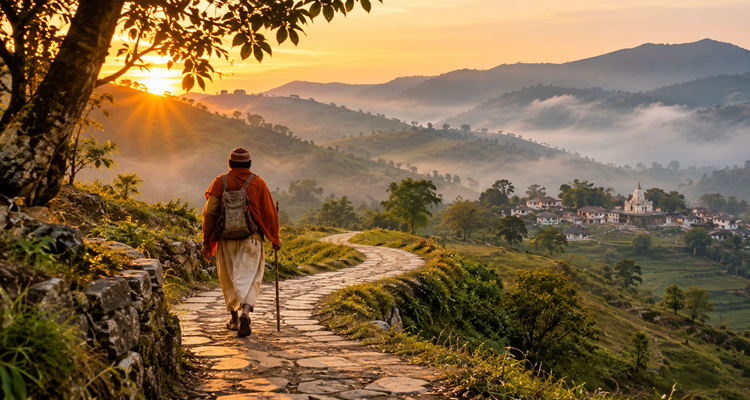
The deepest journeys do not always lead to unfamiliar destinations. Sometimes, they bring us back to the life we already know with a different understanding of who we are, what matters, and what it means to belong.
A pilgrim returns home. The streets are familiar, the doorway is unchanged, and the ordinary responsibilities of life are waiting. Yet something about the return feels different. Places once passed without a second thought seem worthy of attention. Old frustrations may appear smaller. Questions that once demanded immediate answers may no longer feel so urgent.
Nothing in the surroundings necessarily changed. The traveller’s relationship with those surroundings may have.
This is one of the enduring paradoxes of pilgrimage: a journey can end at the same geographical point where it began while leaving the traveller with a profoundly different sense of life.
Across religious traditions and cultures, pilgrimage has involved movement towards sacred places, meaningful landscapes, ancestral connections, or destinations associated with spiritual insight. But its significance cannot always be measured by distance travelled or landmarks reached.
For many pilgrims, the destination is only one part of a larger experience. Preparation, uncertainty, physical effort, encounters with strangers, ritual participation, and the eventual return can all contribute to the journey’s meaning.
Why, then, does coming home sometimes feel like arriving somewhere new?
The Difference Between Travelling Somewhere and Becoming Someone
Ordinary travel and pilgrimage can involve similar activities. Both may require planning, transportation, accommodation, walking, and unfamiliar surroundings. The distinction often lies in the meaning assigned to the journey.
A holiday might be undertaken for relaxation, discovery, or pleasure. A pilgrimage is generally connected to a deeper purpose, whether religious devotion, gratitude, repentance, remembrance, spiritual inquiry, or personal renewal.
That purpose changes how experiences are interpreted.
A difficult climb may become an expression of commitment. Waiting patiently among thousands of other pilgrims may become an exercise in humility. A simple meal shared with strangers may acquire an emotional significance that an elaborate meal at home never possessed.
The experiences themselves are not necessarily extraordinary. Their importance emerges partly from the intention with which the traveller approaches them.
This does not mean every pilgrim experiences spiritual transformation. Some return exhausted, disappointed, or uncertain about what the journey meant. Others describe lasting changes in perspective.
The important distinction is that pilgrimage creates an opportunity for reflection rather than guaranteeing a particular outcome.
And sometimes, the most significant part of that reflection begins only after the traveller has returned.
Why the Return Is Part of the Pilgrimage
A journey is usually described as movement from one place to another. But many pilgrimages are better understood as a cycle: departure, passage, encounter, and return.
The outward journey separates a person, temporarily, from familiar routines. The pilgrimage itself introduces experiences shaped by the destination and its religious or cultural significance. Returning home then creates an opportunity to reconsider ordinary life through what has been encountered.
Anthropologists have explored such transitions through the concept of liminality a condition of being between established states or roles.
In their influential work on ritual, Arnold van Gennep and later Victor Turner examined how people move through periods of separation, transition, and reintegration. Turner and Edith Turner subsequently applied related ideas to pilgrimage.
These frameworks do not explain every pilgrim’s experience, and scholars have questioned whether pilgrimage always produces the unity or transformation sometimes associated with it. Nevertheless, they offer a useful way to understand why returning matters.
A person may leave home primarily identified by everyday roles: employee, parent, student, neighbour, or business owner.
During a pilgrimage, those identities do not disappear, but they may temporarily become less central. The traveller can experience being a seeker, devotee, guest, or participant in something larger than personal routine.
On returning, the challenge is no longer simply to resume those familiar roles. It is to decide whether anything learned during the journey should influence how those roles are lived.
The outward journey creates distance from ordinary life. The return reveals what that distance has made visible.
Sacred Circles: When the Path Itself Carries Meaning
PILGRIMAGE TRADITIONS
Circumambulation moving around a sacred shrine, temple, mountain, or other revered place is an important practice in many Hindu traditions. The circular route expresses reverence and places the sacred centre at the heart of the pilgrim’s movement.
In Islam, pilgrims perform tawaf, circling the Kaaba seven times as part of Hajj and Umrah. The act belongs to a defined religious practice, with its own requirements and significance. Its circular movement provides another example of sacred travel in which returning to a point is integral to the ritual.
In Tibetan Buddhist traditions, kora involves circumambulating sacred sites, including monasteries, stupas, and mountains. Such journeys may express devotion, accumulate religious merit within the tradition’s understanding, or form part of a larger spiritual discipline.
These practices are not interchangeable. Their theological foundations, ritual rules, histories, and purposes differ considerably.
Yet they reveal an intriguing shared spatial pattern: a route can be meaningful without ending somewhere geographically new.
In a circular pilgrimage, the traveller’s physical starting point and finishing point may coincide. The journey is not rendered pointless by that return. Completing the circuit is part of what gives the action its significance.
The circle also offers a compelling philosophical image. A person can move through an entire experience and arrive back at the beginning, carrying memories, intentions, and insights that were not present before.
The spiritual meaning of any particular ritual must be understood within its own tradition. But as a broader human metaphor, the circle suggests that progress need not always resemble a straight line.
What Changes When Familiar Routines Fall Away?
Much of everyday life operates through repetition.
People wake at familiar hours, follow established routes, interact with predictable groups, and respond to responsibilities that rarely leave room for prolonged reflection.
These routines provide stability. They also influence what receives attention.
A pilgrimage interrupts that pattern.
A person accustomed to convenience may experience physical discomfort. Someone whose days are tightly scheduled may encounter long periods of waiting. A traveller who usually feels independent may have to rely on strangers for directions, assistance, or hospitality.
Such experiences do not automatically make someone wiser or more compassionate. Difficulty can just as easily produce frustration.
However, unfamiliar conditions can make habitual reactions more noticeable.
A pilgrim might recognise how quickly impatience arises when plans fail. Another may discover an unexpected capacity for endurance. Someone else may find that moments of quiet are more meaningful than the anticipated arrival at a famous shrine.
The transformation, where it occurs, may involve no dramatic revelation.
It may simply be the discovery that a familiar response is not the only possible response.
The Psychology of Returning With a Different Perspective
The idea that meaningful journeys can influence identity is not confined to religious belief.
Psychological research offers several concepts that help explain how significant experiences may affect a person’s understanding of themselves.
One is autobiographical meaning-making: the process of interpreting life events and incorporating them into a broader personal story.
A journey may become important not only because of what happened, but because of what the traveller later understands it to mean.
For example, completing a demanding pilgrimage might be remembered as evidence of perseverance. Receiving unexpected kindness could challenge an earlier distrust of strangers. Time spent away from everyday distractions might lead someone to reconsider priorities.
Research on narrative identity, including work by psychologist Dan P. McAdams, examines how people construct a sense of continuity and meaning through the stories they tell about their lives.
This perspective helps illuminate an important feature of pilgrimage: the event and its interpretation are not the same thing.
Two people can complete the same route, visit the same sacred site, and return with entirely different understandings.
One may experience renewed religious commitment. Another may feel closer to family history. A third may value the friendships formed along the way. A fourth may find the experience less meaningful than expected.
There is no universal psychological outcome.
Moreover, a powerful feeling immediately after a journey does not necessarily translate into lasting behavioural change. Sustained transformation generally requires more than a memorable experience; it involves what a person subsequently chooses to practise.
The pilgrimage may provide a turning point in someone’s personal narrative, but everyday life determines how much of that turning point becomes part of their future.
The Unexpected Importance of Other Pilgrims
Pilgrimage is often described as an inward journey, but it can also be deeply social.
People who might never meet in ordinary circumstances may walk the same route, share temporary accommodation, wait together, or assist one another through difficult stretches.
Victor and Edith Turner explored the idea of communitas, a sense of human connection that can arise when familiar social distinctions become less important during shared ritual experiences. Their work remains influential, although later scholarship has challenged overly idealised descriptions of pilgrimage communities.
The distinction matters.
Pilgrims do not necessarily abandon differences of wealth, status, language, nationality, or religious interpretation. Shared journeys can involve disagreement, exclusion, commercial pressures, and unequal access.
Still, moments of solidarity can be meaningful precisely because they interrupt expectations.
A stranger offering water during a difficult walk may become part of a traveller’s most enduring memory. Someone who arrives expecting a solitary spiritual experience may discover that the journey’s meaning emerges through relationships.
When the pilgrim returns home, such encounters may raise a quiet question: if compassion and generosity were possible among strangers on the road, why should they be absent from familiar relationships?
That question may prove more enduring than the journey itself.
Why Some Pilgrims Return Disappointed
Not every sacred journey ends in peace, clarity, or renewed faith.
A person may undertake a pilgrimage with enormous expectations, believing that reaching a particular destination will resolve grief, remove uncertainty, or provide a decisive spiritual experience.
The destination may be deeply meaningful within their tradition. Yet the traveller’s emotional response remains unpredictable.
Crowds can be overwhelming. Physical exhaustion can overshadow reflection. Religious expectations may clash with the practical realities of travel. A person may return with unresolved questions rather than satisfying answers.
These experiences deserve recognition rather than dismissal.
A pilgrimage is not a psychological treatment, and spiritual participation does not guarantee relief from distress. Nor should a pilgrim’s disappointment be interpreted automatically as a failure of devotion.
Sometimes the value of the journey emerges gradually. Sometimes it remains ambiguous. Sometimes the traveller simply concludes that the experience was different from what they hoped.
Recognising this complexity makes the possibility of transformation more credible, not less.
Meaningful journeys can influence people without following a predictable emotional script.
The Hardest Part May Begin After Coming Home
During a pilgrimage, the traveller’s purpose can feel unusually clear.
There is a route to follow, a destination to reach, a ritual to complete, or a sacred place to encounter.
At home, life becomes complicated again.
Work demands attention. Relationships require patience. Bills must be paid. The same disagreements, disappointments, and responsibilities that existed before the journey are still present.
This is where the difference between temporary inspiration and lasting change becomes important.
A pilgrim who felt grateful during the journey may struggle to maintain gratitude amid ordinary frustrations. Someone who experienced generosity from strangers may find it difficult to extend the same generosity to a demanding colleague or family member.
The return therefore presents a different kind of challenge.
The journey asked the traveller to move through the world. Everyday life asks whether the traveller can live differently within it.
That change need not be dramatic.
It might involve listening more carefully, responding less impulsively, setting aside time for prayer or reflection, participating more actively in a community, or treating familiar responsibilities with renewed seriousness.
In religious contexts, such actions may be understood as expressions of devotion or spiritual discipline. From a secular perspective, they may represent an effort to align daily behaviour with personally meaningful values.
Neither interpretation requires the assumption that every pilgrim has undergone a permanent transformation.
What matters is whether an insight becomes something more than a memory.
Can a Pilgrimage Happen Without Travelling Far?
Traditional pilgrimage usually involves movement towards a place invested with religious or cultural significance. Physical destinations, rituals, and communities are often essential to its meaning.
A private walk around one’s neighbourhood should not automatically be treated as equivalent to Hajj, a temple pilgrimage, or another established religious practice.
Nevertheless, the broader idea of a reflective journey raises a useful question: must meaningful personal change always require a distant destination?
Not necessarily.
A familiar walk undertaken with deliberate attention can create space for reflection. Returning to a childhood home may prompt a reassessment of memory and identity. Revisiting a place associated with grief or gratitude may alter how someone understands an important experience.
These activities are not necessarily religious pilgrimages. But they share a psychological possibility with pilgrimage: physical movement can help organise an inward process of remembrance, questioning, or renewed commitment.
The significance comes not from distance alone, but from the relationship between place, intention, experience, and interpretation.
For those who cannot travel because of disability, financial limitations, caregiving responsibilities, or other circumstances, it is especially important not to equate spiritual depth with the ability to undertake demanding journeys.
Religious traditions differ in their teachings about obligations, exemptions, alternative practices, and the spiritual significance of travel. Their specific guidance should be respected rather than replaced by a universal claim that every form of reflection is the same as pilgrimage.
The Circle Is Complete, but the Story Continues
The most interesting thing about a circular journey is that its endpoint does not reveal everything that happened along the way.
A map can show that a traveller departed from one location and returned to it. It cannot show how the traveller interpreted a difficult encounter, what memories became important, or which assumptions were reconsidered.
That distinction helps explain why some pilgrimages are remembered as turning points.
The physical journey has a visible conclusion. The personal meaning of the experience may continue developing long afterwards.
Psychologists Dan P. McAdams and Kate C. McLean describe narrative identity as an evolving life story through which people connect remembered experiences with their understanding of who they are and who they may become. Their research also cautions against assuming simple causal relationships between particular life narratives and psychological well-being.
Applied carefully to pilgrimage, this suggests that a journey’s influence may depend partly on how it becomes integrated into a person’s continuing life story.
The pilgrim may come to see the experience as a moment of renewed faith, a lesson in humility, a connection with ancestors, or a reminder of human interdependence.
Or its significance may remain unsettled for years.
Either way, the journey is not confined to the dates of departure and return.
What the Traveller Brings Back
Pilgrims may return with photographs, souvenirs, sacred objects, certificates, or memories of remarkable landscapes.
But the less visible things they carry may eventually matter more.
Perhaps they have discovered that patience is possible even when circumstances are uncomfortable. Perhaps they have recognised how much they depend on others. Perhaps a religious practice has become more personally meaningful, or a familiar relationship has acquired new importance.
Some may return with questions rather than answers.
That, too, can be part of a meaningful journey.
The idea that a pilgrim is never quite the same should therefore be understood as a possibility, not a universal promise. Human beings change through many experiences, and pilgrimage is neither the only path to self-understanding nor a guarantee of it.
Its distinctive power lies in bringing movement, intention, place, ritual, memory, and reflection together within a recognisable journey.
A pilgrim may eventually stand at the same doorway from which they departed. The house has not moved. The road still leads to familiar places. The world has continued with its ordinary demands.
Yet the traveller may now recognise something that was difficult to see before leaving.
Perhaps home was never merely the place from which the journey began. Perhaps it is also the place where the journey’s meaning must finally be lived.
The circle closes on the map. In the traveller’s life, another chapter may just be beginning.
This content is published for informational or entertainment purposes. Facts, opinions, or references may evolve over time, and readers are encouraged to verify details from reliable sources.
Related News
- Why Shiva Drinks the Poison but Never Swallows It: The Mystery Hidden in His Blue Throat
- Why Some Sacred Rituals Begin by Destroying What Took Days to Create
- The Forgotten Hindu Temple in Pakistan That Survived Centuries but Not 1992
- Why Sacred Places Can Feel Different Even When Nothing Around You Has Changed