







Why Some Sacred Rituals Begin by Destroying What Took Days to Create
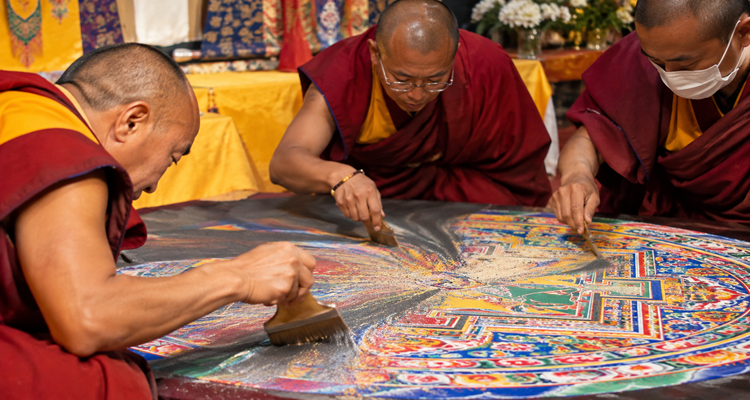
In Tibetan Buddhist tradition, the deliberate dismantling of an intricate sand mandala is not an act of waste or disrespect. It is a sacred lesson about impermanence, compassion, and the meaning of creation itself.
Imagine spending days arranging millions of tiny grains of colored sand into an extraordinary work of art. Every line is carefully measured, every symbol has meaning, and even the smallest mistake requires attention.
Then, when the masterpiece is finally complete, you deliberately sweep it away.
To someone unfamiliar with the tradition, this might seem heartbreaking. Why devote so much patience and skill to something that will soon disappear?
Yet in Tibetan Buddhism, the disappearance is not a failure of the creative process. It is part of its purpose.
The practice of creating and dismantling sacred sand mandalas expresses a profound teaching: something does not have to last forever to possess meaning.
And while the ritual is often explained as a lesson in letting go, its religious significance reaches further, encompassing meditation, spiritual transformation, and the sharing of blessings.
The Sacred Art Designed to Disappear
They may represent an enlightened realm or the symbolic residence of a Buddhist deity. Their geometric arrangements, colors, and religious imagery are connected to specific teachings and ritual traditions.
According to the Smithsonian’s National Museum of Asian Art, mandalas serve as aids to meditation and spiritual development. Practitioners may visualize the design as a three-dimensional sacred palace, using its symbolic structure to contemplate wisdom, compassion, and enlightenment.
Creating one requires extraordinary concentration.
The process typically begins with the preparation and consecration of the space. Practitioners then establish the geometric design and gradually fill it with colored grains.
Traditional instruments called chak-pur allow artists to release a controlled stream of sand through vibration.
A single mandala can require several days or even weeks of work.
Throughout the process, prayers, chanting, meditation, and ritual observances may accompany the physical construction.
But unlike a conventional painting intended for permanent display, many ceremonial sand mandalas are created with the understanding that they will eventually be dismantled.
The artwork is temporary by design.
Why Destroy Something So Beautiful?
The central explanation lies in the Buddhist teaching of anicca, commonly translated as impermanence.
In Buddhist philosophy, conditioned things arise through causes and circumstances and eventually change or cease.
This applies not only to physical objects but also to experiences, relationships, circumstances, and the conditions of human life.
A sand mandala makes this teaching visible.
During its construction, thousands or millions of separate grains gradually become an ordered image. What begins as loose material takes on form, complexity, and sacred significance.
Then the process is reversed.
The patterns disappear, the colors intermingle, and the carefully maintained boundaries lose their shape.
The transition from order to scattered sand becomes a direct illustration of change.
The teaching is not that beauty is worthless because it cannot endure. Rather, impermanence invites practitioners to recognize value without assuming that what is valuable must remain unchanged.
That distinction matters.
Impermanence is not the same as meaninglessness.
A flower can be beautiful even though it will wither. A meaningful conversation does not lose its importance when it ends. A sacred work can fulfill its purpose without surviving as a permanent object.
The sand mandala embodies this understanding through action rather than explanation alone.
The Ritual Does Not Simply End With Destruction
The dismantling of a sand mandala is often called a dissolution ceremony.
It is not ordinarily an impulsive act in which someone destroys a finished artwork out of frustration. It is an intentional and structured part of a religious practice.
Depending on the specific tradition and ceremony, practitioners may begin by making ritual gestures through the design and then sweeping the colored grains inward.
The distinct patterns gradually disappear into a mixture of sand.
Some of the material may be distributed to participants as a blessing. The remainder may be carried to a river or another suitable body of water.
Within the religious understanding of the ceremony, dispersing the sand can symbolize extending blessings beyond the original ritual space.
The Namgyal Monastery Institute of Buddhist Studies explains that the sand mandala’s eventual dismantling is connected to disseminating blessings for the benefit of sentient beings.
This reveals an important point that popular descriptions sometimes overlook.
The ceremony is not only about learning to accept loss.
It can also be understood as a movement from concentrated sacred activity toward a wider expression of compassion.
The object disappears, but the religious intention behind its creation continues through the concluding ritual.
A Real Example: Two Weeks of Work, Then a River
In January 2002, twenty Tibetan Buddhist monks from Drepung Loseling Monastery constructed a healing sand mandala at the Smithsonian’s Arthur M. Sackler Gallery in Washington, D.C.
The ceremony followed the September 11, 2001 terrorist attacks and was presented in a context of healing and remembrance.
The mandala measured approximately seven feet square. According to the Smithsonian, the monks worked in shifts over two weeks to complete it.
After the mandala was finished, it was ceremonially dismantled.
Some of the sand was distributed to visitors, while the remainder was released into the Potomac River.
The Smithsonian describes the dismantling as an expression of impermanence and the dispersal as a symbolic extension of the mandala’s healing blessings.
This event illustrates how a traditional religious practice can acquire additional significance in a particular historical setting.
For the participating monks, the ritual carried established Buddhist meanings. For visitors responding to a period of collective grief, it also offered an opportunity to reflect on loss, compassion, and the possibility of healing.
The two perspectives could coexist without being identical.
The Difference Between Creating Without Attachment and Creating Without Caring
One of the most easily misunderstood aspects of the ritual is the relationship between effort and attachment.
If practitioners know the mandala will disappear, why take such extraordinary care in making it?
Because non-attachment does not mean indifference.
In Buddhist teachings, attachment often refers to a form of clinging that treats changing things as though they could provide permanent security or satisfaction.
Care, by contrast, can be expressed through concentration, discipline, generosity, and respect.
A practitioner may devote full attention to an intricate design while accepting that the finished object is temporary.
These attitudes are not necessarily contradictory.
In fact, the ritual brings them together.
Creating the mandala demands patience and commitment. Dismantling it requires a different kind of discipline: allowing the completed work to change according to the ritual’s purpose.
The result is a striking contrast between two forms of intentional action.
One builds.
The other releases.
Both belong to the same sacred process.
Is the Destruction More Important Than the Creation?
It is tempting to describe the dissolution ceremony as the most meaningful moment of the entire practice.
But that interpretation can oversimplify the tradition.
The creation of a sand mandala is itself a religious activity involving sacred symbolism, visualization, meditation, and prescribed ritual procedures.
The finished image also has significance. It may serve as a representation of an enlightened realm and as a focus for spiritual practice.
Dismantling is therefore not necessarily the single moment when an otherwise ordinary artwork becomes sacred.
Instead, the construction, consecration, contemplation, and dissolution form interconnected parts of a larger ritual.
Tibetan artist and former monk Losang Samten has emphasized this connection. In a Smithsonian discussion of his work, he explained that dismantling belongs to the act of creation rather than standing outside it.
This perspective changes the question.
Rather than asking why practitioners destroy something they have finished, we can ask why the temporary existence of the mandala is essential to the practice.
The answer is that its disappearance can be understood as a meaningful completion, not merely an ending.
Why the Ritual Can Feel Uncomfortable to Modern Audiences
Many people are accustomed to measuring creative achievement through what remains.
A painting is preserved. A building is maintained. A photograph captures a moment that would otherwise disappear.
Objects often become evidence of the time, money, and effort invested in them.
From this perspective, dismantling a beautiful mandala may appear to erase the value of the work.
Yet the ritual operates according to a different understanding of achievement.
Its purpose is not primarily to produce an object for permanent ownership. The process itself is part of a spiritual discipline, and the object’s eventual disappearance has religious significance.
That difference helps explain why the ceremony can be especially affecting when performed in museums and other public spaces.
Visitors may initially approach the mandala as an artwork to admire. The dissolution challenges that expectation by demonstrating that preservation is not always the intended outcome.
An academic discussion of Tibetan sand mandalas in museum settings also highlights how public presentations can emphasize impermanence, sometimes differently from the fuller religious context of traditional ritual practice.
The distinction is important: a mandala is not simply an elaborate demonstration of how to cope with change. It belongs to a living religious tradition with specific teachings, practices, and communities.
Does Every Sacred Mandala Have to Be Destroyed?
No.
Mandalas exist in multiple forms across Buddhist and Hindu traditions. They may appear in paintings, architectural arrangements, ritual diagrams, and other artistic or devotional settings.
Not all are made from sand, and not all are intended for ceremonial dissolution.
Even within Tibetan Buddhism, the details of a mandala’s construction and use depend on its religious purpose and the particular tradition involved.
The deliberate dismantling discussed here is especially associated with temporary Tibetan Buddhist sand mandalas.
It would therefore be misleading to suggest that every mandala must be destroyed or that all traditions interpret these sacred designs in precisely the same way.
The wider lesson about impermanence is significant, but it should not replace the specific religious meaning of the practice.
What This Ancient Practice Can Teach Beyond the Monastery
For people outside Tibetan Buddhism, the ritual may offer a useful way to think about effort, achievement, and change.
Consider how often people postpone satisfaction until something is finished, secured, or made permanent.
A completed project must produce recognition. A meaningful experience must be documented. A personal achievement must somehow remain visible.
The sand mandala offers a different possibility: the value of an experience may exist in the attention, intention, and relationships involved, even when its physical form does not endure.
This is a philosophical reflection inspired by the ritual, not a claim that Buddhist practitioners all interpret it in the same way.
It also does not mean that preservation is unimportant. Protecting historical objects, cultural heritage, personal memories, and meaningful achievements can be deeply worthwhile.
The lesson is more subtle.
We can care about something without expecting it to last indefinitely.
We can work diligently without controlling every outcome.
And we can recognize that the conclusion of an experience does not necessarily cancel its significance.
The Beauty of Something That Was Never Meant to Last
The most remarkable aspect of a Tibetan sand mandala may not be its intricate geometry or the extraordinary patience required to create it.
It may be the relationship between those qualities and the knowledge that the finished design will disappear.
The practitioners do not necessarily work less carefully because the mandala is temporary.
They devote their attention to it precisely within the conditions of its temporary existence.
When the sand is finally gathered, the ritual does not simply reject what has been created. It completes a process in which making, contemplation, and release are connected.
For outsiders, the ceremony offers an opportunity to reconsider an assumption that often goes unquestioned: that lasting value requires lasting form.
Within its Tibetan Buddhist context, the meaning is richer and more specifically religious, involving sacred symbolism, impermanence, spiritual practice, and compassion.
The mandala disappears.
But its disappearance is not evidence that the work was pointless.
It is part of what the work was created to express.
This content is published for informational or entertainment purposes. Facts, opinions, or references may evolve over time, and readers are encouraged to verify details from reliable sources.
Related News
- The Forgotten Hindu Temple in Pakistan That Survived Centuries but Not 1992
- Why Sacred Places Can Feel Different Even When Nothing Around You Has Changed
- Why Mark Zuckerberg Visited Kainchi Dham: The Neem Karoli Baba Connection Behind a Silicon Valley Story
- Kainchi Dham: How a Himalayan Ashram Became a Global Spiritual Landmark