










Kainchi Dham: How a Himalayan Ashram Became a Global Spiritual Landmark
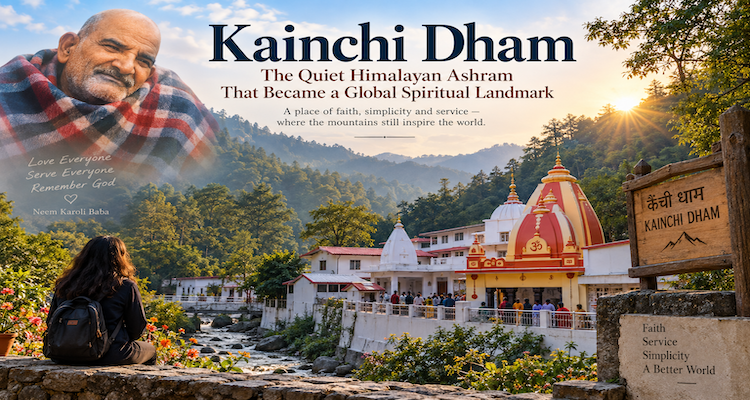
On a mountain road between Bhowali and Almora, a small Himalayan ashram has acquired an influence far larger than its physical size.
Kainchi Dham is associated with Neem Karoli Baba, the Hindu spiritual teacher whose followers remember him as Maharaj-ji. The ashram was founded in 1962 and became a pilgrimage centre in the Kumaon hills. Today, however, its story reaches well beyond traditional pilgrimage: it has become part of the cultural history of Western spirituality and, unexpectedly, the mythology surrounding Silicon Valley.
That transformation is what makes Kainchi Dham worth examining.
Its international reputation was not built around a grand monument, a large institution or a conventional publicity campaign. It spread through people: devotees who carried Neem Karoli Baba’s teachings elsewhere, Western seekers who encountered them in India, and later technology figures whose visits brought the ashram into a very different cultural conversation.
The result is an unusual story about how a quiet religious centre became a meeting point between Indian devotional traditions, Western counterculture and modern technology.
Key Takeaways
- Kainchi Dham was founded in 1962 and became closely associated with Neem Karoli Baba and Hanuman devotion.
- Neem Karoli Baba’s influence spread internationally largely through devotees such as Ram Dass rather than conventional institutional promotion.
- Ram Dass transformed his encounter with the guru into a body of work that helped introduce Indian spiritual ideas to generations of Western readers.
- Steve Jobs and Mark Zuckerberg helped connect Kainchi Dham with the public story of Silicon Valley’s interest in Indian spirituality.
- The ashram’s lasting significance is better understood through its teachings on love, service and remembrance than through celebrity associations.
A Small Ashram With an Unusually Large Story
Kainchi Dham sits in the Kumaon hills of Uttarakhand, on the road between Nainital and Almora. Uttarakhand Tourism describes it as a Hanuman temple and ashram founded by Neem Karoli Baba in 1962. Its name is linked to the shape formed by the surrounding hills, which cross like the blades of scissors kainchi in Hindi.
Geography is important to the character of the place.
The ashram is not located in a major city or surrounded by the infrastructure normally associated with international religious destinations. It is part of a mountain landscape where forests, hills and the road through the Kumaon region remain integral to the experience.
That physical modesty contrasts sharply with the reputation Kainchi Dham has acquired.
The story of the place is therefore less about architecture than about transmission: how an idea travels from one person to another until its original setting becomes known far beyond its geographical boundaries.
Who Was Neem Karoli Baba?
Neem Karoli Baba became one of the most influential Indian spiritual figures among a generation of Western seekers who traveled to India during the 1960s and 1970s.
His public image was notably different from that of a modern institutional leader. His influence was transmitted through devotees, personal encounters and stories rather than through a large publishing or media operation.
One of the central ideas associated with his teaching was remarkably direct: love everyone, serve everyone and remember God.
The phrase is documented repeatedly in the teachings preserved by the Ram Dass organization, which identifies Neem Karoli Baba’s central teaching in those terms.
The simplicity matters.
There is no complicated system in those three instructions. Their difficulty lies in applying them.
“Love everyone” is an ethical challenge.
“Serve everyone” turns spirituality outward rather than making it exclusively about private experience.
“Remember God” places devotion and spiritual awareness at the centre of ordinary life.
For devotees, these ideas became a practical spiritual framework rather than merely a set of philosophical statements.
The Person Who Helped Carry Kainchi Dham West
The most important bridge between Neem Karoli Baba and Western audiences was Richard Alpert, later known as Ram Dass.
Alpert was a Harvard psychologist who traveled to India in 1967. There he encountered Neem Karoli Baba, an experience that changed the direction of his life. The Ram Dass organization records that Alpert met his guru during his 1967 journey and later returned to the United States as Ram Dass, a name meaning “servant of God.”
The encounter did not remain a private spiritual experience.
In 1971, Ram Dass published Be Here Now. The book became an influential work in the Western counterculture and helped introduce meditation, yoga and Eastern spiritual ideas to a large Western readership.
This is one of the most important parts of Kainchi Dham’s story.
The ashram did not need to become a global institution in order for its influence to become global.
A person went there.
That person changed.
He returned to the West.
He wrote.
Other people read his work.
Some of them became interested in the teacher who had influenced him.
Others traveled to India.
The process repeated.
In this sense, Kainchi Dham’s international reach resembles a cultural network more than a conventional religious expansion.
The Silicon Valley Connection
Decades later, another group of visitors changed the public image of Kainchi Dham.
The ashram became associated with Steve Jobs and Mark Zuckerberg.
Uttarakhand Tourism itself notes the recognition Kainchi Dham gained from visits by Apple co-founder Steve Jobs and Facebook founder Mark Zuckerberg.
The Zuckerberg story is particularly well documented.
In a 2015 Washington Post report, Zuckerberg said that Steve Jobs had encouraged him to visit the ashram while Facebook was going through an uncertain period. Jobs had visited Kainchi Dham as a young man in the 1970s, according to the report.
That story created a striking cultural juxtaposition.
At one end was an ashram devoted to spiritual practice, service and devotion.
At the other was Silicon Valley, one of the world’s most powerful centres of technological and commercial ambition.
The connection is fascinating—but it should not be exaggerated.
There is a difference between saying that successful technology figures visited or were influenced by Indian spirituality and claiming that Kainchi Dham directly produced particular innovations, business strategies or products.
The evidence supports the first claim.
The second would go beyond what can responsibly be established.
Why the Steve Jobs Story Became So Powerful
The Jobs connection has become part of the modern mythology surrounding Kainchi Dham because it fits a larger cultural narrative: the idea that technological achievement and material success do not necessarily eliminate the search for meaning.
Jobs’ journey to India occurred before Apple became the global technology company it would eventually become.
The Washington Post reported that Jobs visited Kainchi Dham as a young college student, while Zuckerberg later visited on Jobs’ recommendation.
The story is compelling because it reverses a familiar assumption.
Technology is usually associated with speed, optimization and control.
Spiritual pilgrimage often asks for the opposite: patience, reflection, surrender and attention.
Kainchi Dham sits at the intersection of those two worlds.
But there is another important distinction.
The most defensible lesson from the connection is not that spirituality “caused” Silicon Valley success.
It is that even people operating at the highest levels of technology and business can become interested in questions that technology cannot answer by itself.
What is a meaningful life?
What is success?
What should ambition serve?
What remains when achievement is no longer enough?
Those questions existed long before Silicon Valley.
Kainchi Dham simply became one of the places where some influential modern seekers encountered them.
The Teachings Matter More Than the Celebrity List
Celebrity associations can make a place famous.
They do not necessarily make it meaningful.
If Kainchi Dham’s story is reduced to Steve Jobs and Mark Zuckerberg, its deeper history becomes almost invisible.
Neem Karoli Baba’s influence predates both stories.
His relationship with Ram Dass and other Western seekers belongs to the earlier history of the ashram’s international reach. The Ram Dass archive records how Alpert’s 1967 encounter with Maharaj-ji became part of the origin story of Be Here Now.
Ram Dass later built much of his public teaching around love, service, compassion, meditation and spiritual awareness.
That creates a more meaningful explanation for Kainchi Dham’s continuing influence.
The place became famous because people carried something away from it.
Not necessarily an object.
Not necessarily a business idea.
A practice.
A story.
A way of looking at other people.
A different definition of service.
That kind of influence is difficult to measure, but it can be culturally powerful.
Where Faith Ends and Evidence Begins
Kainchi Dham is also surrounded by stories of miracles and extraordinary experiences.
Such stories are an important part of the devotional tradition surrounding Neem Karoli Baba, and accounts preserved by devotees include numerous supernatural interpretations of events.
But a responsible account should distinguish belief from independently verifiable fact.
A devotee may regard an event as a miracle.
A historian may treat it as a story preserved within a religious community.
A journalist can document that the story exists without presenting the supernatural explanation as scientifically established.
That distinction does not diminish the importance of the belief.
Religious traditions are built partly through stories that communities consider meaningful. The stories reveal what followers believe about a teacher, what values they associate with him and why his memory continues to shape their lives.
For Kainchi Dham, the more useful editorial question is therefore not whether every miracle story can be independently proven.
It is why the stories and the teachings attached to them have remained influential.
Why the Message Still Travels
The phrase “love everyone, serve everyone, remember God” may sound simple in an era of enormous technological complexity.
That may be precisely why it continues to attract attention.
Modern life offers increasingly sophisticated ways to communicate, automate, measure and optimize.
Yet none of those systems automatically answers the question of what people should do with their lives.
Service is not a technological problem.
Compassion is not an efficiency metric.
Meaning cannot be reduced to a dashboard.
This is where Kainchi Dham’s story becomes relevant beyond religion.
Its influence can be understood as part of a broader human search for balance between achievement and inner life.
The people who travel to a Himalayan ashram are not necessarily rejecting modernity. Some may simply be looking for something modernity does not provide.
Kainchi Dham in the Digital Age
The paradox is that the world now discovers Kainchi Dham through the same technology that can make quiet places feel increasingly crowded.
Search engines, social platforms, travel videos and photographs have made it possible for someone thousands of kilometres away to encounter the ashram within seconds.
That visibility can help people discover its history.
It can also flatten the experience.
A sacred site can become a photograph.
A teacher can become a social-media quote.
A spiritual tradition can become a collection of inspirational captions.
Kainchi Dham’s original message points in the opposite direction.
The emphasis is not on collecting information about spirituality.
It is on practicing love, service and remembrance.
That difference is worth preserving as the place becomes more widely known.
The More Interesting Story Behind the Pilgrimage
There is a temptation to ask what makes Kainchi Dham mysterious.
A better question may be what makes it durable.
The answer appears to lie in the combination of place, person and transmission.
The place provides a physical setting in the Kumaon hills.
Neem Karoli Baba provides the spiritual centre of the story.
Ram Dass and other devotees helped carry that story into Western culture.
Later visitors such as Jobs and Zuckerberg added another layer of public visibility.
But none of those elements alone explains the site’s continuing appeal.
The underlying message is unusually portable.
You do not have to live in the Himalayas to serve another person.
You do not have to become a monk to practice compassion.
You do not have to reject technology to recognize its limitations.
And you do not have to share every theological belief associated with Neem Karoli Baba to understand why a philosophy centred on service can remain relevant.
A Landmark Built More Through People Than Stone
Kainchi Dham is often described as a spiritual landmark.
That description is accurate, but incomplete.
Its most important landmark may not be the temple itself.
It is the network of people who carried its story outward.
A Harvard psychologist encountered Neem Karoli Baba and became Ram Dass.
Ram Dass wrote Be Here Now.
The book reached generations of Western readers.
Western seekers continued traveling to India.
Decades later, technology leaders brought the ashram into a new public conversation.
The chain is what made Kainchi Dham global.
This is why the ashram’s story is more interesting than a list of famous visitors.
It demonstrates how cultural influence actually works.
Ideas travel through people.
Places acquire meaning through memory.
And a teaching that begins in one cultural setting can take on new significance when it enters another.
Conclusion
Kainchi Dham’s international reputation cannot be explained simply by its association with famous technology figures.
Steve Jobs and Mark Zuckerberg helped bring renewed attention to the ashram, but they arrived after a much longer story had already begun.
The deeper story starts with Neem Karoli Baba, continues through devotees such as Ram Dass, and rests on teachings that are considerably simpler than the mythology surrounding the place: love, service and remembrance.
That may be Kainchi Dham’s most enduring significance.
It is not a monument to technological success, nor an escape from modern life.
It is a place where very different worlds have repeatedly met and where the question of what makes a life meaningful has remained more important than the question of how successful that life appears from the outside.
This content is published for informational or entertainment purposes. Facts, opinions, or references may evolve over time, and readers are encouraged to verify details from reliable sources.
Related News
- Why Mark Zuckerberg Visited Kainchi Dham: The Neem Karoli Baba Connection Behind a Silicon Valley Story
- How Religious Architecture Continues to Shape Human Emotions Long After Belief Fades
- The New Search for Silence and Why It Is Becoming a Spiritual Movement
- How Constant Notifications Are Changing the Human Capacity for Prayer and Contemplation