










How Religious Architecture Continues to Shape Human Emotions Long After Belief Fades
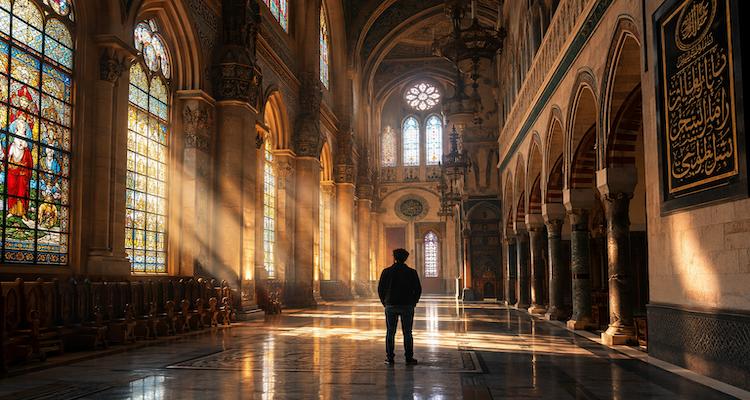
A person can stop believing in the theology associated with a cathedral, temple, mosque, synagogue, or monastery and still feel something when entering one. The reaction may be difficult to name: quietness, awe, melancholy, beauty, unease, belonging, nostalgia, or simply the feeling that ordinary life has been temporarily suspended.
That persistence is not necessarily evidence that religious belief survives unconsciously. It points to something broader about the relationship between people and buildings. Sacred architecture does not communicate through doctrine alone. It works through height and darkness, light and sound, movement and stillness, materials, symbols, ritual pathways, memories and the accumulated history of people who have occupied the space.
Research increasingly treats religious buildings as environments that shape experience rather than neutral containers for worship. Studies of cathedrals, temples, mosques and other sacred places suggest that visitors can respond to architecture through aesthetic, emotional, cultural and sensory channels even when their relationship with organized religion is weak or absent.
That distinction matters. The emotional life of a religious building can outlast the belief system that originally gave it meaning.
Key Takeaways
- Religious architecture communicates through sensory experience as well as religious symbolism and doctrine.
- Scale, light, acoustics and movement can influence how people perceive and emotionally inhabit sacred spaces.
- Nonreligious visitors can still experience peace, attachment, meaning and emotional intensity in religious heritage sites.
- Personal history and cultural familiarity strongly influence whether a building feels sacred, beautiful, nostalgic or simply historical.
- When religious buildings are repurposed, their earlier meanings can remain embedded in collective memory.
- Architecture can preserve emotional associations even when the beliefs that created them become less influential.
A Building Can Preserve Meaning After Belief Changes
Religious buildings are unusual because they accumulate several kinds of meaning simultaneously.
A temple may be an architectural achievement, a place of worship, a tourist destination, a family memory, a symbol of a community and a historical artifact. A cathedral can function simultaneously as a functioning church, a monument, a repository of art and a landmark that people associate with an entire city.
This layering helps explain why secularization does not necessarily make religious architecture emotionally irrelevant.
Research into religious architecture has long emphasized that sacred buildings organize human activity. Their entrances, thresholds, pathways, focal points and boundaries can guide movement and attention. A 2025 study of early Christian sacred spaces, for example, argues that architectural arrangements were fundamental to how these spaces were experienced and used, rather than being merely decorative backgrounds for worship.
The same principle appears in very different traditions. Research on Hindu temples has examined how spatial separation from the outside world and the gradual movement toward the innermost shrine can encourage concentration and contemplative behavior. Studies of Buddhist and Islamic architecture similarly examine how movement, materials, sound, light and spatial organization contribute to experiences of sacredness.
The important point is not that every visitor will experience these spaces in the same way. It is that architecture gives people a structured environment in which experience can happen.
Why Scale Can Feel Bigger Than Belief
One of the most familiar emotional responses to monumental religious architecture is awe.
Awe is associated with encounters that feel vast or difficult to accommodate within an individual’s existing mental frame. Religion can provide one explanation for that experience, but the emotional response itself is not exclusively religious.
Cathedrals provide a particularly clear example. Their verticality, long sightlines, monumental proportions and acoustics can make an individual feel physically small. Historical writing on sacred heritage has also emphasized the role of cathedral scale and acoustics in producing experiences described as awe, reverence and reflection.
But a useful scientific caution is necessary here: large architecture does not automatically produce awe, and awe does not automatically produce religious belief.
A 2026 registered study involving 2,466 participants tested whether imagining oneself in large religious spaces such as cathedrals would increase abstract thinking. The researchers found that religious settings were associated with greater abstraction in the experimental conditions, but spatial size itself did not produce the expected effect. Religiosity-related factors were more important.
That finding complicates a popular architectural assumption. The emotional power of sacred buildings cannot simply be reduced to “big spaces make people feel small.”
Meaning matters.
Light, Sound and the Body Do Much of the Work
Architecture is experienced with more than the eyes.
A visitor notices the echo of footsteps, the temperature of stone, the smell of wood or incense, the filtering of daylight, the rhythm of columns, the distance between one person and another, and the way a ceiling seems to disappear above them.
Historical religious architecture often deliberately organized these sensory conditions.
Research on Byzantine churches, for example, has examined illumination not simply as a practical necessity but as part of how religious images and liturgical practices were experienced. Light helped stage the sacred environment.
Research on Hindu temple architecture has likewise examined the relationship between light and darkness, including the use of controlled illumination to influence the experience of sacred space.
Sound can be equally important. A 2025 study of temple soundscapes examined how acoustic environments in World Heritage religious sites relate to visitors’ emotional experiences, while research into Buddhist temple environments has explored the relationship between architecture, soundscape and states of calm.
This helps explain why photographs rarely reproduce the full emotional effect of sacred architecture. A photograph can capture form and light. It cannot reproduce the acoustic delay of a large interior, the sensation of walking from brightness into darkness, or the physical experience of moving toward a carefully framed focal point.
The building is not merely seen.
It is inhabited, even during a short visit.
The Secular Visitor Is Not an Empty Observer
One of the most interesting developments in research on sacred places is greater attention to visitors who are not participating as conventional worshippers.
At Canterbury Cathedral, research involving 233 tourists found that visitors often approached the site partly as a leisure or cultural attraction and wanted information about its history, architecture, artwork and associated people alongside its spiritual dimensions.
Research at St Davids Cathedral similarly compared pilgrims with secular tourists and found meaningful differences between the experiences of people who regularly attended church services and those who never did.
Yet “secular” does not necessarily mean “emotionally detached.”
A 2026 study of nonreligious tourists at the Royal Mosque of Isfahan examined how people who do not participate in institutional religious practice can nevertheless experience cognitive, emotional and even spiritual engagement in sacred heritage environments. The researchers identified factors including interaction with the physical setting, personal participation, peace and attachment to place.
This is an important distinction for understanding what happens when belief fades.
The visitor may reject the theological explanation while retaining an emotional response to the environment.
Memory Can Outlive the Institution
Religious architecture also works as a memory system.
A building can become associated with weddings, funerals, childhood visits, family traditions, national history, migration, political events or the presence of previous generations. Over time, those associations become layered onto the physical structure.
This means that the emotional response to a former religious building may have little to do with current belief.
Recent research on repurposed churches in Amsterdam, for example, describes how conversion can involve emotions of attachment, belonging, loss and nostalgia. The same building can represent the loss of a familiar home to one group while helping another group create a new sense of belonging.
That tension becomes especially visible when religious buildings are converted to other uses.
A church transformed into housing, a monastery converted into a cultural venue, or a religious structure reused by another faith does not begin its new life with a blank emotional slate. The physical building carries traces of what happened there before.
Adaptive reuse therefore raises a difficult question: Can a building change function without changing what people feel about it?
Often, the answer appears to be no.
When Sacred Buildings Become Cultural Heritage
Secular societies increasingly encounter religious buildings not only as places of worship but as heritage sites.
This changes the source of their value.
A visitor may enter a cathedral to understand medieval construction, see stained glass, hear music, study sculpture or experience the history of a city. Another visitor may enter for prayer. A third may simply want somewhere quiet.
These motivations can coexist.
Research on religious heritage sites in Hindu and Buddhist contexts has similarly found that visitor experience is shaped by multiple dimensions, including religious and cultural significance, environmental qualities, services, facilities and human factors.
The architectural experience therefore becomes partly independent of the original institutional purpose.
That does not mean the religious meaning has disappeared. Rather, another layer of meaning has been added.
The building becomes both sacred space and cultural memory.
Architecture Can Influence Emotion Without Determining It
It is tempting to make a stronger claim: that architecture itself creates particular emotions.
The evidence does not justify such certainty.
Environmental-psychology research supports the broader proposition that built environments can affect psychological and emotional experience, but individual responses vary.
Religious architecture adds further variables: personal belief, cultural background, previous experience, expectations, social context and the historical meaning attached to a particular place.
Two people can stand beneath the same dome and experience entirely different things.
One may feel God’s presence.
Another may feel artistic admiration.
A third may remember a grandparent.
A fourth may feel uncomfortable because the building represents an institution from which they have become distant.
The architecture provides the conditions. It does not dictate the interpretation.
This is why the phrase “architecture shapes emotion” is more defensible than “architecture produces emotion.”
What Happens When Belief Fades?
The decline of religious belief does not necessarily erase the cultural technologies created by religion.
Religious traditions spent centuries refining ways of arranging human attention. Thresholds separate ordinary space from special space. Processions organize movement. Altars and shrines create focal points. Light marks important locations. Music changes the perceived scale of interiors. Silence interrupts ordinary social behavior.
Even after theological belief weakens, these architectural and sensory arrangements remain.
A person who no longer accepts the religious explanation may still respond to the conditions that once supported it.
That may be why an abandoned chapel can feel different from an ordinary empty room. The difference is not necessarily supernatural. It can arise from the building’s history, design, symbolism, expectations and the knowledge that generations of people once treated the space as significant.
Architecture can therefore become a kind of cultural residue: the physical remainder of beliefs that are no longer universally shared.
The Risk of Treating Sacred Architecture as Mere Decoration
There is also a danger in removing religious architecture entirely from its original meaning.
Turning every sacred building into a tourist attraction or aesthetic object can flatten its history. The architectural experience becomes detached from the communities, rituals and beliefs that produced it.
Research into adaptive reuse has shown that changing the function of religious heritage can generate conflicts over memory, identity and belonging, particularly when different groups attach competing meanings to the same site.
Preservation therefore involves more than maintaining walls, roofs and ornament.
It also involves deciding which memories remain visible.
A successful reuse project may need to acknowledge that a former place of worship is not simply an attractive building with an interesting floor plan. It may be a site where people were married, mourned, prayed, gathered, migrated, resisted, celebrated or said goodbye.
Its emotional history is part of the building.
Why This Matters Beyond Religion
The continuing emotional power of religious architecture reveals something larger about human relationships with places.
People do not experience buildings only according to their present function.
A railway station can carry memories of departure. A school can evoke childhood. A stadium can recall collective celebration. A house can represent family history. A religious building can retain associations with transcendence even for someone who no longer accepts the theology behind it.
Sacred architecture makes this especially visible because its original designers often intended to create environments of heightened attention.
That intention can survive its original belief system.
The result is a curious form of cultural afterlife: belief can disappear from a person’s worldview while some of the emotional habits associated with its spaces remain.
That does not prove that architecture secretly restores faith. It suggests something more interesting.
Human beings attach meaning to physical environments through layers of perception, memory, culture and personal experience. Religious architecture is particularly powerful because generations have invested those layers into the same places.
Conclusion
When belief fades, the building does not forget.
Its stones still organize movement. Its windows still shape daylight. Its ceilings still alter sound. Its proportions still affect the body. Its symbols still communicate cultural stories. And its history remains available for anyone who enters, whether as believer, visitor, skeptic or tourist.
The emotional response may change from devotion to beauty, from faith to memory, from worship to contemplation. But the disappearance of one interpretation does not necessarily erase every other meaning.
That is why religious architecture can remain psychologically and culturally powerful in increasingly secular societies.
The enduring lesson is not that buildings can make people believe.
It is that belief is only one of the ways human beings give buildings meaning and architecture can preserve the emotional traces of a worldview long after that worldview has changed.
This content is published for informational or entertainment purposes. Facts, opinions, or references may evolve over time, and readers are encouraged to verify details from reliable sources.
Related News
- Why Mark Zuckerberg Visited Kainchi Dham: The Neem Karoli Baba Connection Behind a Silicon Valley Story
- Kainchi Dham: How a Himalayan Ashram Became a Global Spiritual Landmark
- The New Search for Silence and Why It Is Becoming a Spiritual Movement
- How Constant Notifications Are Changing the Human Capacity for Prayer and Contemplation