










The New Search for Silence and Why It Is Becoming a Spiritual Movement
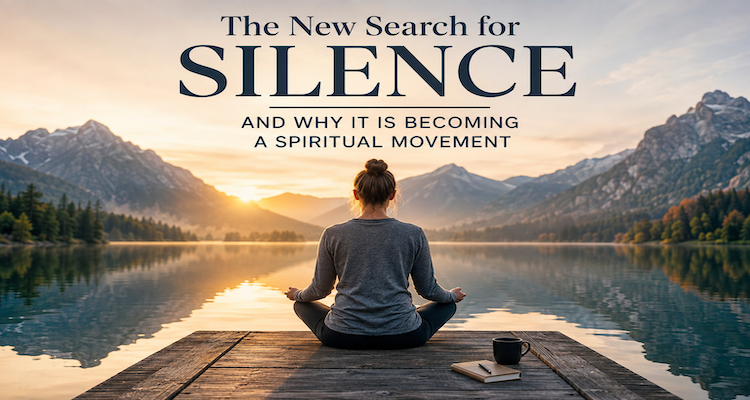
Silence is becoming harder to find and increasingly, people are treating it as something worth deliberately seeking.
The search is not simply about escaping traffic, notifications or noisy workplaces. Quiet rooms, meditation retreats, time in nature, device-free periods and contemplative practices are converging around a deeper idea: that uninterrupted quiet can create space for reflection, attention and a sense of connection.
Calling this a formal “silence movement” would be premature. There is no single organization, doctrine or community behind it. But the ingredients of a movement are increasingly visible. Meditation is becoming more common, spiritual practice is often separated from organized religion, and researchers are paying greater attention to the psychological and physiological consequences of both noise and contemplative retreat. In the United States, 70% of adults describe themselves as spiritual in some way or say spirituality is very important to them, while 22% identify as spiritual but not religious.
The interesting question, then, is not whether silence is suddenly fashionable. It is why silence is acquiring spiritual meaning at a moment when modern life has made uninterrupted attention unusually difficult.
Key Takeaways
- The renewed interest in silence sits at the intersection of noise pollution, digital overload, meditation and changing ideas about spirituality.
- Silence itself is not proven to produce spiritual transformation, but contemplative practices often deliberately use quiet to support attention and reflection.
- Research suggests quiet environments can be restorative, although the quality and character of a soundscape matter as much as decibel levels.
- Meditation and silent retreats are increasingly studied scientifically, but many findings remain preliminary or difficult to separate from other retreat effects.
- The appeal of silence may be less about rejecting modern life than creating protected spaces in which people can experience their own attention again.
Silence Has Become a Scarce Resource
The modern search for silence begins with a very physical problem: many environments are simply not quiet.
The World Health Organization treats environmental noise as a significant public-health concern. Its European work links excessive environmental noise with sleep disturbance, annoyance, cardiovascular effects, cognitive impacts and other health consequences. WHO estimates that roughly 100 million people in the European Union are exposed to unhealthy levels of road-traffic noise.
That changes the cultural meaning of quiet.
When silence is abundant, it can be taken for granted. When it becomes scarce, people begin to seek it deliberately.
The distinction matters because “silence” is not necessarily the same thing as the absence of every audible sound. A forest with birds, wind and insects can feel quieter than a technically lower-decibel urban space dominated by unpredictable traffic. Research on urban quiet areas has found that perceived restoration is influenced not only by measured sound levels but also by the types of sounds people hear and the wider character of the environment.
In other words, people may not be searching for an acoustically perfect vacuum.
They may be searching for a place where their attention is no longer constantly being interrupted.
From Noise Reduction to Inner Quiet
This is where the idea of silence starts to move beyond environmental design and into spirituality.
Religious and contemplative traditions have used silence for centuries, but contemporary seekers do not necessarily approach it through traditional religious institutions. Silence can instead appear as meditation, a retreat, a walk in nature, a period without a phone, or simply sitting without deliberately filling every moment with information.
That fits a broader change in how spirituality is practiced.
A 2023 Pew Research Center survey of more than 11,000 U.S. adults found that 22% were categorized as “spiritual but not religious.” Among this group, connection with the true self, connection with something larger than oneself and connection with nature were important elements of spirituality.
A 2025 Pew analysis also found that 40% of U.S. adults say they look inward or center themselves at least weekly for spiritual reasons, while 23% meditate weekly or more often for spiritual reasons. Three percent report going on a spiritual retreat more than once a year, with additional respondents doing so annually or every few years.
These figures do not demonstrate that silence itself is becoming a new religion. They do, however, show why practices built around stillness can fit comfortably into contemporary spirituality.
The spiritual appeal is often not a particular belief.
It is an experience of attention.
The Retreat as a Laboratory for Silence
Silent meditation retreats make this especially visible.
A retreat removes many of the ordinary signals that structure daily life: conversations, advertising, entertainment, social media, work messages and the expectation to respond immediately. Participants may spend long periods sitting or walking in meditation, eating quietly and following a structured routine.
Scientific research has begun examining what happens under these unusually concentrated conditions.
A 2016 controlled, non-randomized study of experienced meditators examined a month-long Vipassana retreat in which silence was compulsory and participants practiced for an average of eight to nine hours a day. Compared with a matched control group, retreat participants showed improvements across several measures of mindfulness and well-being.
But the study also illustrates why claims about silence need to be handled carefully.
The participants were experienced meditators. The retreat involved intensive meditation, a controlled environment, diet changes and a major interruption of ordinary life. It therefore cannot establish that silence alone caused the observed changes.
That distinction is essential.
The scientific evidence is stronger for meditation and quiet environments as broader categories than for the proposition that “silence itself” has a unique spiritual or medical effect.
Science Is Studying What Happens When the World Gets Quieter
Research into intensive meditation is becoming increasingly sophisticated.
A 2026 study published in Neuroscience of Consciousness examined 42 experienced meditators in connection with a 10-day mindfulness retreat. The retreat was conducted in silence, with minimal communication and encouragement to avoid electronic devices. The researchers investigated sensory processing and attention-related mechanisms. The study did not find the expected global reduction in sensory attenuation, instead reporting more nuanced effects that the researchers suggested could reflect changes in expectation formation.
That result is valuable precisely because it is not a dramatic confirmation of a simple story.
Meditation research does not show that entering silence automatically produces a special brain state. Instead, it increasingly suggests that intensive contemplative practice can interact with attention, perception and bodily awareness in complicated ways.
Other retreat research has produced biological findings that remain preliminary. A 2024 study of a month-long silent Insight meditation retreat, involving 28 retreat participants and 34 controls, found a small decrease in circulating oxytocin in the retreat group. The researchers emphasized measurement limitations and the need for further research to distinguish the effects of different meditation practices and retreat contexts.
This is precisely the kind of evidence that should make the subject more interesting—not less.
The science is moving away from simple claims that silence “heals” the mind and toward questions about attention, perception, stress, social connection and the conditions under which contemplative practices may have effects.
Quiet Places May Matter Even Without Meditation
One of the most overlooked parts of the story is that a person does not have to meditate to benefit from a quieter environment.
Research into urban quiet areas suggests that parks, gardens and other relatively quiet spaces can provide perceived restorative benefits. A multi-site study in three UK cities involving 151 visitors found that quiet environments were associated with perceived restoration, while also showing that the relationship between sound levels and restoration was not straightforward. The character of the sounds and the overall environment mattered.
This has implications beyond spirituality.
Urban planners traditionally have to think about noise as a problem to control. But quiet can also be understood as something worth actively preserving.
That changes the question from:
How do we reduce harmful noise?
to:
Where can people reliably go to experience calm?
The distinction is increasingly important in dense cities, where a quiet park or contemplative public space can function as a form of psychological infrastructure.
Research from Amsterdam has similarly examined the need for quietness in urban environments, finding that access to quiet places and pleasant outdoor environments can compensate for people’s need for quiet.
Silence, in this sense, is not merely a personal luxury.
It can become a feature of a livable city.
Why Silence Feels Spiritual
There is also a philosophical reason the search for silence resonates.
Most everyday experiences are filled with interpretation. We read messages, evaluate information, make decisions, compare ourselves with others and anticipate what comes next.
Silence interrupts that chain.
For some people, the resulting experience is simply restful. For others, it becomes reflective. And for still others, it can acquire explicitly spiritual meaning.
Pew’s research shows how closely contemporary spirituality is connected with ideas of inwardness and connection. Among spiritual-but-not-religious Americans, 72% say being connected with their “true self” is essential to what being spiritual means to them, while 59% say connection with nature is essential.
Silence fits naturally into both ideas.
It can reduce external demands long enough for someone to notice thoughts, emotions, surroundings and assumptions that normally remain buried beneath activity.
But there is an important qualification: silence does not guarantee peace.
For some people, removing external stimulation can make internal thoughts more noticeable rather than less. A retreat can therefore be demanding as well as restorative. The point of contemplative silence is often not to create an empty mind but to change one’s relationship with thoughts and sensations.
That is a much more modest and more defensible claim.
The Digital Dimension
The contemporary search for silence also has a technological dimension.
A smartphone does not have to make a sound to interrupt attention. Notifications, feeds and the expectation that something new may have arrived can keep attention oriented toward the outside world.
This helps explain why modern “silence” increasingly means more than turning down the volume.
It can mean temporarily removing inputs.
The 2026 retreat study described above is illustrative: participants were not merely placed in a quiet room. Communication was restricted and electronic devices, particularly smartphones, were discouraged.
The lesson is significant for everyday life.
People may not need absolute silence as much as they need protected attention.
A quiet walk without a phone, a meal without a screen, several minutes of sitting without entertainment, or a regular period without notifications can all create versions of the same experience without requiring a monastery or week-long retreat.
That makes the search for silence more accessible and potentially more culturally significant.
But Silence Should Not Become Another Productivity Hack
There is a paradox in the new enthusiasm for quiet.
Modern culture has a habit of turning almost everything into optimization.
Meditation can become a productivity technique. Nature can become a wellness product. A retreat can become a premium experience. Silence itself can be marketed as something that will make people calmer, sharper or more successful.
That risks missing the point.
If every period of silence is evaluated according to how much work it enables afterward, silence remains trapped inside the same productivity logic people were trying to escape.
The deeper appeal may be precisely that silence does not have to produce anything.
It can be valuable because nothing is demanded from the person occupying it.
That is also where the spiritual dimension becomes clearest.
A Movement Without a Doctrine
It would be misleading to suggest that millions of people have formally joined a “silence movement.” The evidence does not establish that.
What the evidence does show is a convergence.
Meditation has become considerably more common in the United States: National Center for Complementary and Integrative Health data show meditation use among U.S. adults rising from 7.5% in 2002 to 17.3% in 2022.
Spirituality increasingly exists outside traditional religious categories. Quiet urban spaces are being studied as potentially restorative environments. Silent retreats are being investigated using psychological, biological and neuroscientific methods. And environmental noise remains a significant public-health concern.
Together, these developments point toward something broader than a wellness fad.
They suggest that attention itself is becoming something people consciously protect.
That may be the real significance of the new search for silence.
Conclusion
The search for silence is not necessarily a rejection of technology, cities, modern work or organized religion. Nor does the evidence justify treating silence as a scientifically proven cure for modern stress.
Its significance is subtler.
In an environment where sound, information and digital demands can follow people almost everywhere, deliberately creating periods of quiet becomes a way of reclaiming attention. For some, that is relaxation. For others, meditation. For others, prayer, contemplation, nature or a sense of connection beyond the self.
The emerging spiritual movement around silence, if that is what it becomes, may therefore have no manifesto and no central institution.
Its common practice is simpler: stop filling every available moment, and see what becomes noticeable when nothing is added.
That is not an escape from modern life.
It is a different way of being present within it.
This content is published for informational or entertainment purposes. Facts, opinions, or references may evolve over time, and readers are encouraged to verify details from reliable sources.
Related News
- Why Mark Zuckerberg Visited Kainchi Dham: The Neem Karoli Baba Connection Behind a Silicon Valley Story
- Kainchi Dham: How a Himalayan Ashram Became a Global Spiritual Landmark
- How Religious Architecture Continues to Shape Human Emotions Long After Belief Fades
- How Constant Notifications Are Changing the Human Capacity for Prayer and Contemplation