










The Rise of “Credential Fatigue”: Why Degrees Alone Are Losing Their Power to Explain What Someone Can Do
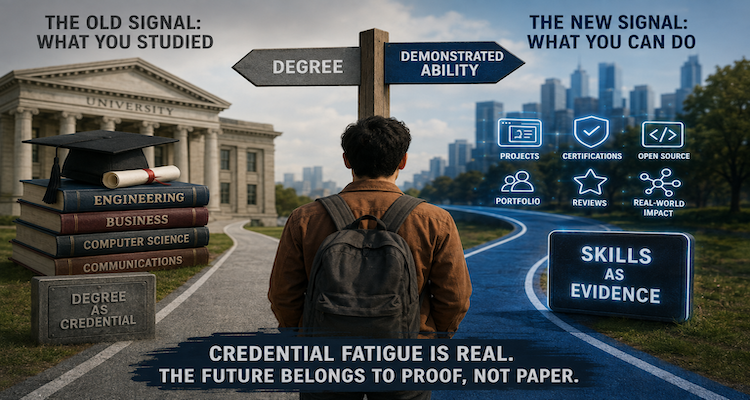
For decades, a degree has served as one of the simplest signals in hiring: it tells an employer that a candidate completed a defined course of study, met academic requirements and, in many cases, acquired a broad foundation of knowledge. But a growing problem is emerging in workplaces where skills change faster than educational credentials do: a degree can tell employers where someone studied without necessarily telling them what that person can do today.
That tension is helping drive a shift toward skills-based hiring. The World Economic Forum’s Future of Jobs Report 2025, based on more than 1,000 employers across 55 economies, found that 63% of employers identify skills gaps as a major barrier to business transformation. Work experience remains the most widely expected assessment mechanism, while 48% of employers expect to use skills assessments and 43% expect to continue using university degrees as a hiring requirement through 2030.
The important point is not that degrees are becoming worthless. They are not. Rather, employers are increasingly asking a harder question: What evidence shows that this person can perform the work?
That change has implications for graduates, self-taught professionals, career changers and employers alike.
Key Takeaways
- Degrees remain valuable, but they increasingly work as one signal rather than a complete measure of job readiness.
- Skills-based hiring is expanding because employers need more direct evidence of what candidates can actually do.
- Research shows a significant gap between companies removing degree requirements and actually hiring more non-degree workers.
- AI is accelerating the need to demonstrate current, practical capabilities because some technical skills are changing rapidly.
- Portfolios, assessments, work samples and relevant experience can make capabilities more visible than credentials alone.
- The emerging model is less “degree versus skills” than credentials plus demonstrable capability.
Why the Degree Became Such a Powerful Hiring Shortcut
The degree has never been a perfect measure of ability. It became powerful partly because it was convenient.
Recruiters evaluating hundreds or thousands of applications need ways to reduce a large pool of candidates to a manageable group. Educational qualifications provide a standardized signal: the institution, field of study, level of education and graduation date can all be processed relatively quickly.
Harvard Business School and the Burning Glass Institute have described this phenomenon as “degree inflation.” Their research found that employers increasingly added degree requirements to jobs whose underlying tasks had not necessarily changed. In other words, the educational requirement sometimes changed even when the work itself did not.
That created an unusual feedback loop.
More people obtained degrees. Employers then had a larger supply of degree holders from which to recruit. Once a bachelor’s degree became common among applicants, it could become a screening requirement even when the actual work did not demand four years of university education.
The result was that the credential increasingly became a proxy for other characteristics employers wanted: communication ability, persistence, analytical thinking, basic digital literacy or the ability to complete a demanding project.
But a proxy is not the same thing as direct evidence.
“Credential Fatigue” Is Really a Problem of Information
“Credential fatigue” is best understood as an editorial shorthand for a growing frustration with credentials that provide insufficient information about current capability. It is not a formal labor-market diagnosis or universally established academic term.
The underlying problem is easier to observe.
Consider two candidates for a digital role.
One has a prestigious degree but has not worked with the relevant tools for several years. Another has a less conventional educational background but has built production projects, solved comparable problems and can demonstrate the required skills.
A degree can distinguish the candidates’ educational histories. It cannot, by itself, establish which person can perform the specific job better.
This distinction becomes more important when occupations evolve quickly.
The OECD’s 2026 report A Skills-First Labour Market argues that formal qualifications remain important foundations for knowledge and skills, but they do not always capture the full range of capabilities people possess or keep pace with rapidly changing skill demand. The organization identifies skills-first hiring, modular learning, micro-credentials and recognition of prior learning as parts of a broader transition in labor markets.
That is a more nuanced development than simply saying employers are “rejecting degrees.”
They are increasingly trying to obtain better information about capability.
The Evidence Shows a Shift But Also a Major Catch
There is credible evidence that employers are moving away from degree requirements in some occupations.
Research from Harvard Business School and the Burning Glass Institute found that material degree resets occurred across 46% of middle-skill occupations and 31% of high-skill occupations between 2017 and 2019. The researchers concluded that most of the changes appeared structural rather than simply temporary responses to the pandemic.
But there is a crucial qualification.
Removing “bachelor’s degree required” from a job advertisement does not automatically produce skills-based hiring.
A 2024 Harvard Business School/Burning Glass Institute analysis found that the transition from announced policy to actual hiring was much slower than headlines suggested. Harvard summarized the finding in 2025 by noting that fewer than one in 700 hires in the studied period represented the increased opportunity promised by skills-based hiring.
That finding changes the story considerably.
The problem isn’t simply that companies need to remove degree requirements. They also need to change how they identify, assess and select candidates.
If a company removes a degree requirement but continues relying on conventional résumés, elite-school signals, referrals and previous job titles, the practical barrier may remain.
A genuine skills-first system requires different evidence.
What Employers Are Starting to Look For Instead
The emerging alternative is not necessarily another single credential.
It is a collection of evidence.
Depending on the occupation, that evidence can include:
- Work samples
- Portfolio projects
- Technical assessments
- Writing samples
- Demonstrated results
- Relevant professional experience
- Certifications
- Apprenticeships
- Internships
- Structured interviews
- Problem-solving exercises
- Evidence of continuous learning
The World Economic Forum’s 2025 research illustrates this changing hierarchy. It found that 81% of surveyed businesses expected to continue relying on work experience when assessing talent between 2025 and 2030, while 48% expected to use skills assessments. University degrees ranked third, with 43% expecting to continue using them as a requirement.
That does not mean experience or tests are automatically better than education.
It means employers increasingly have alternatives for answering the question that matters most during recruitment:
Can this candidate perform the work?
AI Is Making the Problem More Visible
Artificial intelligence adds another layer to credential fatigue because technology is changing the relationship between learning and employment.
A person can complete a degree and enter a profession with a particular set of technical skills, only to encounter tools and workflows that were not central to their education.
This is especially visible in technology-related occupations.
A 2025 peer-reviewed study analyzing approximately 11 million UK job vacancies from 2018 through mid-2024 found that demand for AI roles increased while mentions of university education requirements for AI roles declined. The researchers reported a 21% increase in AI-role demand from 2018 to 2023 and a 15% decline in university-education requirements for those roles.
The finding should not be interpreted as evidence that AI jobs no longer require advanced education. The same study notes that AI and green occupations continue to have above-average educational requirements.
The more interesting development is that specific AI skills can become valuable faster than conventional credentials can be updated.
This changes the value proposition of education.
A degree can establish a foundation. But employers increasingly need evidence of what happened after the foundation was built.
The New Signal: “Show Me”
For workers, this is where the labor-market shift becomes practical.
A résumé says what someone claims to have done.
A degree says what someone studied.
A portfolio, assessment or work sample can provide evidence of what someone can actually produce.
That distinction matters particularly for digital professions.
A developer can point to software they have built. A designer can show completed work. A data professional can demonstrate an analysis. A marketer can show campaign results. A cybersecurity professional can demonstrate relevant technical competence through legitimate assessments or projects.
Not every occupation permits this kind of portfolio.
A physician, lawyer, engineer or other regulated professional may require formal education, licensing or other legally defined qualifications. In such fields, credentials are not merely convenient hiring signals; they can be essential safeguards and professional requirements.
That is why the argument that “degrees no longer matter” goes too far.
The more defensible argument is that the informational value of a degree depends heavily on the job.
The Degree Still Has Economic Value
There is another reason to avoid declaring the death of the degree: the aggregate economic evidence does not support that conclusion.
The U.S. Bureau of Labor Statistics reported that in 2024, full-time workers aged 25 and older with bachelor’s degrees had median weekly earnings of $1,543 and an unemployment rate of 2.5%. Workers with only a high-school diploma had median weekly earnings of $930 and unemployment of 4.2%. Workers with master’s, professional and doctoral degrees had still higher median earnings and lower unemployment rates.
Those figures do not prove that a degree causes higher earnings. Many other factors influence earnings, including occupation, experience, industry, location and individual circumstances.
But they do establish something important: formal education continues to correlate strongly with labor-market outcomes.
The emerging skills-first model should therefore not be confused with an anti-university movement.
For many careers, education remains one of the strongest foundations a worker can build.
The change is that employers increasingly have reasons to want additional evidence.
Why “Degree vs. Skills” Is the Wrong Debate
The most useful way to understand this shift is not to imagine credentials and skills competing for the same position.
They answer different questions.
| Signal | What it can tell an employer |
|---|---|
| Degree | What a person formally studied and completed |
| Certification | Whether a person met a defined external standard |
| Work experience | What a person has previously done |
| Portfolio | What a person can demonstrate through completed work |
| Skills assessment | How a person performs a defined task or test |
| References | How others describe past performance |
| Interview | How a candidate explains reasoning, judgment and experience |
No single signal is sufficient for every job.
The more sophisticated hiring model combines them according to the actual requirements of the role.
That is also where the idea of “credential fatigue” becomes useful: employers may be growing tired not of credentials themselves, but of using one credential as a substitute for evaluating everything else.
The Hidden Risk: Skills-First Hiring Can Create New Problems
Skills-based hiring sounds straightforward until employers have to implement it.
How should a company define a skill?
How should it measure communication?
How can it distinguish a genuine portfolio from copied or AI-generated work?
How should it compare candidates who acquired skills through completely different pathways?
And how can recruiters ensure that “skills” does not become another vague proxy for elite background?
The OECD has warned that skills-first systems need clearer and more standardized ways to describe and validate skills. Without those systems, workers may encounter new barriers when trying to demonstrate capabilities acquired outside conventional education.
There is also a risk of replacing one opaque filter with another.
A company can remove “bachelor’s degree required” and then demand five years of experience, expensive certifications, unpaid portfolio work or an elaborate assessment process.
The wording changes, but access may not.
That is why genuine skills-first hiring requires better assessment, not simply different job-advertising language.
What This Means for Workers
The practical lesson is not to abandon education.
It is to stop treating education as the final proof of professional capability.
For people entering or changing careers, a stronger professional profile increasingly combines:
Foundation + capability + evidence + continuous learning.
A graduate entering technology, for example, may benefit from making current technical skills visible through projects rather than relying exclusively on a university qualification.
An experienced worker without a degree can do the reverse: translate years of practical experience into concrete, verifiable evidence of competencies.
Career development therefore becomes less about accumulating credentials indefinitely and more about maintaining a current, legible record of capability.
That distinction may become particularly important as AI changes the tasks inside existing occupations.
The World Economic Forum estimates that nearly 40% of workers’ existing skill sets could be transformed or become outdated by 2030, while 85% of surveyed employers plan to prioritize workforce upskilling.
In that environment, a static credential has a natural limitation: it records an educational achievement at a particular point in time.
Skills evidence can be updated continuously.
What Employers Should Learn From the Shift
For companies, the lesson is equally straightforward but harder to implement.
A degree requirement should answer a genuine question about the job.
If the job legally requires a qualification, the requirement is clear.
If it does not, employers should ask whether the degree is actually necessary or simply convenient for screening.
The next step is to identify the capabilities associated with successful performance and develop reliable ways to assess them.
That might mean structured work samples for one position, technical tests for another and evidence of customer or project outcomes for a third.
The goal is not to eliminate judgment from hiring. It is to make the judgment more closely connected to the work itself.
Conclusion
The rise of “credential fatigue” does not signal the end of degrees. It signals a weakening of the idea that a credential alone can adequately describe a person’s current professional capability.
That is an important distinction.
Education remains valuable. Degrees can provide knowledge, networks, professional pathways and, in many fields, necessary qualifications. But as work becomes more skills-intensive and technology changes faster, employers have stronger reasons to look beyond the credential and examine evidence of capability.
The emerging labor market is therefore unlikely to become completely degree-free.
A more plausible future is evidence-rich hiring: education establishes part of the foundation, while experience, skills assessments, portfolios, certifications and demonstrated results help complete the picture.
For workers, that means the most durable professional asset may no longer be simply what credential you earned.
It may increasingly be what you can demonstrate you can do now.
The information presented in this article is based on publicly available sources, reports, and factual material available at the time of publication. While efforts are made to ensure accuracy, details may change as new information emerges. The content is provided for general informational purposes only, and readers are advised to verify facts independently where necessary.