









Why Some Students Are Quietly Becoming Better at Learning Without Becoming Better at School
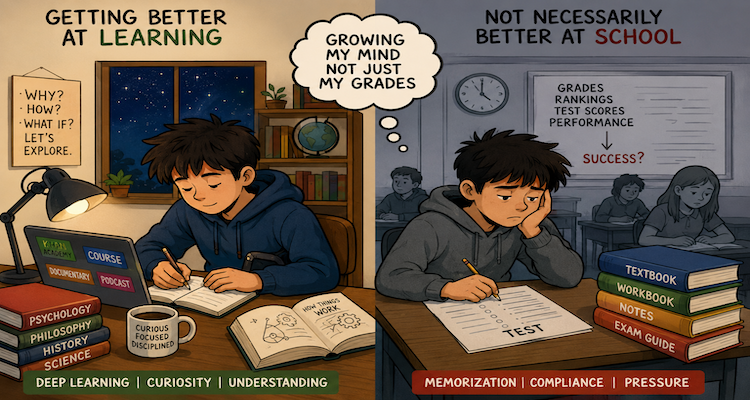
A student can become better at finding information, testing an idea, teaching themselves a difficult concept, recognizing what they do not understand, or organizing their own learning and still receive an ordinary report card.
That apparent contradiction matters because learning and school performance overlap, but they are not identical things.
Research increasingly distinguishes between academic achievement and the learning processes that help students become independent learners. The OECD’s PISA 2022 analysis, for example, examines students’ ability to monitor their own work, think critically, connect new information with prior knowledge, manage their workload and learn proactively. Students who reported using these strategies more frequently generally performed better academically, even after accounting for socioeconomic differences. Yet many students do not regularly use them.
The more interesting question, then, is not whether grades matter. They do. It is whether grades can capture every meaningful improvement in how a person learns.
They cannot and that distinction becomes increasingly important as students have access to information, tutorials, communities and digital tools far beyond the classroom.
Key Takeaways
- Learning how to plan, monitor and adjust study can improve learning capacity even before grades noticeably change.
- School marks measure important academic performance, but they are not a complete measurement of every learning skill.
- OECD research links proactive learning strategies with stronger performance, while showing that many students use them inconsistently.
- Self-regulated learning can be developed; meta-analyses find improvements in strategies, motivation and academic performance after structured training.
- Digital resources can expand independent learning, but access to information does not automatically produce deep understanding.
- A student who learns independently may be developing capabilities that traditional school assessments capture only partially.
Learning Is Bigger Than a Grade
Grades answer a relatively practical question: How well did the student perform within a particular educational system?
That can involve tests, assignments, projects, participation, attendance, deadlines and teacher judgments. Exactly what contributes to a grade varies by school and education system.
Learning is broader.
A learner might discover that rereading a chapter repeatedly produces little retention, while retrieval practice works better. Another might learn to break a difficult subject into smaller questions. Someone else might become comfortable searching for multiple explanations, checking conflicting sources and identifying the point at which they need help.
Those are changes in the process of learning.
They may eventually improve academic performance. But the improvement does not necessarily appear immediately.
This is one reason the distinction between learning strategies and achievement is useful. The OECD describes metacognitive learning strategies as involving awareness, understanding and control of one’s learning processes. Its 2024 analysis of PISA 2022 data also connects learning strategies with motivation and self-belief as components of readiness for lifelong learning.
A student can therefore make progress on the machinery of learning before the visible academic output catches up.
The Quiet Skill: Knowing How to Learn
One of the most valuable changes a student can make is also one of the least visible.
It is learning to notice how learning is happening.
A student who asks, “Do I actually understand this, or does it merely look familiar?” is using a form of metacognitive monitoring.
So is the student who changes strategies after discovering that memorizing definitions does not help with problem-solving.
The student who connects a new idea with something already understood is also doing something important. PISA 2022 found that fewer than half of students across OECD countries reported frequently trying to relate new mathematics material to what they had previously learned. Students who reported more proactive learning behaviors tended to perform better.
The implication is more subtle than “good study habits produce good grades.”
It suggests that students differ not only in what they know, but in how deliberately they manage the process of becoming knowledgeable.
That capability can be useful far beyond a particular examination.
Why School Performance Can Lag Behind Learning Growth
There are several reasons a student’s learning development may not immediately translate into better school results.
The student may be learning outside the curriculum
A teenager interested in programming may spend hours understanding JavaScript, debugging a small project and reading documentation. A student fascinated by astronomy might work through university-level explanations of a subject that never appears on a school test.
That learning is real, but it may have little immediate effect on the student’s mathematics or science grade.
The reverse is also possible. A student may perform well in a course through strong preparation without developing equally strong independent-learning habits.
The two dimensions can overlap without being interchangeable.
Assessment captures specific outcomes
Tests are useful precisely because they measure particular things under defined conditions. But the interpretation of those measurements has limits.
The American Psychological Association notes that tests, grades and teacher evaluations can all provide valuable information about student skills and knowledge, while warning that tests can have unintended consequences when used inappropriately or treated as a single measure of performance.
Assessment experts likewise emphasize that an assessment should be interpreted according to what it was designed to measure. A score can be valid for one purpose without being a complete measure of a student’s broader capabilities.
This does not make grades meaningless.
It makes them specific measurements rather than universal measurements of a learner.
The Rise of Self-Directed Learning
The distinction becomes more relevant when students can learn from sources outside school.
Search engines, educational videos, online courses, documentation, digital libraries and specialist communities have reduced the distance between a curious learner and an explanation.
But access alone is not the important development.
The valuable skill is knowing what to do with that access.
A student who searches for an answer, accepts the first result and memorizes it may acquire information without developing much independent understanding. Another student may compare explanations, question an apparent contradiction, test an idea and return to the subject several days later.
Both students are “using the internet to learn.”
They are not necessarily learning in the same way.
Research on teenagers’ digital research behavior has shown how deeply online search has become integrated into school-related research. In a Pew Research Center survey of teachers, 94% said their students were very likely to use Google or another search engine for a typical research assignment. YouTube and online encyclopedias were also widely reported sources.
The lesson is not that online learning is automatically better.
It is that the learner’s ability to evaluate, organize and apply information increasingly matters alongside the ability to access it.
Better Learning Does Not Mean Every Grade Should Rise
This is where the headline needs an important qualification.
It would be misleading to argue that a student who develops better learning strategies is necessarily going to see grades rise immediately or even that every form of independent learning improves academic achievement.
Research does provide evidence that self-regulated learning can help.
A 2021 meta-analysis covering 49 studies and 5,786 university students found that self-regulated learning training improved academic performance as well as metacognitive strategies, resource-management strategies and motivation. The reported average effect for academic performance was small to moderate.
A separate meta-analysis of learning-strategy interventions in primary and secondary education reviewed 58 studies involving 95 interventions. It found positive effects across several academic domains, while also finding that the effectiveness of particular strategies differed by subject and outcome.
That evidence is important because it prevents the argument from becoming romantic.
Independent learning is not automatically superior to formal education.
The strongest interpretation is more measured: learning how to regulate one’s learning is itself an educational capability, and deliberately developing that capability can contribute to academic success.
What School May Be Measuring That Independent Learning Does Not
There is another side to the story.
A student can be an excellent self-directed learner and still struggle in school for reasons unrelated to raw intellectual curiosity.
School requires students to work within constraints.
They may have to:
- learn material they did not choose;
- complete work by fixed deadlines;
- demonstrate knowledge in a particular format;
- work collaboratively;
- respond to teacher feedback;
- maintain effort across several subjects;
- perform under examination conditions.
Those are not trivial demands.
In fact, school performance can reflect persistence, organization and sustained effort alongside subject knowledge. Research examining the differences between school marks and achievement tests has noted that grades can reflect the broader social context of classroom performance, including effort and persistence, while standardized tests capture performance under a different set of conditions.
So the student who learns independently is not necessarily “better” than the student who excels at school.
They may simply possess a different combination of learning and performance skills.
The strongest students eventually need both.
The Hidden Advantage Is Transfer
The most consequential form of learning is not merely remembering something.
It is being able to use what was learned somewhere else.
Suppose a student learns how to break a programming problem into smaller components. The immediate result may be a better piece of code. But the underlying skill decomposing a complex problem can potentially transfer to mathematics, writing, research or project planning.
That is why learning strategies matter beyond individual subjects.
The OECD’s PISA work emphasizes the importance of connecting new information with previous knowledge, asking questions when something is unclear, thinking from multiple perspectives and managing learning proactively. These are not tied exclusively to one textbook or examination.
They are closer to the infrastructure of lifelong learning.
And that infrastructure may develop gradually, without producing an immediately dramatic change in grades.
What Parents and Teachers Should Watch For
If grades are only one indicator, what should adults look for?
Not vague signs of “intelligence.” More useful signals are changes in learning behavior.
A student may be developing stronger learning capacity when they begin to:
Recognize confusion earlier.
Instead of hiding the fact that something is unclear, they can identify exactly what they do not understand.
Choose strategies deliberately.
They stop treating every subject as if it requires the same study method.
Connect ideas.
New information gets attached to previous knowledge rather than remaining isolated facts.
Check their own understanding.
They test themselves instead of assuming familiarity means mastery.
Seek better explanations.
They move beyond the first answer when a concept remains unclear.
Recover from mistakes.
An incorrect answer becomes information about the learning process rather than simply evidence of failure.
These behaviors do not guarantee higher grades. But they provide more meaningful evidence of developing learning independence than a single score can provide.
The Important Caution About “Learning to Learn”
There is a temptation to turn all of this into a new educational slogan: teach children how to learn and everything else will follow.
The evidence does not justify that simplicity.
Learning strategies work within subjects. Students still need knowledge. They still need effective teaching. They still need feedback. They need time, resources and an environment in which learning is possible.
The OECD’s research itself does not frame independent learning as a replacement for teachers. Its analysis emphasizes the relationship between strategies, motivation and self-belief, while other OECD work finds that students need a combination of teacher instruction, feedback, independent work and collaboration.
That distinction matters.
A student cannot become a strong independent learner simply by being told to “study smarter.”
They need to learn which strategies work, when they work, why they work and how to judge whether they are working.
A Different Way to Think About Student Progress
Perhaps the most useful question is not:
“Are your grades improving?”
It is:
“Are you becoming more capable of learning without someone constantly telling you what to do next?”
Grades remain important. They can reveal gaps in knowledge, provide feedback and document academic performance.
But another kind of progress can happen underneath them.
A student may become more curious, more strategic, more reflective, better at finding reliable information and more capable of recovering from confusion. Those qualities may not immediately transform a report card. Over time, however, they can change the student’s relationship with learning itself.
That is the quieter development worth noticing.
The goal of education is not merely to produce students who can perform well when a teacher supplies the questions, schedule and materials. It is also to help people become capable of continuing to learn when those structures are no longer there.
A report card can tell us something important about what a student has accomplished.
It cannot, by itself, tell us everything about what kind of learner that student is becoming.
Conclusion
The idea that some students can become better learners without immediately becoming better students should not be treated as proof that grades are irrelevant. It is a reminder that the two measures answer different questions.
School performance asks how successfully a learner meets a defined set of academic demands.
Learning capacity asks what happens when the learner encounters something new, difficult or unfamiliar.
The evidence increasingly points toward the value of students becoming more deliberate about that second process: monitoring their understanding, connecting ideas, managing their effort, questioning information and choosing learning strategies consciously.
The most encouraging sign in a student may therefore sometimes be invisible on the report card.
It may be the moment they stop asking only, “What do I need to get right?”
and start asking, “How can I figure this out?”
The information presented in this article is based on publicly available sources, reports, and factual material available at the time of publication. While efforts are made to ensure accuracy, details may change as new information emerges. The content is provided for general informational purposes only, and readers are advised to verify facts independently where necessary.