







Why Practical Intelligence Is Becoming Harder to Teach in Traditional Education

A student can memorize a formula, explain a historical event and score highly on an examination, yet still struggle when confronted with a problem that has no clear instructions.
That gap is at the heart of a growing challenge for education: knowing something is not always the same as knowing what to do with it.
Practical intelligence involves applying knowledge to messy, unfamiliar situations deciding what matters, adapting when a plan fails, communicating with other people, judging incomplete information and learning from consequences. Psychologist Robert J. Sternberg and colleagues have described one important part of this capability as tacit knowledge: knowledge about how to handle real situations that is often acquired through experience rather than explicitly taught. Research on teachers, for example, has examined how tacit knowledge can help explain effectiveness in dealing with difficult classroom situations.
The difficulty is that traditional education is often much better equipped to assess what students can demonstrate under controlled conditions than what they can do when the conditions change.
That does not mean schools are failing. It means that practical intelligence requires a different learning environment.
Key Takeaways
- Practical intelligence depends on applying knowledge when problems are uncertain, contextual and lacking a single correct answer.
- Research on learning shows that remembering information does not automatically guarantee successful transfer to unfamiliar situations.
- Tacit knowledge is often developed through experience, feedback and reflection rather than conventional instruction alone.
- Schools are increasingly assessing creativity and open-ended problem solving, but implementation varies across education systems.
- Practical intelligence can be deliberately developed through authentic tasks, reflection, multiple contexts and meaningful feedback.
- The challenge is not replacing academic knowledge but connecting academic knowledge to action.
The Problem Is Not Knowledge It Is Transfer
One of the most persistent misunderstandings about practical intelligence is that it represents an alternative to academic knowledge.
It does not.
A person cannot solve sophisticated real-world problems without relevant knowledge. A doctor needs medical knowledge, an engineer needs technical knowledge, and a business manager needs an understanding of markets, finance and organizations.
The problem appears when knowledge remains trapped inside the context in which it was learned.
Research summarized by the National Academies has long distinguished between learning that produces good memory and learning that supports transfer. Students may learn a procedure successfully in one setting without necessarily becoming capable of recognizing when or how that knowledge should be applied elsewhere.
The challenge becomes particularly visible when familiar school problems are replaced with ambiguous ones.
A mathematics exercise may provide the numbers, the objective and often the appropriate method. A real household budget does not. A science examination may identify the variables that matter. A real environmental problem may involve incomplete information, competing interests and uncertain outcomes.
Practical intelligence begins where the instructions become less obvious.
Why Traditional Assessment Can Miss Practical Ability
Standardized assessment has an important purpose. Schools need ways to evaluate learning across large groups of students, and structured examinations can measure knowledge and certain forms of reasoning efficiently.
But practical problems rarely behave like examination questions.
Real decisions frequently involve several reasonable options. Information can be incomplete. Priorities can conflict. The person making the decision may need to negotiate with others. A solution that works in one environment may fail somewhere else.
This creates a measurement problem.
A student can be highly successful at answering questions for which the rules are known while having limited experience deciding which rules apply. The two abilities overlap, but they are not identical.
Sternberg’s research into practical intelligence and tacit knowledge illustrates this distinction. In research involving elementary-school teachers in the United States and Israel, researchers examined knowledge associated with handling challenging classroom situations. The study found relationships between tacit-knowledge measures and evaluations of teacher effectiveness, supporting the idea that useful professional knowledge can extend beyond formal subject-matter knowledge.
The lesson for education is broader: some important forms of competence become visible only when people have to use knowledge in context.
Experience Is Part of the Curriculum
Practical intelligence is difficult to teach if learning is separated too completely from experience.
A student who studies entrepreneurship entirely through definitions may understand terms such as revenue, costs, customers and competition. A student who actually designs a small project encounters different questions: Who is the customer? What happens when nobody wants the product? Which cost was underestimated? How should feedback change the plan?
The second environment introduces something textbooks cannot fully reproduce: consequences.
Experience creates opportunities to make decisions, observe outcomes and adjust behaviour.
Research on tacit knowledge has also explored whether reflection can strengthen the acquisition of experience-based knowledge. This matters because experience by itself is not automatically educational. People can repeat ineffective habits for years. The learning value increases when experience is combined with feedback, explanation and reflection.
That suggests a more useful educational cycle:
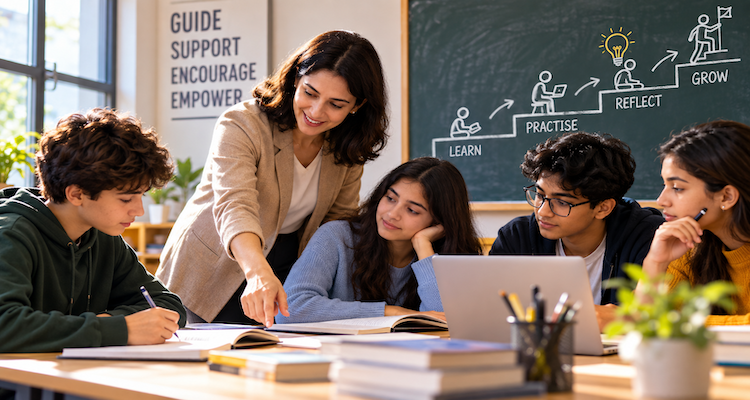
Learn → Apply → Observe → Reflect → Adjust → Apply again.
The objective is not to abandon classroom instruction. It is to connect instruction with situations in which students must decide how knowledge should be used.
Schools Are Beginning to Broaden What They Measure
There are signs that education systems are moving in this direction.
The OECD’s PISA 2022 assessment included creative thinking as a distinct area of assessment for 15-year-old students across 64 countries and economies. Rather than asking only for a single predetermined answer, the assessment examined students’ ability to generate diverse and original ideas and to evaluate and improve ideas in areas including scientific and social problem solving.
That shift is significant because it recognizes that useful thinking can involve generating possibilities, evaluating them and improving an initial response.
The OECD has also found that classroom practices matter. Across OECD countries, roughly 60–70% of students reported that their teachers valued creativity, encouraged original answers or gave them opportunities to express ideas; students reporting these experiences tended to perform somewhat better in creative-thinking assessments after accounting for other student and school characteristics.
But this should not be interpreted as evidence that traditional education has solved the problem.
The OECD’s policy work also identifies challenges in integrating creative thinking systematically into curricula, assessment, teacher training and learning environments.
In other words, recognizing a skill is easier than building an education system around it.
Practical Intelligence Needs Multiple Contexts
One reason practical intelligence is difficult to teach is that flexible thinking develops through variation.
If a student learns a concept in only one context, the student may associate the knowledge with that particular type of problem. Research discussed by the National Academies indicates that learning in multiple contexts can help students identify the underlying features of a concept and understand when knowledge is applicable.
Consider percentage calculations.
A student may learn to calculate a discount in mathematics class. But percentages appear differently in salaries, taxation, loans, inflation, business margins, sports statistics and household spending.
The mathematical operation may remain the same while the decision surrounding it changes.
Teaching across contexts helps students recognize the structure beneath the surface.
This is particularly important because real-world problems rarely announce the academic subject they belong to. A workplace decision might simultaneously involve mathematics, communication, psychology, technology and ethics.
Practical intelligence therefore depends partly on seeing connections between forms of knowledge that schools traditionally organize into separate subjects.
Reflection May Be the Missing Bridge
Another important ingredient is metacognition—the ability to think about one’s own thinking.
The Education Endowment Foundation’s evidence review describes metacognition and self-regulation as approaches that help students plan, monitor and evaluate their learning. Its teaching guidance emphasizes explicitly modelling these processes rather than assuming students will automatically develop them.
This is directly relevant to practical intelligence.
After solving a problem, students can be asked:
- Why did I choose this approach?
- What information did I ignore?
- What assumption turned out to be wrong?
- What would I do differently with less information?
- Would the same approach work in another situation?
- How could I recognize this type of problem next time?
These questions transform an individual experience into reusable knowledge.
The goal is not simply to produce students who can solve today’s problem. It is to help them recognize the structure of tomorrow’s unfamiliar problem.
AI Makes the Question More Important
Artificial intelligence adds another dimension to this educational challenge.
As AI systems become increasingly capable of generating explanations, summaries, drafts, calculations and possible solutions, the value of simply retrieving an answer may decline in some contexts.
That does not make foundational knowledge less important. In fact, knowledgeable people are often better positioned to evaluate whether an answer is plausible, incomplete or misleading.
But it increases the importance of judgment.
A student using AI may receive five possible solutions to a problem. Practical intelligence determines which solution deserves consideration, what information is missing, what risks are involved and whether the proposed answer actually fits the situation.
That makes education’s task more demanding: students need both knowledge to understand answers and judgment to evaluate them.
The World Economic Forum’s Future of Jobs Report 2025 reflects this broader shift in employer expectations. Analytical thinking remains the leading core skill identified by employers, while resilience, creative thinking, technological literacy, curiosity and lifelong learning also rank prominently. The report suggests that technical and human capabilities increasingly need to work together rather than develop in isolation.
What Education Can Do Differently
The answer is not to turn every lesson into a simulation or eliminate examinations.
Academic knowledge remains essential.
Instead, schools can create more opportunities for students to use that knowledge under realistic conditions.
That can include project-based assignments, experiments, debates, case studies, community problems, collaborative tasks, entrepreneurship exercises and open-ended investigations. More importantly, students need opportunities to explain not only what answer they reached but why they chose a particular approach.
Teachers can also deliberately introduce contrasting situations.
If students learn a scientific principle, they can encounter several problems in which the same principle applies differently. If they study economics, they can examine decisions from the perspectives of consumers, businesses and governments. If they learn programming, they can work on problems where the specification is incomplete and requirements must be clarified.
These approaches make uncertainty part of learning rather than something that appears only after graduation.
Conclusion
Practical intelligence is not a mysterious ability that schools cannot teach. The evidence points toward something more useful: it is a form of competence that develops when knowledge is repeatedly used, tested, reflected upon and transferred across contexts.
Traditional education has historically been strongest at organizing knowledge and measuring certain forms of academic performance. Its next challenge is to make the bridge between knowing and doing more deliberate.
That does not require choosing between academic knowledge and practical capability.
It requires recognizing that the two depend on each other.
The student who knows a concept has acquired a tool. The student who understands when, why and how to use that concept has begun to develop judgment.
And in a world where problems increasingly arrive without answer keys, that difference may become one of education’s most important responsibilities.
The information presented in this article is based on publicly available sources, reports, and factual material available at the time of publication. While efforts are made to ensure accuracy, details may change as new information emerges. The content is provided for general informational purposes only, and readers are advised to verify facts independently where necessary.