








Why Students Are Learning More but Remembering Less
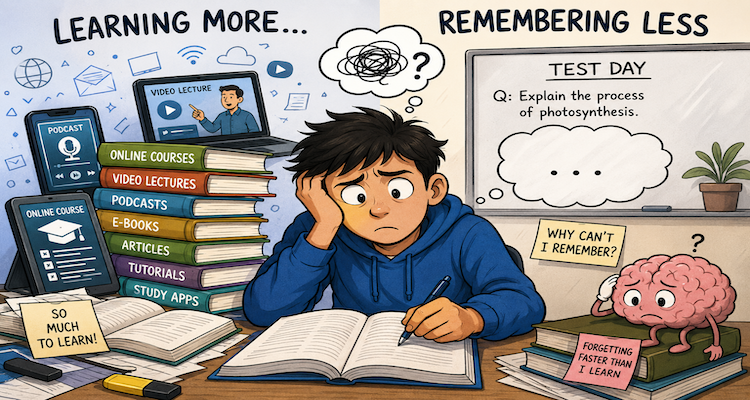
A student can watch a lecture, download the slides, search unfamiliar terms instantly, summarize a chapter with AI, and still struggle to explain what was learned a week later. The apparent contradiction is increasingly important: access to information has become easier, but access to information is not the same as storing knowledge in memory.
Research in cognitive psychology has long shown that learning improves when students actively retrieve information and space their study over time rather than repeatedly rereading material in one sitting. At the same time, newer evidence on digital distraction suggests that the way technology is used can interfere with attention, comprehension and retention.
That does not mean technology is making students incapable of learning. Digital tools can improve access, personalization and engagement when they are deliberately designed around learning objectives. The more useful question is different: Are students spending enough time doing the mental work that turns information into durable knowledge?
Key Takeaways
- Easy access to information can reduce the need to actively retrieve and reconstruct knowledge.
- Digital distraction is associated with poorer learning outcomes, particularly when devices are used for non-academic activities.
- Research consistently favors retrieval practice and spaced learning over passive rereading and cramming.
- Taking notes digitally is not inherently harmful, but verbatim transcription can encourage shallower processing.
- Generative AI introduces a new version of the same problem: completing a task can be easier than learning how to perform it.
- Better learning does not require abandoning technology; it requires designing technology use around active thinking.
The Difference Between Exposure and Learning
One of the easiest mistakes in education is treating exposure to information as evidence of learning.
A student may read a chapter several times and recognize its main ideas. Recognition can create a powerful feeling of familiarity: the material looks known, the explanation sounds understandable, and the page seems easier to follow on the second or third reading.
But recognition is not the same as recall.
When students eventually have to answer a question without seeing the material, explain an idea in their own words, solve a new problem or connect one concept to another, the difference becomes visible.
This is why one of the most important findings in learning research is also one of the least intuitive: retrieving information from memory is itself a learning activity.
A major review by John Dunlosky and colleagues found strong evidence for practice testing and distributed practice. Practice testing repeatedly outperformed simply restudying material, while spreading learning across time generally produced better long-term retention than concentrating study into a single session.
The implication is significant. A student can spend hours studying and still spend relatively little time actually practicing remembering.
Why Cramming Can Feel More Effective Than It Is
Cramming has one major advantage: it can make students feel prepared quickly.
Information is still fresh. Notes look familiar. Answers may come easily immediately after studying.
But the conditions that produce strong short-term performance are not necessarily the conditions that produce durable memory.
Research on distributed practice has repeatedly found an advantage for spreading learning over time. The 2013 review by Dunlosky and colleagues summarized a large body of evidence showing that spaced practice generally produces better long-term retention than massed study.
This creates an uncomfortable mismatch between how learning feels and how learning works.
A difficult retrieval attempt may feel like evidence that a student has forgotten everything. In reality, attempting to retrieve an answer and then checking the correct answer can strengthen later retention.
By contrast, rereading can feel fluent because the information is already in front of the learner.
The more familiar a page becomes, the easier it can be to mistake familiarity for mastery.
The Digital Classroom Adds an Attention Problem
Technology does not automatically damage learning. The OECD’s recent reviews make a more nuanced point: digital tools can support learning when they are intentionally integrated, but the same devices can also create substantial opportunities for distraction.
PISA 2022 data provide a useful illustration. Across OECD countries, about 30% of students reported becoming distracted by digital devices in most or every mathematics lesson. Around one-quarter reported being distracted by other students’ devices at a similar frequency. Students who reported being distracted by digital devices in most or every mathematics lesson scored, on average, 15 points lower in mathematics than students who rarely or never experienced that distraction, after accounting for socioeconomic factors.
These figures should not be interpreted as proof that device use itself causes lower achievement. PISA data are observational, and students who are more easily distracted may differ from other students in ways that also affect performance.
Still, the pattern matters. A learning device is also a communication device, entertainment device, search engine and social platform. Every additional option competes for attention.
That creates a basic educational challenge: the same screen that delivers the lesson can also make leaving the lesson effortless.
Even Note-Taking Can Change How Students Process Information
The issue is not simply smartphones and social media.
A widely cited 2014 study by Pam Mueller and Daniel Oppenheimer compared students taking notes by hand with students taking notes on laptops. Across three studies, laptop note-takers performed worse on conceptual questions, and the researchers linked this partly to a tendency among laptop users to transcribe lectures more literally rather than processing and reframing information.
That finding needs an important qualification: it does not establish that handwriting is always superior to typing, nor does it mean every student should abandon a laptop.
The deeper lesson is about processing.
Writing fewer words can sometimes force a learner to decide what matters, compress an explanation and reconstruct it in their own language. Typing can make it easier to record almost everything without deciding what deserves attention.
The distinction is not paper versus screen.
It is thinking versus transcription.
Multitasking Makes the Problem Worse
Learning requires attention. Switching between a lecture and unrelated digital activity creates competition for that attention.
In a 2013 study published in Computers & Education, Faria Sana, Tina Weston and Nicholas Cepeda found that participants who multitasked on laptops during a simulated lecture scored lower on a subsequent test. Students sitting within view of multitasking peers also performed worse.
The finding is especially relevant to modern classrooms because distraction is not necessarily an individual choice anymore. One student’s device can become another student’s visual interruption.
OECD data point in the same direction at a much larger scale: digital distraction is now recognized as a meaningful classroom-management and learning issue, while intentional educational use of technology can have positive associations with learning.
The distinction matters.
Technology used to solve a learning problem is different from technology that merely occupies the learner while information is being delivered.
Generative AI Creates a New Version of an Old Learning Problem
Generative AI makes this distinction even more important.
A student can now ask an AI system to summarize a difficult chapter, explain a mathematical concept, generate flashcards, draft an essay or provide an answer to a question in seconds.
Used carefully, these capabilities can support learning. AI can explain a concept at different levels, generate practice questions and provide feedback that helps students identify gaps.
But there is another possibility: the tool performs the cognitive work that the student was supposed to practice.
This is sometimes described as cognitive offloading using an external system to perform mental work that might otherwise be carried out internally.
Recent research is beginning to examine how students naturally use generative AI and how much cognitive work is being delegated to these systems. One 2026 preprint analyzing thousands of student-AI interactions highlights that cognitive offloading in higher education remains an emerging area of research rather than a settled conclusion.
That distinction is crucial. It would be premature to claim that ChatGPT or other AI tools are making students forget what they learn. The evidence base is still developing, and outcomes depend heavily on how the tools are used.
But the educational risk is easy to understand.
If a student asks AI to answer a question, the student may finish the assignment.
If the student asks AI to challenge their answer, generate counterexamples, quiz them or identify weaknesses in their reasoning, the same technology can become part of the learning process.
UNESCO’s guidance on generative AI in education similarly emphasizes human-centered and pedagogically meaningful use rather than treating AI simply as a productivity technology.
The Better Goal Is Not Less Technology
The evidence does not support a simple “technology is bad” conclusion.
The OECD’s 2025 review of digital technologies in education found that digital interventions can improve areas such as literacy when they are aligned with learning objectives. It also warns that interactive elements unrelated to the educational objective can become counterproductive distractions.
That suggests a more useful principle for schools, teachers and students:
Technology should make the learner think more, not make thinking unnecessary.
A digital lesson can therefore be designed around short cycles:
- Learn a concept.
- Close the material.
- Retrieve the main idea from memory.
- Explain it without copying the original wording.
- Apply it to a new example.
- Check the answer.
- Revisit the concept later.
The same principle applies to AI.
Instead of asking an AI system to produce a finished answer immediately, students can use it to create questions, test their understanding, expose gaps, compare competing explanations or provide feedback after the student has attempted the task independently.
This changes the role of the technology from replacement to scaffold.
What Students Can Change Immediately
The most evidence-supported improvements are surprisingly low-tech.
Replace some rereading with retrieval
After studying a topic, close the book or notes and write down everything you can remember. Then compare your answer with the source.
The objective is not to prove that you already know everything. The retrieval attempt is part of the learning process.
Space the reviews
Instead of studying the same material repeatedly in one evening, revisit it across multiple days.
Spacing makes recall harder, but that difficulty can be productive for long-term retention.
Make notes in your own language
Whether notes are handwritten or digital, avoid treating note-taking as transcription.
Write the central idea, explain why it matters and connect it with something you already know.
Remove unnecessary digital competition
Turn off nonessential notifications during study sessions. Keep unrelated browser tabs and messaging apps closed when possible.
PISA analyses have found lower reported distraction when students reduce interruptions such as social-media and app notifications during lessons.
Use AI after attempting the problem
For difficult assignments, make an initial attempt before asking AI for help.
That preserves the opportunity to retrieve, reason and make mistakes before receiving assistance.
The objective is not to make learning slower for its own sake. It is to ensure that convenience does not eliminate the mental activity that produces learning.
What Schools Should Measure
Schools often have better information about whether students completed an assignment than whether they can still use the knowledge later.
That distinction deserves more attention.
A completed digital module, a polished AI-assisted essay or a correct answer can demonstrate task completion without necessarily demonstrating durable understanding.
A stronger learning environment would therefore include more opportunities for students to:
- explain concepts without notes;
- solve unfamiliar problems;
- retrieve earlier material weeks after it was taught;
- compare competing explanations;
- defend an answer rather than merely select one;
- revise mistakes after receiving feedback.
These practices make learning more visible.
They also shift the emphasis from producing an answer to building the ability to produce one independently.
Conclusion
Students are not necessarily learning less simply because they use more technology. The more defensible conclusion is that modern learning environments can make it easier to consume information without deeply processing it.
Digital devices can divide attention. Fast access to information can reduce the need to remember. Cramming can create short-term confidence without durable retention. And generative AI can either strengthen learning or quietly perform the very thinking a student needs to practice.
The answer is not to return education to a world without screens.
It is to make a clearer distinction between having information available and having knowledge you can retrieve, explain and use.
The best educational technology should not merely help students finish more work. It should help them leave the lesson knowing more and still be able to recall it when the screen is gone.
The information presented in this article is based on publicly available sources, reports, and factual material available at the time of publication. While efforts are made to ensure accuracy, details may change as new information emerges. The content is provided for general informational purposes only, and readers are advised to verify facts independently where necessary.