










The Hidden Cost of Making Every Lesson “Interesting”
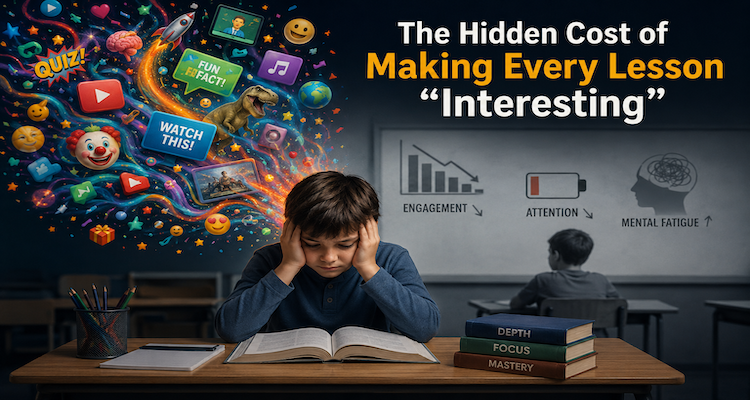
A lesson can be entertaining without being effective and sometimes the effort to make learning more interesting can actually make it harder to learn.
Teachers and instructional designers routinely add stories, animations, surprising facts, decorative images, videos, jokes, dramatic examples and other attention-grabbing elements to lessons. Some of these additions can be genuinely useful. But when an engaging element is only loosely connected to the learning objective, it can compete for the learner’s limited attention rather than strengthen understanding.
Researchers have studied this problem under the name “seductive details”: interesting but instructionally unnecessary information. A 2012 review and meta-analysis covering 39 experimental effects found that such details could reduce retention and transfer, although the size of the effect varied.
More recent evidence makes the issue harder to dismiss. A 2026 multi-level meta-analysis drawing on 177 effect sizes from 50 studies found a small but statistically significant negative effect of seductive details on overall learning outcomes, including recall, comprehension and transfer.
The lesson is not that education should become dull. It is that interesting is not the same thing as useful.
Key Takeaways
- An entertaining lesson can produce strong attention without producing equally strong learning.
- Irrelevant stories, images and effects can compete with information students actually need to understand.
- Research distinguishes useful engagement from “seductive details” that add interest without advancing the learning goal.
- Difficult learning activities can sometimes produce better long-term retention than methods that feel easy in the moment.
- The best classroom engagement connects curiosity, activity and challenge directly to the knowledge being learned.
- Teachers do not need to eliminate fun; they need to make entertainment serve the learning objective.
When “Interesting” Becomes a Learning Problem
Imagine a biology lesson about the human circulatory system.
The teacher could explain how blood moves through the heart, use a clear diagram, ask students to predict what happens when a valve fails, and have them retrieve the sequence from memory.
Or the lesson could begin with a dramatic medical story, followed by an animated heart, a surprising historical fact, background music, several humorous images and a short video.
The second lesson may feel more memorable.
That does not automatically mean students will remember the circulatory system better.
This distinction matters because momentary performance and durable learning are not the same thing. Research from the UCLA Learning and Forgetting Lab describes how conditions that make learning feel easy can sometimes produce weaker long-term retention, while certain forms of difficulty can improve later recall and transfer. These are often described as “desirable difficulties.”
In other words, a student looking engaged is not necessarily evidence that the student is learning deeply.
The Problem With Decorative Engagement
The research on seductive details is especially relevant to the modern classroom because educational material can now contain almost unlimited multimedia.
A slide can include text, photographs, animations, video, sound, icons, transitions and interactive elements. Digital tools make adding these elements easy.
But ease of addition does not mean educational value.
The 2012 meta-analysis by Günter Rey defined seductive details as interesting but irrelevant information that is unnecessary for achieving the instructional objective. Across the studies reviewed, removing such material was generally associated with better retention and transfer.
A 2020 meta-analysis reached a similar broad conclusion, while also emphasizing that the effect varies according to factors such as delivery format, subject, learner pacing, image type and other design characteristics.
That qualification is important.
The evidence does not justify saying that every picture, story or video damages learning. The problem is more specific: an engaging element can become counterproductive when it consumes cognitive resources without helping the learner construct an understanding of the subject.
Why the Brain May Pay for the Extra Entertainment
Learning requires attention.
When students encounter instructional material, they must identify relevant information, connect it with existing knowledge and construct some form of mental representation. Working memory is limited, so unnecessary material can create additional processing demands.
Researchers have proposed several mechanisms for the seductive-detail effect, including distraction of attention, working-memory overload, interference with developing schemas and disruption of coherence. The precise explanation is still debated, but the practical pattern has appeared repeatedly enough to receive substantial research attention.
A 2026 meta-analysis provides an important update. Its analysis of 50 studies found that seductive details had a small negative overall effect on learning, with negative effects reported for comprehension, recall and transfer. The authors identified increased extraneous cognitive load as the principal mediating pathway in their model.
That offers a useful way to think about the problem.
If a student has to decide whether an image, anecdote or animation matters to the lesson, some of the student’s limited processing capacity may be spent on that material. If the material is genuinely irrelevant, that effort does not necessarily help build the knowledge the lesson is supposed to teach.
But Engagement Still Matters
This is where the argument can easily go too far.
The answer is not to remove every story, game, image or moment of surprise from education.
The National Academies’ How People Learn II emphasizes that motivation and engagement are important parts of learning. It also describes technology as capable of supporting active learning, feedback, reflection, collaboration and other productive learning activities. But the report stresses that the usefulness of technology depends on the learner, task and learning context rather than assuming technology is inherently motivating.
That distinction is central.
Consider two uses of a video in a history class.
Useful engagement: Students watch a short primary-source-based reconstruction and then evaluate what it reveals about the historical question being studied.
Decorative engagement: Students watch an entertaining historical clip because it makes the lesson more exciting, but the clip contributes little to the question they are expected to answer.
Both activities may attract attention.
Only the first clearly makes attention part of the learning process.
The Better Goal: Make the Learning Interesting
The most productive alternative to “make everything interesting” is make the intellectual task worth engaging with.
That can mean giving students a problem they genuinely need to solve, asking them to predict an outcome, confronting them with conflicting evidence, allowing them to explain an idea in their own words or requiring them to retrieve information rather than simply recognize it.
The National Academies identifies approaches such as problem- and project-based learning and collaborative learning as ways of creating classroom activities that invite students to think rather than merely perform artificial school tasks.
This changes the role of entertainment.
Instead of asking:
How can I make this lesson more interesting?
A teacher can ask:
- What is the most interesting problem inside this subject?
- What misconception could students discover for themselves?
- What prediction could they make before seeing the answer?
- What evidence would force them to reconsider their first explanation?
- What should students be able to explain or do after the activity?
- Does this image, story or video help them accomplish that?
Those questions produce a different kind of engagement.
Difficulty Can Be Part of Good Teaching
There is another uncomfortable implication.
Students and teachers can mistake fluency for learning.
When material is presented smoothly and students can follow along easily, the experience can feel successful. But research on desirable difficulties shows that some conditions that make learning feel harder can improve later retention and transfer. Spacing, interleaving and retrieval practice are among the examples discussed by the UCLA Learning and Forgetting Lab.
That does not mean teachers should deliberately make lessons confusing.
There is a crucial difference between productive difficulty and unnecessary difficulty.
A student struggling to retrieve an answer from memory may be experiencing a useful challenge.
A student struggling to figure out what an elaborate animation has to do with the lesson is experiencing something else.
Good instructional design removes obstacles that do not contribute to learning while preserving challenges that help learning happen.
What This Means for AI-Powered Education
The issue becomes particularly relevant as AI makes it easier to generate educational material.
An AI system can rapidly produce stories, quizzes, images, dialogue, simulations, examples and personalized activities. That creates enormous possibilities for teachers and learners.
It also makes it easier to produce more material than the learner needs.
The danger is not necessarily that AI-generated lessons will be boring. It may be the opposite: lessons can become continuously stimulating without being sufficiently selective.
The National Academies’ review of learning technologies similarly emphasizes the importance of aligning technology with learning goals rather than treating technological features as valuable simply because they can engage users.
For AI-assisted education, that suggests a useful design principle:
Generate less decoration and more purposeful activity.
An AI tutor should not merely keep a student entertained. It should know when to explain, when to question, when to provide feedback, when to introduce a relevant example and when to leave the learner to struggle productively with a problem.
That is a much harder design problem than generating an entertaining lesson.
A Practical Test for Teachers and Course Designers
Before adding an element to a lesson, ask one simple question:
If I remove this, does the learner lose something necessary for understanding, remembering or applying the concept?
If the answer is yes, the element may have instructional value.
If the answer is no, ask a second question:
Does the element provide a different educational benefit that justifies the cognitive cost?
If the answer is still no, removing it may improve the lesson.
This does not require stripping classrooms of personality. A relevant story can make an abstract concept understandable. A well-designed animation can reveal a process that is difficult to visualize. A game can provide meaningful practice. Humor can make a classroom more human.
The issue is not whether something is enjoyable.
The issue is what the enjoyment is doing for learning.
The Real Measure of an Engaging Lesson
Education has a measurement problem when it treats visible engagement as the final goal.
Students laughing, clicking, talking and watching can tell a teacher something about the classroom experience. They do not, by themselves, establish whether students have developed durable knowledge or can transfer it to a new problem.
The research on seductive details and desirable difficulties points toward a more demanding standard: evaluate instructional choices by what students can remember, explain and use later not simply by how enjoyable the lesson felt while it was happening.
That standard also makes room for genuinely engaging teaching.
A great lesson does not have to choose between interesting and effective.
Its strongest moments are interesting because the learning itself is interesting.
Conclusion
The hidden cost of making every lesson interesting is not boredom.
It is the possibility that teachers begin optimizing for attention when they should be optimizing for understanding.
Research does not say that education should become austere or joyless. It says something more useful: engaging elements work best when they serve the learning objective, while interesting but irrelevant details can sometimes interfere with retention, comprehension and transfer.
The challenge for educators especially in an era of increasingly capable digital and AI tools is therefore not to make every lesson more stimulating.
It is to become better at knowing which stimulation earns its place.
The information presented in this article is based on publicly available sources, reports, and factual material available at the time of publication. While efforts are made to ensure accuracy, details may change as new information emerges. The content is provided for general informational purposes only, and readers are advised to verify facts independently where necessary.